Published July 14, 2026 · Educational information — not legal, tax, lending, or financial advice.
Part of the Home Buying & Credit Resource Center.
Quick answer
Mortgage applications get denied for credit reasons when something in the file falls outside the loan program’s guidelines. In practice, the reasons cluster into a short list: a middle credit score below the program’s floor, recent late payments, unresolved collections or charge-offs, credit card balances reporting close to their limits, a cluster of recent hard inquiries or brand-new accounts, too little credit history to evaluate, or a debt-to-income ratio above the program’s limit. Frequently it’s a combination — one weakness a lender might work around becomes three that they can’t.
The most important thing to know is that you don’t have to guess which one applied to you. When a lender denies a credit application, they’re generally required to send a written adverse action notice naming the principal reasons. That notice converts a discouraging “no” into a specific, workable list — and several items on that list can change within weeks.
What a denial actually means
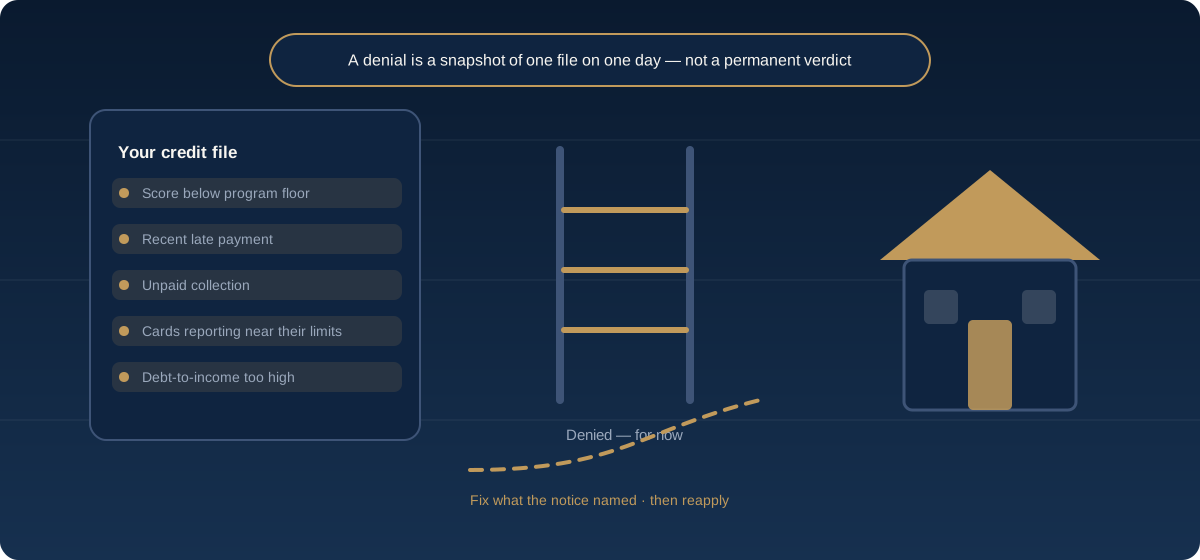
A mortgage denial is a decision about one file, reviewed against one lender’s guidelines, on one day. It is not a judgment about you, and it is not permanent. Underwriting is a matching exercise: the lender compares what your reports and documents show against the rules of the loan program, plus whatever extra requirements — called overlays — that lender adds. When part of the file falls outside the lines, the application stops.
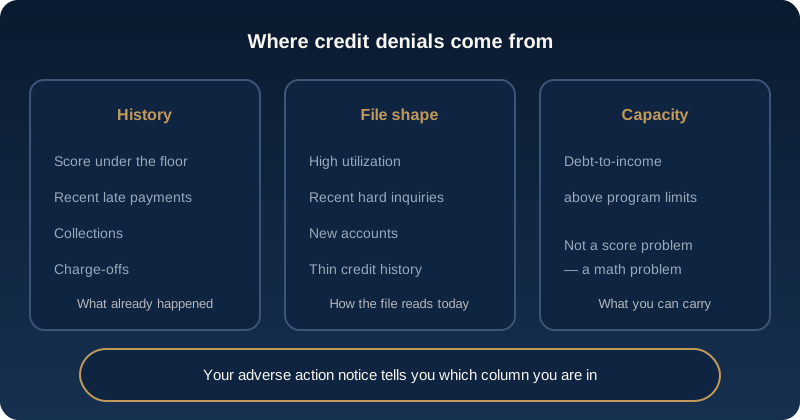
That points to where the useful information lives. Under federal credit law, a lender who denies an application generally has to tell you in writing the principal reasons — and if credit report information was used, to identify which agency supplied it and note that you can obtain a free copy. That document is the adverse action notice, and it tells you exactly which reason below applied to you — so you never spend months fixing the wrong thing.
One distinction is worth holding onto: credit reasons come in three flavors. There is history (scores, late payments, collections, charge-offs), file shape (balances, inquiries, how much history exists), and capacity (debt-to-income). History fades slowly. File shape can change in a single statement cycle. Capacity is arithmetic you can attack directly. Knowing your bucket tells you how long the road back is.
The score is below the program’s floor
The most common credit denial is the simplest: the qualifying score didn’t reach the program’s minimum. Conventional, FHA, VA, and USDA loans each treat scores differently, and individual lenders often require more than the program’s baseline — the ranges are laid out in what credit score do you need to buy a house, and the most overlay-driven program of all gets a dedicated walkthrough in FHA loan credit requirements explained. Because guidelines and overlays vary, “too low” at one lender isn’t automatically “too low” everywhere.
One detail catches applicants off guard: lenders typically pull all three bureaus and qualify you on the middle of your three scores — not the highest, and not the one in the app you check. If your scores come back 690, 648, and 641, the number that matters is 648. That’s how a buyer can feel comfortably qualified and still be denied: they were watching the wrong number. It’s also why an error on one bureau’s report can quietly set your entire qualifying position (see why are my three credit scores different and what happens during a mortgage credit check).
The encouraging part is that a score is a symptom, not a cause. Something is producing that number — balances, a late payment, a derogatory mark, a thin file. The sections below are what could be sitting underneath it.
Late payments — especially recent ones
Payment history is the most heavily weighted part of most scoring models, and the section an underwriter reads most literally — account by account, month by month. A single payment reported 30 days late can do real damage. Several, or a 60- or 90-day late, can push a file out of qualifying range.
What matters most is recency. Underwriters weight the last 12 to 24 months heavily, because recent behavior is the best available signal about the next 360 payments. A late payment from four years ago, followed by four clean years, reads very differently from one that landed two months ago — even though both appear on the report. How long these marks last and how their weight decays is covered in how long do late payments stay on your credit report.
There is no fast fix here. Accurate late payments can’t be removed on request — only inaccurate ones can be disputed, and only time reduces the sting of an accurate one. What you can do is make the present overwhelming: a long, unbroken streak of on-time payments eventually outweighs an old scar.
Collections and charge-offs
A collection means an unpaid debt was handed or sold to a collection agency. A charge-off means the original creditor wrote the debt off as a loss — which does not mean you no longer owe it. Both are serious derogatory marks, and both can generally stay on a report for around seven years.
Neither is automatically disqualifying — a misconception that makes people give up before asking a single question. Treatment varies by program and lender: some look at the aggregate balance of unresolved accounts, some want a payment plan or a letter of explanation, and some care far more about how recent the item is than whether it exists at all. The nuances are in can you get a mortgage with a collection on your credit report.
These items tend to trigger denials when they are recent, unresolved, and large relative to the rest of the file — or when an underwriter finds a collection the borrower didn’t know about, which happens often with medical debts and old utility accounts. So check two things: whether the account is actually yours and accurately reported (if not, dispute it), and how long it has been there (see how long do collections stay on your credit report).
Credit card balances and utilization
Credit utilization — the share of your revolving limits your balances are using — is heavily weighted, and it’s the factor most likely to be quietly sabotaging an otherwise decent file. Someone who pays every bill on time but carries cards near their limits can still land below a program’s score floor. It feels unfair; it’s entirely mechanical.
Balances hurt in two places. First, high utilization drags the score. Second, the minimum payments on those balances count as monthly obligations in your debt-to-income ratio, evaluated independently of the score. One set of balances, two failure points.
The flip side is the best news in this article: utilization has no memory. Issuers report balances roughly monthly, and scoring models react to the current picture, not your history of balances. Pay a balance down, let it report, and the file genuinely looks different — often within a cycle or two. One practical note: what counts is the balance that reports, usually near the statement date, not the balance on your due date.
Recent inquiries and new accounts
A hard inquiry is recorded when you apply for new credit. Any single one typically has a modest effect, and inquiries rarely sink an application by themselves. But a cluster of recent ones can matter, in two ways.
The first is mechanical: several inquiries can shave points off a score already near a program boundary — and near a boundary, a handful of points is the whole ballgame. The second is interpretive. Recent credit-seeking raises an underwriting question: is this person about to take on obligations that don’t appear on these reports yet? Which is why a new account is far more damaging than the inquiry that produced it: the financed car or the furniture card doesn’t just ding the score, it adds a monthly payment straight onto your DTI at the worst possible moment.
A fair caveat: rate-shopping for a single mortgage within a short window is generally treated more gently by scoring models than the same number of unrelated applications, so comparing lenders is not the problem. See soft inquiry vs. hard inquiry and how long do hard inquiries stay on your credit report.
Not enough credit history
Some applicants are denied not because their credit is bad, but because there isn’t enough of it to evaluate. This is a thin file: too few accounts, or accounts too new, for a scoring model to produce a reliable number — sometimes no score at all. It frustrates younger buyers, recent arrivals, and people who responsibly avoided credit their whole lives, only to learn lenders read that as an absence of evidence rather than proof of virtue.
The reframe matters: this is not a credit repair problem, it’s a credit construction problem. Nothing needs disputing — accounts simply need to exist, report, and age, which is mostly patience rather than sacrifice. Ask a loan officer about manual underwriting, too: some programs permit alternative records such as rent or utility payments, though availability varies by lender and program. What a score is built from is in what makes up your credit score.
Debt-to-income ratio
Debt-to-income blindsides people because it isn’t a credit score problem at all — it’s arithmetic. Your DTI compares total monthly debt obligations, including the proposed new mortgage payment, against gross monthly income. Programs set limits, and a file over the limit can be denied while carrying an excellent score. Plenty of denied applicants have credit they’re proud of; what they don’t have is room in the ratio.
DTI rises when you finance a car, take on a student loan payment, co-sign for someone (their obligation typically becomes yours in the lender’s math), or shop for a pricier house — the bigger mortgage payment lands on the debt side of the same ratio. That last point is often missed: a DTI denial doesn’t always mean you can’t buy. Sometimes it means you can’t buy that house at that price with those debts.
There are only two levers — reduce monthly obligations, or increase documentable income — and paying down revolving balances helps DTI and utilization at once, which is why it appears on nearly every list here. But it isn’t automatically right: draining the savings you need for a down payment and reserves weakens the file elsewhere. The trade-offs are in should you pay off debt before buying a house.
Which reasons improve quickly — and which don’t
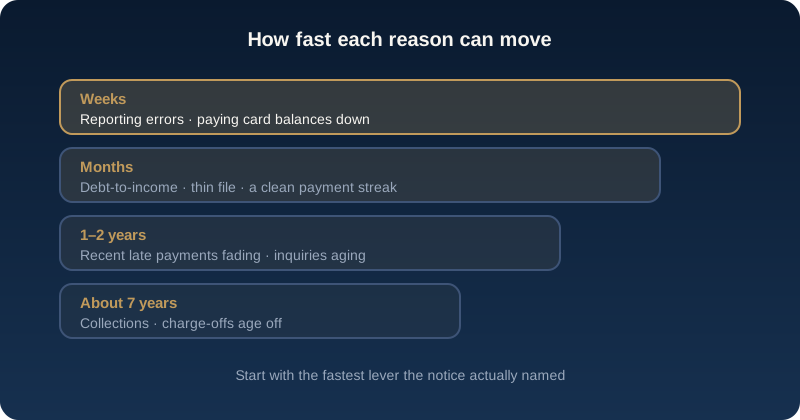
Not every reason is on the same clock, and knowing the difference keeps the months after a denial from feeling like guesswork:
Weeks. Correcting a genuine reporting error (once a dispute resolves) and paying card balances down so they report lower. The fast levers — reach for these first.
Months. Lowering debt-to-income by retiring obligations, building a thin file, and accumulating a clean payment streak. Real progress, measured in statement cycles rather than days.
A year or more. Reducing the weight of a recent late payment, and letting inquiries and new accounts age into irrelevance. Time does this work; you stay out of its way.
Around seven years. Collections and charge-offs aging off entirely — though their impact fades well before they disappear, and resolving or documenting them usually matters more than waiting them out.
How to improve your chances before reapplying
The most common mistake after a denial is reapplying too quickly — rushing to another lender with nothing in the file changed. The result is usually the same answer plus another hard inquiry. The alternative is a short, sequenced plan:
- Read the adverse action notice first. It names the principal reasons. Everything else in this list is guesswork until you’ve read it.
- Pull all three reports and read every line. The middle score qualifies you, so one bureau’s error can be the whole problem. How to read your credit report walks through it.
- Dispute genuine errors immediately. Disputes take weeks, and you want them resolved before the next underwriting, not during it.
- Pay card balances down and let them report. The fastest lever — it helps your score and your DTI at once. Keep the accounts open.
- Make a late payment impossible. Autopay every account for at least the minimum. One new late payment can undo a year of repair.
- Address derogatory accounts deliberately. Verify they’re accurate and yours, then ask how your program treats them — paid, unpaid, on a plan, or explained in writing.
- Freeze new credit activity. No new cards, loans, financed purchases, or co-signing — through closing day on the next attempt.
- Ask the loan officer what would change the answer. Turn “improve my credit” into something finishable: a number, a balance, a document, a date.
One narrow option: where a documented correction is in hand and a lender is actively working your file, a rapid rescore can speed up how quickly a verified change appears on your reports. It cannot manufacture a change that hasn’t happened — but when the fix is real and the timing is tight, it shortens the wait.
Timing matters too. If the notice cited balances or an error, weeks may be enough. If it cited a recent late payment or a fresh derogatory mark, give the file real time to rebuild — then prepare the next application the way the first-time homebuyer credit checklist lays out.
Common mistakes to avoid
The period after a denial is when the most damaging decisions get made, usually out of urgency or discouragement. Guard against these:
Immediately reapplying somewhere else. Nothing about the file has changed, so the reasons haven’t either — and each attempt adds another hard inquiry.
Assuming you know the reason. People spend months fixing their score when the notice said debt-to-income, or clearing an old collection when the real problem was a card reporting at 95% of its limit. The notice exists so you don’t have to guess.
Closing credit cards to “clean up” the file. Closing a paid-off card removes its limit from the utilization math and can push your ratio up. A quiet, open, unused card is helping you (see can closing a credit card hurt your credit score).
Draining savings to pay off every debt. Down payment and reserves are part of the file’s strength. Solving a DTI problem by creating a cash problem trades one denial for another.
Financing something new while regrouping. The car, the furniture, the “we’ll need it anyway” purchase — each lands directly on the DTI you’re trying to lower, and adds a fresh account to a file that needs to look calm.
Paying a company that promises to delete accurate items. Accurate information generally can’t be removed on request, and guaranteed-deletion promises are a well-known warning sign. Disputing genuine errors is free and is your right.
Going quiet with the loan officer. They can usually tell you what would change the answer, and whether another program might treat your situation differently. That conversation is free, and it’s the shortest path to a plan.
Key takeaways and next steps
- A denial is one lender’s guidelines applied to one file on one day — a snapshot, not a permanent verdict.
- The adverse action notice names the principal reasons in writing. Read it before you fix anything.
- Most credit denials trace to eight causes: low middle score, late payments, collections, charge-offs, high utilization, recent inquiries and new accounts, a thin file, or DTI.
- Card balances are the fastest lever — they can lift the score and lower DTI in one statement cycle.
- Recent late payments and fresh derogatory marks are slow. Time and an unbroken payment streak are the only real remedies.
- Don’t reapply until the reason has actually changed — the same weakness usually returns the same answer.
Your next three steps: read the adverse action notice and write down the reasons it names; pull all three credit reports and confirm every item is accurate; then take the fastest lever on your list — usually a balance paydown or a dispute. That is a plan, and a plan is a very different thing from a denial.