
Published July 7, 2026 · Educational information — not legal, tax, lending, or financial advice.
Part of the Home Buying & Credit Resource Center.
Quick answer
Sometimes, some of it — and rarely all of it. The decision runs through two mechanisms. Debt-to-income (DTI): your monthly debt payments divided by gross monthly income — often the binding constraint on how much house you can finance, and every retired monthly payment hands its slice back to the mortgage column. Credit effects: paying down revolving balances (cards) while keeping accounts open usually helps quickly through utilization; paying off installment loans (auto, student) helps DTI but often moves the score little — and closing accounts can even nudge it down briefly.
The cautions: draining savings to zero out debt can hurt the reserves lenders want to see, and near-finished installment loans sometimes don’t count against DTI anyway. Which lever your file needs — paydown, down payment, or patience — depends on your specific numbers, which is a conversation worth having with a loan officer before moving money.
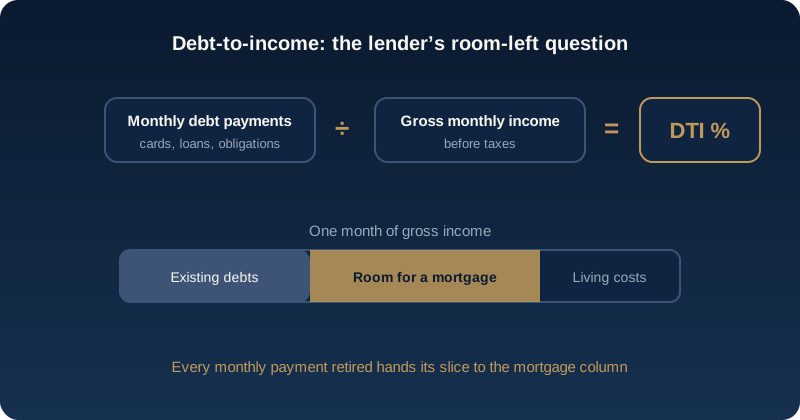
Debt-to-income: the lender’s room-left question
DTI is the simplest important number in mortgage lending: total monthly debt payments divided by gross monthly income. If your debts cost $1,500 a month and you earn $5,000 gross, your DTI is 30% before the mortgage — and the lender’s question is how much room remains for a housing payment once your existing obligations take their share. Programs and lenders set varying limits, but the mechanic is universal: the payment, not the balance, is what counts. A $20,000 loan costing $250 a month and a $6,000 card balance costing $250 a month occupy identical space in the ratio.
That has a useful implication — the highest-leverage payoff target is often the debt with the largest monthly payment relative to its balance, not the largest balance. For many buyers, DTI is the constraint that decides how much house the income can carry, which makes it the first number to know before deciding whether to pay anything off. (Credit score sets the price of the loan — that side is covered in what credit score do you need to buy a house.)
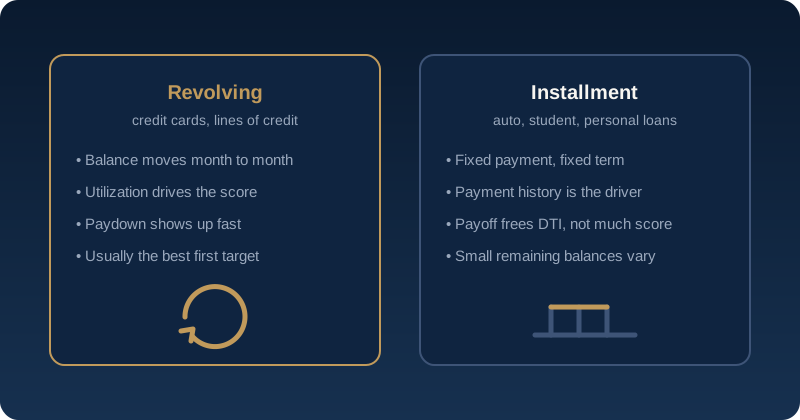
Revolving vs. installment debt
The two debt types behave differently on a credit file, which is why “pay off debt” is too blunt an instruction. Revolving debt — credit cards and lines of credit — carries balances that move month to month, and scoring models weigh utilization: how much of your available limit you’re using. Pay a card down and keep it open, and the improvement typically shows in your file within a reporting cycle or two — fast, meaningful, and doubly useful since it helps DTI too.
Installment debt — auto, student, and personal loans — has a fixed payment over a set term, and what scoring models mostly want from it is on-time history. Paying an installment loan off early frees its payment from DTI, but often moves the score little; it can even dip it briefly, since a closed loan changes credit mix and eventually account age — the paradox unpacked in can paying off debt lower your credit score. One more wrinkle worth asking a lender about: installment loans with only a handful of payments remaining are sometimes excluded from DTI entirely, meaning a nearly finished loan may need no early payoff at all.
The case for paying down first
When paydown is the right move, it usually earns its keep three ways at once. Qualification: if DTI is blocking approval or capping the loan below the houses you’re shopping, retiring monthly payments is the direct fix — often the only one short of more income. Pricing: lower revolving utilization supports a higher score, and if your middle score sits near a pricing-tier boundary, a few points can reprice decades of payments.
Breathing room: a mortgage adds taxes, insurance, and maintenance to the payment itself; entering that commitment with fewer competing obligations is a durability argument, not just an underwriting one. The timing matters as much as the move: paid-down balances have to report before they help, which takes a cycle or two — one of many reasons the paydown belongs in the 6-month window of the countdown laid out in preparing your credit before buying a home, not the week of application.
The case against paying off everything
Three ways the zeal backfires. Reserves: lenders want to see money left after closing — months of housing payments in savings reads as durability, and a borrower who zeroed every debt but emptied every account has traded a strength for a strength and kept neither. Down payment trade-off: every dollar sent to debt is a dollar not sent to the down payment, and if DTI was never your binding constraint, the debt dollar may buy less than the down-payment dollar would have.
The closing-account trap: paying off is fine; closing what you paid off is the mistake — shrinking available credit raises utilization on remaining balances and eventually trims history, as covered in can closing a credit card hurt your credit score. And one absolute regardless of strategy: whatever you pay or don’t, every account stays current — a new late payment in the mortgage window costs more than almost any balance, per common credit mistakes before applying for a mortgage.
Why every situation differs
The honest reason there’s no universal answer: buyers differ on which constraint binds. One file is blocked by DTI with a comfortable score — paydown is the lever. Another has easy DTI but a middle score a few points under a pricing tier — revolving paydown again, but for a different reason, and only the revolving kind. A third has both in good shape but thin savings — that buyer’s best move may be paying nothing extra and banking reserves.
A fourth carries a car loan with four payments left that the lender may exclude from DTI entirely. Same question, four different right answers — determined by numbers a loan officer can read off your file in minutes. The preparation isn’t guessing which case you are; it’s knowing your three reports, your middle score, and your ratio early enough to act on whichever answer comes back.
So what should you do first?
A general-purpose order of operations, to be adjusted by your actual numbers. First, know the file: read all three reports early — an error inflating a balance or showing a false late is free DTI and free score, and the dispute costs nothing but time you have. Second, protect the baseline: autopay everything; no new debt from here forward.
Third, target revolving balances — the double-lever that helps utilization and DTI together — while keeping every account open. Fourth, ask before killing installment loans: a loan officer can tell you whether the payoff helps your ratio enough to beat the same dollars in reserves or down payment. Fifth, let it report: changes need a cycle or two to land on the file, so the moving finishes months before the application, and the final stretch is stillness.
Two real-world examples
The ratio that was the wall. Elena’s score is solid, but her DTI caps her loan below the houses in her market — a car payment and two card minimums are eating the room. Her loan officer runs the numbers: paying off the car (11 payments left) frees the most ratio per dollar. She retires it, keeps the cards open with small balances, waits two reporting cycles, and requalifies at a number that matches her search.
The savings that were the strength. Marcus has modest card balances, an easy DTI, and a score comfortably inside its pricing tier — but 4% saved toward a down payment. Zeroing his cards would empty half of it and improve almost nothing that’s binding. He pays the cards down partially for utilization’s sake, banks the rest, and arrives at closing with the reserves that made his file read as durable rather than merely debt-free.
Key takeaways
- DTI counts payments, not balances — the highest-leverage payoff is often the biggest payment per dollar of balance.
- Revolving paydown is the double lever: utilization and DTI together, showing on the file within a cycle or two.
- Installment payoff frees ratio more than score — and near-finished loans may not count against DTI at all. Ask first.
- Don’t trade reserves for zeroes: lenders want money left after closing, and pay-down never means close-the-account.
- Which lever your file needs — paydown, down payment, or patience — is readable from your numbers; know them early.