
Published July 7, 2026 · Educational information — not legal, tax, lending, or financial advice.
Part of the Home Buying & Credit Resource Center.
Quick answer
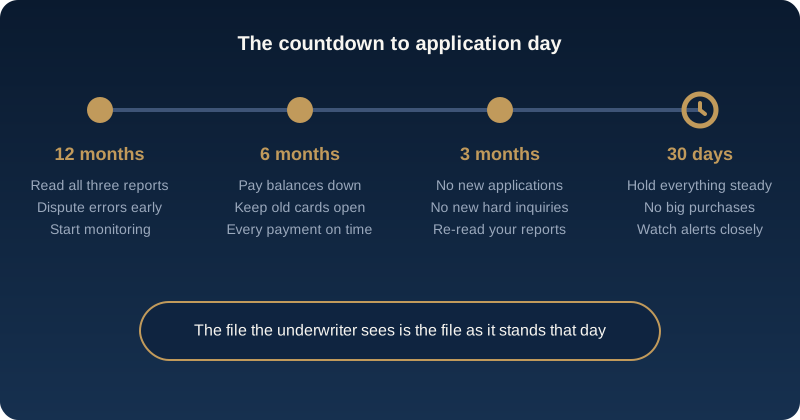
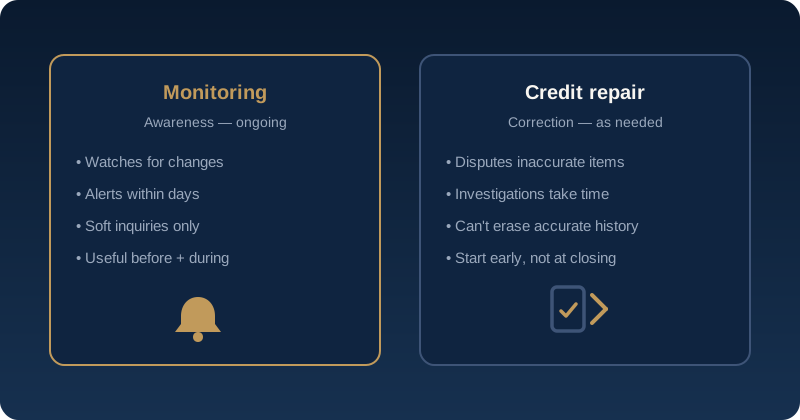
A mortgage is the one credit decision where preparation time pays the most, because the file the underwriter sees is the file as it stands that day — not as you meant it to be. Start about 12 months out: read all three bureau reports and dispute errors early, since investigations need runway. At 6 months, work balances down and keep every payment spotless. At 3 months, stop opening anything new. In the final 30 days, hold everything steady. Along the way, know the difference between monitoring (ongoing awareness through soft-inquiry alerts) and credit repair (disputing inaccurate items) — one watches, the other corrects, and neither erases accurate history. The most expensive mistakes are self-inflicted and late: new accounts, big purchases, and closed cards in the final stretch.
Why lenders review your credit
A mortgage lender is agreeing to a very large loan repaid over decades, and your credit file is the longest, most detailed evidence available of how you handle borrowed money. Lenders generally pull reports from all three bureaus — which is one reason the differences between your three files matter more here than anywhere else — and what they read typically influences three things: whether you qualify at all, the interest rate you’re offered, and which loan programs are open to you.
The rate effect is the quiet one with the biggest price tag: over a multi-decade loan, the gap between rate tiers compounds into a sum that can dwarf every other closing cost. What lenders are reading for is covered across what makes up your credit score and what is a good credit score — payment history, utilization, account age, and the absence of surprises — and the program-by-program guidelines are mapped in what credit score do you need to buy a house. Preparation is simply making sure that when the look happens, the record is accurate and telling your best true story.
12 months out: read, dispute, baseline
The year mark is when the highest-leverage, slowest-moving work happens. Pull full reports from all three bureaus and read them line by line — the field-by-field walkthrough is in how to read your credit report — verifying that every account is yours, every balance is plausible, every payment history matches your memory, and every hard inquiry traces to an application you made. Anything wrong gets disputed now, not later: investigations take time, corrections take another reporting cycle to appear, and a dispute still open at underwriting can complicate the process itself.
This is also the moment to start a continuous watch, so nothing new lands unnoticed during the year you’re building — the full case is in why monitor your credit year-round. Twelve months of runway turns problems into paperwork; two weeks of runway turns them into emergencies — the full case for that timing, and what to do with less of it, is in how long before buying a house should you check your credit.
6 months out: balances and payment history
With the file verified, the middle stretch is about the numbers lenders weight heaviest. Utilization: paying card balances down relative to limits generally helps, and the mechanics — including why the timing of when balances report matters — are laid out in what is credit utilization. Payment history: nothing in the final year should be late; a single new late payment lands with far more force on an underwriter’s desk than an old one, and autopay for minimums is cheap insurance. Renters have one extra lever here: a documented on-time rent record can support certain programs’ view of payment reliability, and getting it onto the file is covered in can rent payments help you build credit.
Account age: resist the tidy-up instinct — paying a card to zero is good, but closing it can shrink available credit and eventually trim history, as covered in can closing a credit card hurt your credit score. Six months is also enough time for these changes to actually appear in reported data, which is the point: the improvements have to be on the file, not just in your bank account. Whether to pay debt down at all — and which kind first — is its own calculation, worked through in should you pay off debt before buying a house.
3 months out: stop opening things
The final quarter is when the file needs to stop moving. No new credit cards — including the store card with the tempting discount. No new financed furniture or appliances for the house you don’t own yet. No co-signing for anyone. Each application adds a hard inquiry, each new account drops your average account age, and each new balance shifts your utilization — three small dents at exactly the moment the file is being judged. (Rate-shopping for the mortgage itself is the exception: scoring models generally treat multiple mortgage inquiries within a shopping window as one event, so comparing lenders doesn’t require inquiry anxiety.)
This is also the time for one more full read of all three reports — a last sweep for anything that appeared during the year, while there’s still runway to address it.
30 days out: hold steady
In the final month, the strategy is stillness. No new accounts, no large purchases, no balance spikes, no moving large sums without a paper trail, no closing anything. Underwriters can re-verify credit late in the process — some lenders check again shortly before closing — so the discipline holds not just to application day but through it. Watch your alerts closely: at this range, an unexpected change on the file — an inquiry you didn’t make, an account you don’t recognize — is exactly the thing you want to know about the day it happens, not the day the lender mentions it. If something does surface, address it immediately and tell your loan officer; surprises age badly in underwriting, but disclosed, documented issues are usually manageable.
Monitoring vs. credit repair
Two terms that get tangled, doing two different jobs. Monitoring is awareness: a continuous watch across your files that alerts you when something changes — a new inquiry, account, address, or collection — through soft inquiries that never touch your score. It doesn’t fix anything; it makes sure you know. Credit repair is correction: the process of disputing items that are inaccurate, incomplete, or unverifiable so the bureaus investigate and fix the record.
It works on errors — and only errors. No legitimate process can erase accurate negative history; accurate items age off on their own schedule, as covered in how long late payments stay on your credit report. For a homebuyer, the two sequence naturally: monitoring finds the issues, disputes correct the inaccurate ones, and time plus good habits handle the rest. Anyone promising to delete true history or manufacture a score is selling something the system doesn’t contain.
Common mistakes to avoid
Each of these gets a fuller treatment in common credit mistakes before applying for a mortgage — the short version follows. Financing the furniture before the house. The new-home shopping spree, financed, in the final stretch — the classic self-inflicted wound, moving utilization and adding inquiries at the worst time. Closing old cards to “clean up.” Tidiness that reduces available credit and, in time, history — keep them open, use them lightly. Checking the score but never the reports. The number can’t show you the error; only the record can, and lenders read the record — the distinction is in credit report vs. credit score.
Disputing at the last minute. A dispute filed the month of application may still be open at underwriting; the same dispute filed a year earlier is long resolved. Assuming one bureau speaks for three. Mortgage lenders typically read all of them; an error on the one you never check is still an error they’ll see. Draining every account to zero out debt. Reserves matter to lenders too; a slightly higher balance with healthy savings can read better than a zero balance and an empty account.
Two real-world examples
The year of runway. Dana starts 14 months before her target application. Her first full read turns up a paid medical collection still showing a balance on one bureau. She disputes it with documentation; the investigation and correction take a couple of reporting cycles — time she has. Over the following months she works two card balances down and lets monitoring watch the file. At application, all three reports are clean, current, and boring — which is exactly what an underwriter wants to read.
The final-stretch stumble. Marcus is three weeks from closing when a furniture store offers 10% off for opening a store card. He applies — a hard inquiry, a new account, and a financed balance land on his file days before the lender’s final credit check. The loan survives, but the last-minute changes trigger questions, documentation requests, and a nervous week that a plain debit card purchase after closing would have avoided entirely.
Key takeaways
- Lenders read all three bureaus, and credit typically shapes approval, rate, and program — the rate effect compounds for decades.
- 12 months: read everything, dispute errors early, start the watch. 6 months: balances down, payments spotless, old cards open.
- 3 months: nothing new opens. 30 days: nothing moves at all — and the discipline holds through closing, not just application.
- Monitoring is awareness; repair is correction of errors — and nothing legitimate erases accurate history.
- The costliest mistakes are late and self-inflicted: new accounts, financed purchases, and closed cards in the final stretch.