
Published July 5, 2026 · Educational information — not legal, tax, lending, or financial advice.
Quick answer
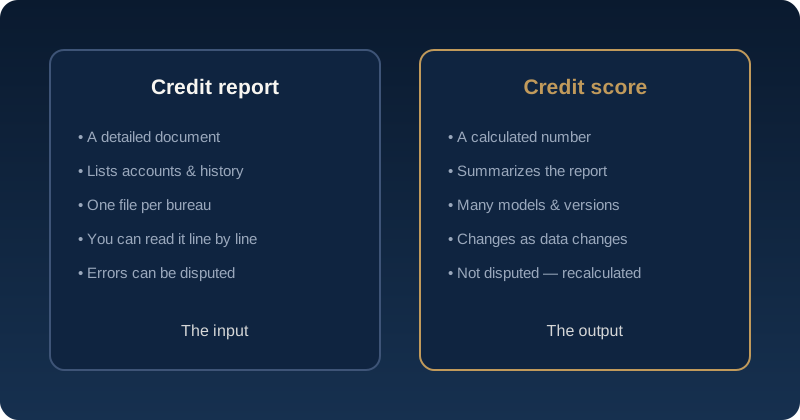
Your credit report is the record: a detailed document listing your accounts, balances, payment history, and inquiries, maintained separately by each of the three major bureaus. Your credit score is the summary: a three-digit number a scoring model calculates from that record. The report is the input; the score is the output. That’s why you have three reports but many possible scores, why errors are disputed on the report rather than the score, and why the report — not the number — is where your attention pays off. Fix or maintain the record, and every score calculated from it follows the data.
Two different things with one job
The two terms get used interchangeably in everyday conversation, and that’s where most of the confusion starts. They’re related the way a book and its one-sentence review are related: the report is the full text of your credit history, and the score is a compressed judgment derived from it. Each of the three major bureaus — Equifax, Experian, and TransUnion — maintains its own report on you, built from what lenders choose to furnish. Scoring models like FICO and VantageScore then read a report and produce a number. Because the bureaus’ files can differ and multiple models exist, the same person routinely holds three reports and considerably more than three possible scores — the mechanics behind that spread are covered in why your three credit scores are different.
What’s actually in your credit report?
A report reads like a ledger. It identifies you (name, addresses, date of birth), then lists your credit accounts — cards, loans, mortgages — with their open dates, limits or original amounts, current balances, and month-by-month payment history. It records hard inquiries from credit applications, and it can include public-record items such as bankruptcies. Notably absent: your income, employment details beyond what you’ve reported to lenders, savings, assets, and your score itself — the free reports you’re entitled to generally don’t include a number. The report is also where errors live, when they exist: an account that isn’t yours, a payment marked late that wasn’t, a balance that never updated. None of those are visible in a score; they’re only findable by reading the record.
So what is the score, exactly?
A score is a calculation, produced fresh each time it’s requested, from whatever the report says at that moment. Most models read the same five concepts — payment history, utilization, length of history, credit mix, and new inquiries — with payment history and utilization typically carrying the most weight; the full breakdown is in what makes up your credit score. Because it’s a calculation, a score has no memory and no independent existence: change the report and the number changes; apply a different model to the same report and a different number appears. Where your number lands against the commonly referenced ranges is its own topic, covered in what is a good credit score.
Side-by-side comparison
The differences line up cleanly once the input/output relationship is clear. The report is a document; the score is a number. The report is compiled by bureaus from lender-furnished data; the score is computed by a model reading that data. You have one report per bureau; you have as many potential scores as there are models and versions. The report can be read line by line and disputed where it’s wrong; the score can only be understood and, indirectly, influenced — by what happens on the report. And they update differently: the report changes when furnishers send new data, while the score simply reflects whatever the report says whenever someone asks.
Who uses which, and when
Scores earn their keep as shorthand: they let a card issuer screen applications quickly or a lender sort files into pricing tiers. But for significant decisions, lenders generally look past the number to the report itself — the account depth, the payment record, the recent activity — often alongside things neither document contains, like income and obligations. You, meanwhile, have the opposite relationship: the score is a convenient dashboard light, but the report is the machine underneath. A dashboard light tells you that something changed; only the report tells you what. That’s the logic behind reviewing reports on a rhythm rather than just glancing at numbers — and since checking your own report is a soft inquiry, the habit is free, a point unpacked in does checking my own credit hurt my score.
Why you dispute reports, not scores
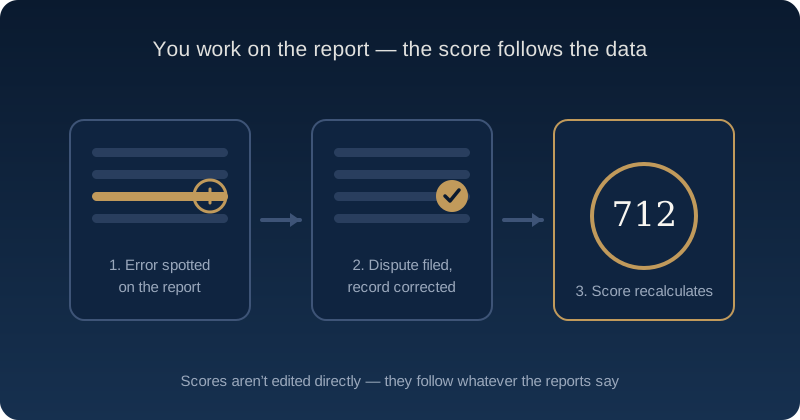
“How do I dispute my score?” is one of the most common credit questions, and the honest answer is that there’s nothing in a score to dispute — it’s arithmetic, and the arithmetic is working exactly as designed on whatever data it’s given. What can be wrong is the data. If a report shows an account you never opened, a late payment you didn’t make, or a balance that was paid off, you can dispute that item with the bureau reporting it, which is generally obligated to investigate.
If the record is corrected, every score calculated from it afterward reflects the corrected data automatically — no separate score fix exists or is needed. This is also why offers to “fix your score” directly deserve skepticism: legitimately, the work always happens at the report level, and accurate negative information generally cannot be removed simply because it’s unwelcome.
Two real-world examples
The number that couldn’t explain itself. Marisol’s banking app shows her score down 31 points with no explanation she can see — the number is a dashboard light, and it’s blinking. Pulling her actual report, she finds the story in two minutes: a medical bill she thought insurance had covered was sent to collections and reported. The score told her that something happened; only the report told her what, and gave her something concrete to address — first with the insurer and biller, and on the report if the item proves inaccurate.
The applicant who only knew his number. Theo walks into a mortgage preapproval proud of his 740, then is surprised when the lender starts asking about a two-year-old dispute remark and a co-signed loan he’d forgotten. The lender was never going to stop at the number — underwriting reads the report. Borrowers who’ve read their own reports walk into those conversations already knowing what’s in the file; borrowers who only know their score learn it in the meeting.
Key takeaways
- The report is the record; the score is a number calculated from it — input and output.
- You have three reports (one per bureau) but many possible scores across models and versions.
- Errors live on reports and are disputed there — scores simply recalculate from corrected data.
- Lenders use scores as shorthand but generally review the report for significant decisions.
- Reviewing your own report is a soft inquiry — free to your score, and the only way to verify accuracy.