
Published July 5, 2026 · Educational information — not legal, tax, lending, or financial advice.
Quick answer
Checking your own credit report or score does not hurt your score. A self-check is a soft inquiry, and soft inquiries generally have no effect under commonly used scoring models — you can look every day if you want to. The inquiries that can matter are hard inquiries: the checks a lender runs when you apply for credit. Even those play a modest role, typically fading within months and aging off the report in about two years. The practical takeaway is the opposite of the myth — regularly reviewing your own credit is one of the lowest-cost habits in personal finance, and it costs you nothing on the scoreboard.
What’s the difference between soft and hard inquiries?
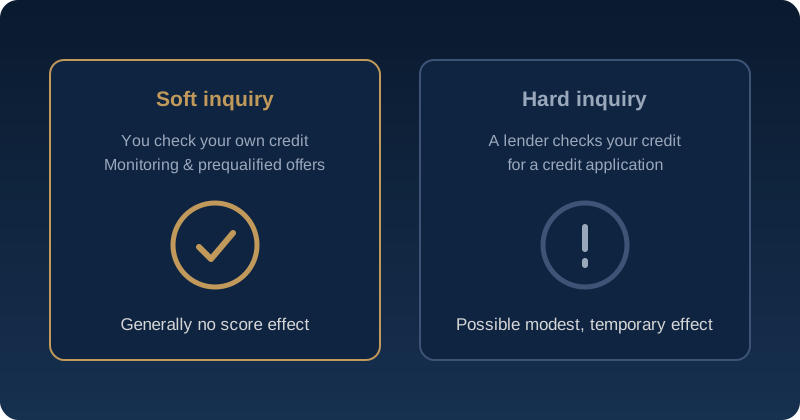
Every time someone looks at your credit file, the bureaus record it as an inquiry — but the two kinds are treated very differently. A soft inquiry is a look that isn’t tied to a new credit application: you checking your own report, a monitoring service scanning your file, or a card issuer screening you for a prequalified offer. Soft inquiries are visible to you on your own report, but they generally are not visible to lenders and do not factor into credit scores.
A hard inquiry happens when a lender pulls your credit because you applied for something — a card, an auto loan, a mortgage. Hard inquiries appear on your report, are visible to other lenders, and can have a modest, temporary scoring effect. The entire question in this article’s title turns on that one distinction.
Where the myth comes from
The belief that checking your credit hurts it is one of the most persistent ideas in personal finance, and it survives because it’s half true. Inquiries really are a scoring factor — they’re one of the five concepts behind the number, alongside payment history, utilization, length of history, and credit mix, which our homepage walks through in the credit factors overview.
What the myth drops is the soft/hard distinction: the inquiry factor refers to hard inquiries from applications, not to you looking at your own file. The confusion is understandable — both events are called “inquiries,” and both can show up when you read your own report. But scoring models are built to ignore self-checks entirely, precisely because reviewing your own information is considered responsible behavior, not risk behavior. The unfortunate side effect of the myth is that it discourages the single habit that catches errors and surprises early.
What counts as a soft inquiry?
Soft inquiries cover most of the ways your file gets looked at day to day: pulling your own free annual reports, viewing a score inside a banking or monitoring app, ongoing credit monitoring that watches your file for changes, prequalification screenings for card or loan offers, background-style reviews by existing creditors managing your account, and some employment or insurance screenings. None of these are tied to a new application you initiated, and none of them generally affect your score. If you’re comparing numbers across apps and bureaus and they don’t match, that’s a different (and normal) phenomenon — covered in why your three credit scores are different.
What counts as a hard inquiry?
Hard inquiries follow applications. Applying for a credit card, an auto loan, a mortgage, a personal loan, or a new line of credit typically triggers one. Some non-lending events can too — certain apartment applications, utility setups, or cell phone financing arrangements may involve a hard pull, which is worth asking about before you authorize a check. The common thread is your consent to a credit-based decision: a hard inquiry generally requires your permission, which is also why an unrecognized hard inquiry on your report deserves attention. It can be an authorized pull you forgot about, a company operating under an unfamiliar corporate name — or, occasionally, a sign someone applied for credit in your name, a scenario our article on overnight score drops covers in the identity-review section.
How much do hard inquiries actually matter?
Less than most people fear. Inquiries sit at the small end of the scoring factors — payment history and utilization do the heavy lifting, while a single hard inquiry is typically described as a handful of points, varying by model, version, and the depth of the rest of the file.
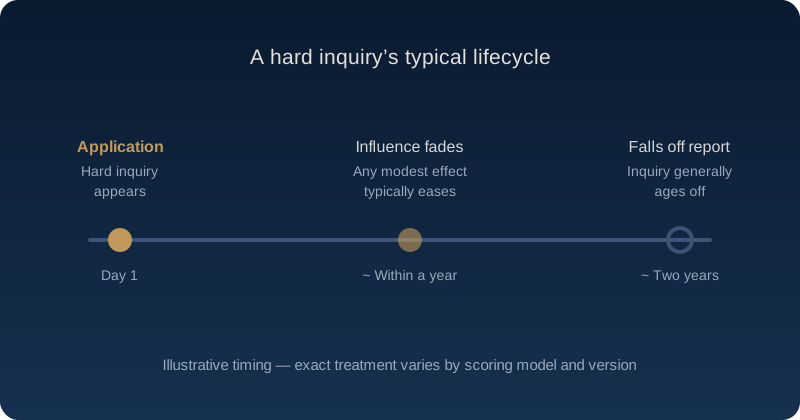
The influence also decays: any modest effect tends to ease within months, and the inquiry itself generally ages off the report in about two years. A thin, young file may feel an inquiry a bit more than a long-established one, which is one more reason the same event lands differently for different people. If your score is already sitting where you want it — the ranges are covered in what is a good credit score — an occasional application is a normal part of using credit, not something to dread.
Rate shopping without the penalty
The natural follow-up worry: “If I get quotes from five mortgage lenders, is that five hard inquiries?” Commonly used scoring models are generally designed to handle this. Multiple inquiries for the same type of loan — mortgage, auto, student — made within a shopping window are typically treated as a single event for scoring purposes, because comparing offers is exactly what a careful borrower should do. Window lengths vary by model and version, which is why the standard guidance is simply to keep serious shopping compact rather than spreading applications across many months. Note the deduplication logic applies to same-type loans; opening several unrelated credit cards in the same window is a different pattern and is generally counted separately.

Two real-world examples
The checker who checked constantly. Priya reviews her credit app every Sunday and pulls her full reports quarterly — dozens of soft inquiries a year. Her score moves for the ordinary reasons scores move (statement balances, account aging), but never because she looked. When a card she never applied for appeared as a hard inquiry one spring, she caught it inside a week precisely because she looks so often. The habit the myth warns against is the habit that protected her.
The shopper who spread it out. Marcus wanted the best auto loan rate, but — wary of inquiries — he applied with one lender in March, another in May, and a third in August. Spread that far apart, the pulls were less likely to be grouped as one shopping event. Had he gathered his quotes within a compact window, the models are generally built to treat them as a single inquiry for scoring purposes. The caution was reasonable; the calendar was the mistake.
Key takeaways
- Checking your own credit is a soft inquiry — it generally does not affect your score, ever.
- Hard inquiries come from credit applications and can have a modest, temporary effect.
- Inquiry influence typically fades within months; the entry generally ages off in about two years.
- Rate shopping for the same loan type within a compact window is generally scored as one event.
- An unrecognized hard inquiry deserves a closer look — regular self-checks are how you spot one early.