
Published July 5, 2026 · Educational information — not legal, tax, lending, or financial advice.
Quick answer
A reasonable baseline is a full credit report review at least once or twice a year — and since checking your own credit is a soft inquiry with no scoring cost, more often is fine and frequently smart. Step up the rhythm ahead of a major application (mortgage, auto loan, apartment), after a data breach notice, after anything that smells like fraud, and while actively building credit. Free reports from AnnualCreditReport.com give you detailed snapshots; monitoring covers the gaps between them with alerts. The most common mistake isn’t checking too rarely — it’s glancing at the score and never reading the report behind it.
A baseline rhythm
For most people in ordinary circumstances, a full read of each bureau’s report once or twice a year keeps the record honest, with lighter score check-ins in between. AnnualCreditReport.com — the federally authorized source — has generally made free weekly access to all three bureau reports available, which opens up a useful pattern: instead of pulling all three at once, stagger them, reviewing one bureau every few months. You cover the whole year with fresh eyes on some file each quarter, and because the bureaus maintain separate records that lenders don’t always report to uniformly, rotating through all three matters — the reasons your files can differ are laid out in why your three credit scores are different.
Why frequency is free
The old worry — “won’t checking hurt my score?” — has a clean answer: no. Reviewing your own credit is a soft inquiry, invisible to lenders and ignored by scoring models; only hard inquiries from credit applications can carry a modest, temporary effect. The full soft-versus-hard breakdown lives in soft inquiry vs. hard inquiry, and the myth itself gets a dedicated debunking in does checking my own credit hurt my score. The practical consequence: frequency is purely a question of usefulness, never of cost. The only real constraint is attention — which is exactly why a rhythm beats resolve.
When to check more often
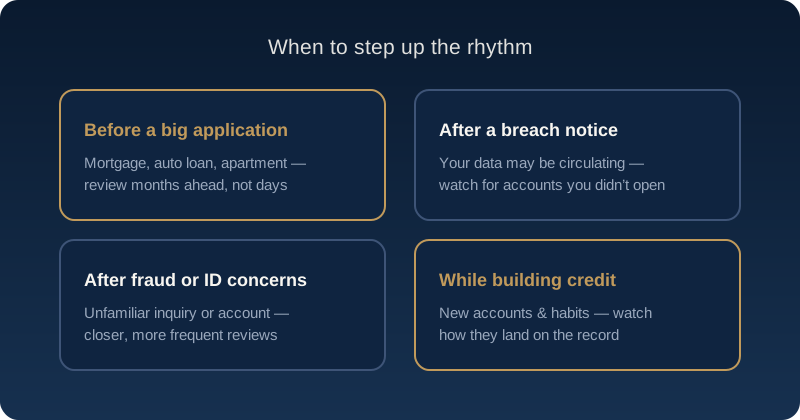
Four situations reliably justify stepping up. Before a major application: review your reports a few months ahead of a mortgage, auto loan, business funding, or apartment application — far enough out that if you find an error, there’s time for a dispute to be investigated before an underwriter reads the file. After a data breach notice: if a company holding your information reports a breach, closer watching for accounts and inquiries you didn’t initiate is warranted for a while. After any fraud signal: an unfamiliar hard inquiry, a collection call about a debt you don’t recognize, mail about an account you never opened — each is a cue to read everything, promptly. While building or rebuilding: new accounts and new habits deserve verification that they’re landing on the record the way you expect.
Free annual reports vs. credit monitoring
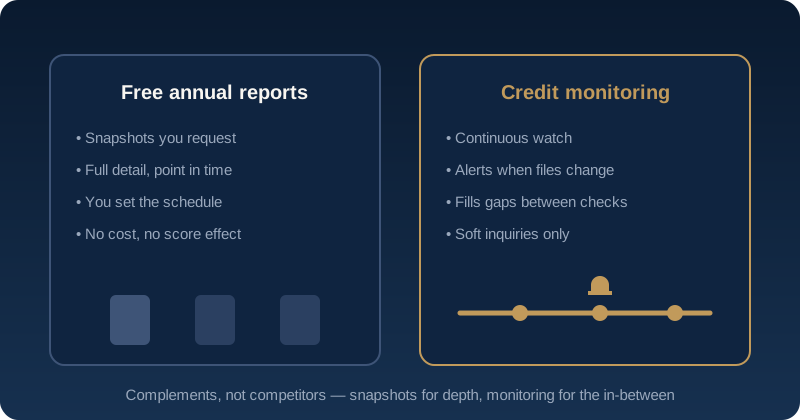
These two tools answer different questions. A pulled report answers “what exactly is on my file right now?” — full detail, every account and inquiry, at a point in time you chose. Monitoring answers “did anything just change?” — a continuous watch that alerts you when a new account, inquiry, or address appears, without you having to remember to look. Neither replaces the other: snapshots without monitoring leave months of blind spots between reviews; monitoring without periodic full reads means alerts arrive without the context of the whole record. A workable combination is the staggered free-report rotation for depth, with 3-bureau monitoring filling the gaps — every touch a soft inquiry either way. The full case for the continuous side of that pairing is made in why monitor your credit year-round, and our Professional Credit Monitoring hub covers how professional, three-bureau monitoring fits — including why we recommend MyFreeScoreNow.
Common mistakes to avoid
Watching the score instead of reading the report. The score is a dashboard light; the report is the machine. A number can’t show you the misreported late payment or the account you never opened — the distinction is unpacked in credit report vs. credit score. Checking only one bureau. Errors and unfamiliar activity can appear on one file and not the others; a single-bureau habit leaves two-thirds of your record unreviewed. Checking only when something feels wrong. By the time a symptom surfaces, the cause may have been sitting on the report for months. Skimming instead of reading. A useful review verifies each account is yours, each balance looks right, each payment history matches your memory, and every hard inquiry traces to an application you actually made. Treating one clean read as permanent. Reports change as furnishers send new data — a clean file in January says nothing about October.
Two real-world examples
The head start. Amara plans to apply for a mortgage in the fall, so she reads all three of her reports in the spring. One shows an auto loan payment marked 30 days late from two years ago — a payment she can document as on time. She disputes it with the bureau, the investigation runs its course, and the record is corrected months before any underwriter looks. Had she pulled the report the week of her application, the same error would have surfaced with no runway.
The quarterly rotation that caught a stranger. Luis pulls one bureau’s report every quarter on a rotating schedule. In July, his TransUnion read shows a retail card inquiry from a store he’s never entered. It traces to nothing he did — so he disputes the inquiry, reviews the rest of the file for other unfamiliar activity, and tightens his watch for the next few months. The rotation didn’t prevent the attempt; it made sure the attempt didn’t sit unnoticed for a year.
Key takeaways
- Baseline: a full report review once or twice a year, with a staggered bureau rotation as a strong upgrade.
- Self-checks are soft inquiries — frequency never costs your score anything.
- Check more often before major applications, after breach notices, after fraud signals, and while building credit.
- Free reports give depth; monitoring covers the gaps — they complement rather than replace each other.
- Read the report, not just the score — and read all three bureaus over time, not one.