
Published July 6, 2026 · Educational information — not legal, tax, lending, or financial advice.
Quick answer
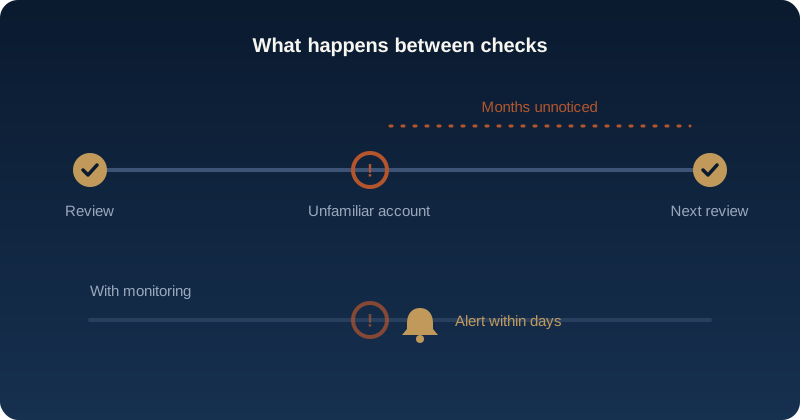
Because your credit file doesn’t change on your schedule — it changes on everyone else’s. Lenders report new data every month, fraud can start any week of the year, and errors appear without announcement. A periodic check is a snapshot; everything between snapshots happens in the dark, and problems do their worst damage while they sit unnoticed. Year-round monitoring closes that gap: soft-inquiry alerts (no scoring cost) tell you within days — not months — when a new account, inquiry, address, or collection lands on your file, so small problems get handled while they’re still small and your file stays ready for the moments that matter.
Your file changes whether you look or not
A credit report feels like a document, but it behaves like a live feed. Every month, the lenders and furnishers who report to the bureaus send fresh data — balances, payments, limits, statuses — and each of the three bureaus updates its separate file on its own timing. Add the changes you don’t initiate: a new inquiry from an application (yours or an impostor’s), a collection account surfacing, an address you’ve never lived at, a status flipping from current to late. None of it waits for your annual review. The file is being written year-round, by parties who aren’t you — which is exactly why your three files can differ and why a single glance at a single bureau tells you so little. Reading that movement as a trend over months, rather than a one-day figure, is also why historical views like FLASHBACK score history can be useful alongside continuous monitoring.
The gap problem
Suppose you review your reports diligently every January. That’s a genuinely good habit — and it still leaves roughly 350 days a year when nothing is watching. Anything that lands on your file in February sits there until next January: an account opened in your name, a misreported late payment quietly dragging on your score, a collection you could have disputed on day one. The problem isn’t that periodic checks are bad; it’s that they’re snapshots, and everything between snapshots is a blind spot. Monitoring exists for the in-between: it doesn’t replace your deep reads (the right rhythm for those is covered in how often should you check your credit report) — it patrols the months when you aren’t reading. Whether that patrol is worth a membership fee — and when free tools honestly suffice — gets its own treatment in is credit monitoring worth paying for.
Fraud damage compounds with time
With identity theft, the variable that matters most is often not whether you find out but when. An impostor who opens one card and gets caught in a week is a contained incident: one dispute, one closure, a fraud alert, done. The same impostor operating undetected for ten months is a different story — multiple accounts, missed payments reported in your name, collections, a damaged file, and a recovery process measured in months of disputes and documentation. Fraud is one of the few credit problems where speed of discovery directly limits the size of the damage. Year-round alerts are how you compress dwell time from months to days — and the earliest signals are usually exactly what monitoring watches: a hard inquiry you didn’t authorize, an account you didn’t open, an address you don’t recognize. The full list of warning signs is in how to spot identity theft.
Errors don’t announce themselves
Not every problem on a credit file is a criminal. Mixed files, misapplied payments, accounts reported with the wrong status, a paid collection still showing a balance — ordinary reporting errors appear without notice and without malice, and they cost you the same way fraud does: silently, until something forces a look. Often that something is a lender pulling your file at the worst possible moment. An alert about an unexpected change — a new derogatory mark, a status flip, a balance that doesn’t match reality — is frequently the first and only notice you’ll get that a furnisher sent bad data. From there, the fix is a normal dispute; the monitoring just determines whether that dispute starts this week or after the damage has had a year to settle in.
Readiness: opportunity doesn’t send a save-the-date
Major applications are sometimes planned far in advance — and sometimes they aren’t. The apartment that opens up, the auto loan after a breakdown, the business opportunity that needs financing on a short clock: these moments pull your credit on their schedule, and the file the lender sees is the file as it stands, not as you last remember it. Someone who’s been watching year-round walks into those moments with a known quantity — no surprises, no scramble, no discovering an old error with two weeks of runway instead of six months. For the highest-stakes versions of that moment, see how monitoring helps before buying a home and before applying for business funding. Awareness isn’t just defense; it’s the difference between reacting to your credit and operating from it. What counts as a strong file is covered in what is a good credit score.
What a year-round watch covers
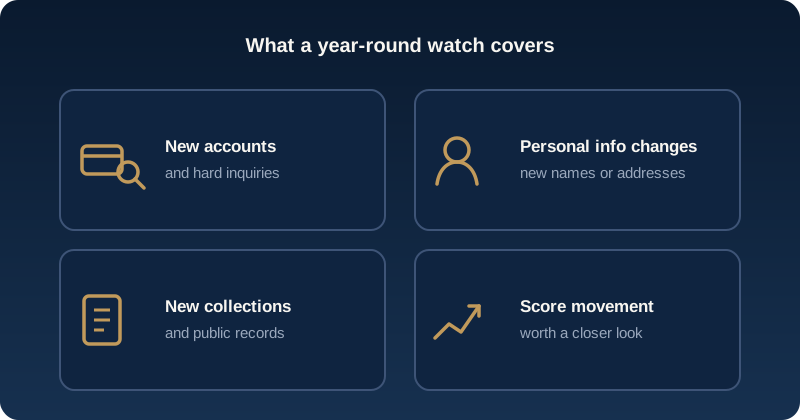
If you’re still getting oriented, our primer on what credit monitoring is covers the basics first. The specifics vary by service, but the core watch list is consistent: new accounts and hard inquiries — the earliest footprints of both legitimate applications and fraud; personal information changes — new names, addresses, or employers attached to your file, a classic precursor to account takeover; new collections and public records — derogatory items that hit scores hardest and benefit most from a fast response; and meaningful score movement — not the routine point-to-point wobble, but shifts large enough to signal that something changed on the report underneath. The common thread is change detection: monitoring doesn’t judge your credit — it tells you when the record moved, so you can decide whether the movement was expected. For the professional version of that continuous watch, see our Professional Credit Monitoring hub and why we recommend MyFreeScoreNow.
Detection, not prevention — and why that’s still essential
One honest boundary: monitoring doesn’t stop anything from happening. It’s a smoke detector, not a firewall. The prevention tool is a credit freeze, which blocks most new-account fraud at the source by walling off your file from new creditors. But a freeze can’t see misuse of your existing accounts, can’t catch reporting errors, and tells you nothing about what’s already on your file — which is why the two work as a pair rather than a choice: the freeze blocks, the monitoring watches everything the freeze doesn’t cover. The trade-offs between the protective tools are compared in fraud alert vs. credit freeze. And because the bureaus keep separate files that fraud or errors can hit unevenly, coverage across all three — not one — is what actually closes the blind spots.
Two real-world examples
The alert that shrank a fraud. Denise gets a new-inquiry alert on a Tuesday: an electronics store card she never applied for. By Thursday she’s disputed the inquiry, placed a fraud alert, and frozen her files. The impostor’s attempt goes nowhere — one blocked application instead of a portfolio of accounts aging in her name. Without the alert, her next scheduled review was eight months away.
The error caught before it mattered. Marcus gets a score-movement alert and a new derogatory flag: an old utility account, paid and closed years ago, has resurfaced with a collection status. He disputes it that week with documentation. Four months later, a landlord runs his credit for an apartment he didn’t know he’d want — and the file is clean, because the correction ran its course long before anyone was looking.
Key takeaways
- Your credit file is updated year-round by lenders, furnishers, and sometimes impostors — it doesn’t wait for your review.
- Periodic checks are snapshots; monitoring covers the months of blind spot between them.
- Fraud damage compounds with time — fast detection is what keeps an incident small.
- Monitoring is detection, not prevention — pair it with a freeze for blocking power, and cover all three bureaus.
- Year-round awareness means opportunity finds your file ready — all through soft inquiries, at no scoring cost.