
Published July 6, 2026 · Educational information — not legal, tax, lending, or financial advice.
Quick answer
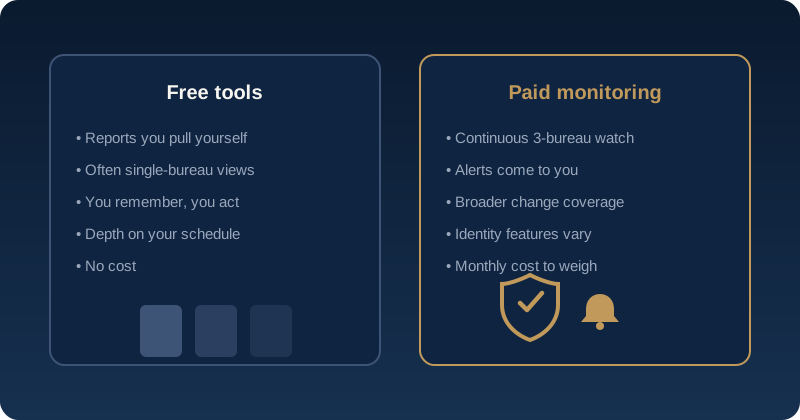
Sometimes — and the honest answer depends on you. If you’re weighing the cost before you’ve pinned down the fundamentals, our primer on what credit monitoring is lays them out. Free tools cover real ground: AnnualCreditReport.com provides full reports from all three bureaus, and many issuers show a free score. What paying adds is continuity — a 3-bureau watch that alerts you within days of a change instead of waiting for your next manual review — plus broader change detection and, often, identity features. Paying tends to earn its cost after a breach or past fraud, ahead of a major application, when life is too busy for a reliable review habit, or when your personal credit backs business financing. If you genuinely review all three bureaus on a schedule and your risk is ordinary, free may be enough. The trap in the math is the word genuinely. For a side-by-side of the two options, see free vs. professional credit monitoring.
What free tools already cover
Start with what costs nothing, because any honest value calculation does. AnnualCreditReport.com — the federally authorized source — has generally made free weekly access to all three bureau reports available, which means depth is free: every account, every inquiry, every address, on whatever schedule you set (a practical rotation is laid out in how often should you check your credit report). Many card issuers and banks show a free score alongside your statement — usually from one bureau and one model, which is why the numbers rarely match, but useful as a trend line. And after a data breach, the exposing company sometimes offers a stretch of free monitoring. None of this is a lesser version of the paid product; it’s a different product. Free tools deliver depth on demand. What they don’t deliver is anything when you forget to look.
What paying actually adds
Three things, mainly. Continuity: alerts arrive within days of a change — a new account, a hard inquiry, an address you don’t recognize — instead of surfacing at your next manual review, which might be months out. That gap, and why it matters, is the whole subject of why monitor your credit year-round. Coverage: a paid membership typically watches all three bureaus at once, where free score peeks usually show one; because the bureaus keep separate files, single-bureau vision leaves two-thirds of your record unwatched. Breadth: beyond scores, monitoring flags the changes that matter most — new collections, public records, personal-information changes — and some services layer on identity-theft features and resolution support. A few now also surface your score history over time, so you can read the trend rather than just today’s number. Every touch is a soft inquiry, so none of it costs score points; the question is purely whether the continuity is worth the membership fee for your situation.
When paying tends to earn its cost
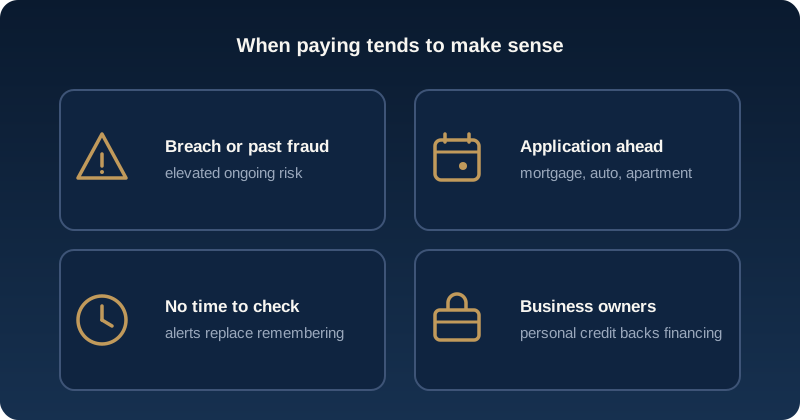
Four situations shift the math toward paying. After a breach or past fraud: if your data is already circulating or someone has used it before, your risk isn’t ordinary — and the value of catching the next attempt in days rather than months is concrete, because fraud damage compounds with time. Ahead of a major application: in the months before a mortgage, auto loan, or apartment, an unexpected change on your file is exactly what you can’t afford to discover late; alerts buy runway for a dispute to finish before an underwriter looks (the full mortgage countdown is in preparing your credit before buying a home). When the review habit won’t hold: free tools have one hidden cost — your consistent attention. If the honest forecast is that you won’t pull three bureaus’ reports on schedule, alerts do the remembering. When personal credit backs business financing: owners whose funding options ride on a personal guarantee have more downstream cost per surprise than most, and less tolerance for finding problems at application time.
When free is probably enough
The other side deserves equal honesty. If your fraud risk is ordinary, no application is on the horizon, your files are frozen — which blocks most new-account fraud outright, for free — and you actually maintain a rotation through all three bureaus’ free reports, then a paid membership adds convenience more than capability. That’s a legitimate answer, and anyone selling monitoring should be able to say so. The qualifier doing the heavy lifting is “actually maintain”: the free system works exactly as well as your discipline does, and no better. A useful self-test — when did you last read a full report from each bureau? If the answer comes easily, free is working for you. If it takes a minute, you’ve found the gap monitoring exists to fill.
How to judge a specific service
If the math points toward paying, compare on substance. Coverage: all three bureaus or one — the single biggest differentiator, since one-bureau monitoring leaves two files dark. Alert breadth: new accounts and inquiries at minimum; better services also flag personal-information changes, new collections, public records, and meaningful score movement. Terms: the monthly cost, what the trial includes, how billing works, and how cancellation works — read the provider’s terms before enrolling, not after. What’s real vs. decorative: a dark-web scan headline matters less than whether the service watches the changes that actually precede damage. Weigh a specific membership’s feature list against the four situations above, and the worth-it question usually answers itself. The full evaluation criteria live in what to look for in a credit monitoring service, our Professional Credit Monitoring hub collects the wider resources, and why we recommend MyFreeScoreNow explains the platform we chose.
What no monitoring replaces
Two boundaries keep the decision honest. First, monitoring — free or paid — is detection, not prevention: it reports change; it doesn’t block anything. The blocking tool is a credit freeze, free by law, and the two work as a pair (the comparison with fraud alerts is in fraud alert vs. credit freeze). Second, alerts don’t replace reading: a notification tells you that something changed, but only a full report read tells you what your record actually says — the difference is unpacked in credit report vs. credit score. The strongest setup is boring: freeze for blocking, monitoring for the in-between, periodic deep reads for the whole picture.
Two real-world examples
The math that said yes. Priya’s data was in a breach last year, and she’s planning a mortgage application next spring. Her risk is elevated, her stakes have a date on them, and her calendar is full. A 3-bureau membership costs her a few dollars a month; a fraud incident discovered late, or an error found the week of underwriting, would cost her far more in time and outcome. She enrolls, keeps her freeze in place, and treats alerts as tripwires with her deep reads scheduled quarterly.
The math that said not yet. Tomas froze his files at all three bureaus two years ago, has no application planned, and — the deciding fact — genuinely pulls one bureau’s free report every quarter on a rotation he’s kept since. His new-account risk is largely blocked, his review habit is real, and his risk profile is ordinary. He skips the membership for now and marks one condition for revisiting: the day the rotation slips or an application appears on the horizon.
Key takeaways
- Free tools deliver depth on demand; paying buys continuity, 3-bureau coverage, and alerts you don’t have to remember.
- Paying tends to earn its cost after a breach or fraud, before major applications, when the review habit won’t hold, or when personal credit backs a business.
- Free is probably enough if your files are frozen, your risk is ordinary, and your three-bureau review rotation is real — not aspirational.
- Judge services on coverage, alert breadth, and terms — and read cancellation conditions before enrolling.
- Nothing here replaces a freeze for prevention or full report reads for the whole picture — monitoring covers the in-between.