
Published July 5, 2026 · Updated July 7, 2026 · Educational information — not legal, tax, lending, or financial advice.
Quick answer
Business funding is capital a business obtains to operate or grow. Most commonly it arrives as debt — term loans, lines of credit, equipment financing, and similar products repaid over time — though equity and revenue-based structures exist too. Lenders typically weigh time in business, revenue, cash flow, and often the owner's personal credit. No option is guaranteed: qualification and any funding offers depend on lender review and eligibility. The practical starting point is understanding your options — which is what a free Business Funding Snapshot is designed to help with.
So what exactly is business funding?
Business funding is any capital a business brings in to do something it couldn't fund from current cash — buy equipment, hire ahead of revenue, stock inventory, open a location, or simply smooth the timing gap between paying expenses and collecting receivables. The word covers a wide family of tools, and the tools differ enormously in cost, structure, and fit. The category name matters far less than the terms: two products called the same thing can behave very differently once payments start.
That's the single most useful mental shift for a first-time borrower. Business funding isn't one product with one price — it's a marketplace of structures, each built around a different assumption about why the money is needed and how it will come back. A tool that's a good fit for buying a delivery van can be a poor fit for covering a slow season, and vice versa. This guide walks through the landscape so the vocabulary, the categories, and the evaluation process feel familiar before any real conversation starts.
Why do businesses seek funding?
Healthy, profitable businesses borrow all the time — funding is not a signal of trouble. The most common reasons fall into a few buckets:
Growth investments
Equipment, vehicles, build-outs, a second location, a large inventory purchase ahead of a busy season. These are defined, one-time investments where the amount needed is known in advance — the classic use case for a term loan or equipment financing.
Working capital and timing gaps
Payroll lands every two weeks whether or not customers have paid their invoices. Businesses with seasonal revenue, long receivable cycles, or lumpy project income often use funding to bridge predictable timing gaps — the classic use case for a line of credit or invoice financing.
Opportunity and resilience
A supplier offers a steep discount for a bulk order. A competitor's customer list becomes available. A piece of equipment fails without warning. Access to capital — even unused access, like an open line of credit — lets a business say yes to opportunities and absorb surprises without derailing operations.
Naming the reason matters because the reason points to the structure. Lenders will ask what the funds are for, and the honest answer to that question is also the best guide to which product category to explore first.
Debt vs. equity: the two big families
Debt funding is borrowed capital repaid over time with interest or fees — the business keeps full ownership, and the obligation exists whether or not the plan works out. Equity funding trades a share of ownership for capital — no repayment schedule, but the owner permanently gives up part of the business and usually some control. Equity is the world of angel investors, venture capital, and bringing on partners; it tends to fit high-growth companies with large capital needs and long horizons.
Most small-business funding conversations, and everything the Business Funding Snapshot addresses, live in the debt family, so that's where this article focuses. Within debt, the variety is wide — and that's the next section.
Common types of business funding
A few categories cover most of what established businesses encounter. Availability, cost, and qualification standards vary significantly across these categories — and across lenders within each category.
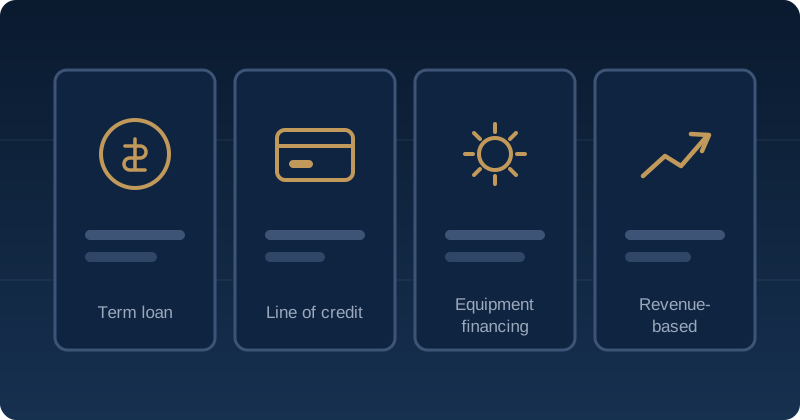
Term loans
A lump sum delivered up front and repaid on a fixed schedule — usually monthly — over a set period, with interest. Terms range from about a year to ten or more. Because the amount, rate, and schedule are set at the start, term loans suit defined investments where the amount needed is known. Predictability is the appeal; inflexibility is the trade-off, since you pay interest on the full amount whether or not you deploy it all immediately.
Business lines of credit
Revolving access to capital up to an approved limit: draw what you need, repay it, and the availability returns. Interest is generally charged only on the amount drawn, not the full limit. Lines of credit suit working capital, seasonal swings, and cash flow timing — recurring needs where the exact amount and timing aren't known in advance. The two products are compared in depth in Business Line of Credit vs. Term Loan, and the line of credit itself is explained in How a Business Line of Credit Works.
Equipment financing
Funding tied to a specific asset — a vehicle, machine, or system — where the asset itself typically serves as collateral. Because the lender has something concrete to secure the obligation, equipment financing can be accessible to businesses that might not qualify for unsecured products, and terms often track the useful life of the asset. See how equipment financing works for the full walkthrough.
SBA-backed loans
Loans made by participating lenders with a partial guarantee from the U.S. Small Business Administration. The guarantee reduces lender risk, which generally translates into longer terms and competitive rates — in exchange for a more extensive application process and documentation requirements. SBA programs are worth understanding for established businesses planning significant, non-urgent investments — the SBA loan requirements are explained in their own guide.
Revenue-based financing
Capital repaid as a fixed percentage of ongoing revenue rather than a fixed payment. When revenue rises, repayment accelerates; when it dips, payments shrink. That flexibility carries a cost that is often higher than traditional loans, so the structure tends to fit businesses with strong but variable revenue.
Invoice financing and factoring
Capital advanced against unpaid receivables. Invoice financing uses the invoices as the basis for a loan or line; factoring involves selling the receivables to a third party at a discount, which then collects payment. Both convert money you're owed into money you can use, at a cost, and both fit businesses whose customers pay on long terms.
Merchant cash advances
An advance against future card sales, repaid through a daily or weekly percentage of receipts. Merchant cash advances are typically fast to obtain and among the most expensive forms of business capital, with costs quoted as factor rates rather than interest rates — a distinction covered in the terminology section. They deserve especially careful reading before signing.
Business credit cards
Familiar, flexible, and useful for everyday expenses and short-term float — with the same caveat that applies to personal cards: carried balances get expensive quickly. For owners, business cards also intersect with personal credit, since many issuers check the owner's personal credit at application and some report activity to consumer bureaus. Understanding credit utilization is as relevant here as it is on the personal side.
The Business Funding Center keeps a fuller overview of each type, and How to Prepare Your Business Before Applying for Funding in New Jersey covers what to have in order before approaching any of them.
What do lenders actually look for?
Every lender applies its own criteria, but a familiar set of factors shows up across most reviews. None of these factors alone decides an outcome, and no combination guarantees one; they're the inputs to each lender's own underwriting.
Time in business
Newer businesses have less track record to evaluate, which is why many traditional products favor roughly two or more years of operating history. Some alternative products consider younger businesses, generally at higher cost.
Revenue and cash flow
The central question in most underwriting: can the business comfortably support the payments? Lenders typically review bank statements and financial statements to see not just how much comes in, but how steadily — consistent deposits read differently than the same total arriving in spikes.
Industry
Some sectors are treated as higher risk based on failure rates, seasonality, or regulatory exposure, and a few lenders exclude certain industries entirely. This is one reason the same business profile can receive very different responses from different lenders.
Existing debt
How much obligation already sits on the business, and how new payments would stack on top of current ones. Lenders often look at debt service relative to income — a business-side cousin of the debt-to-income thinking familiar from consumer lending.
Credit history — business and personal
Businesses can build their own credit files with commercial bureaus, and established files help. But for smaller businesses, the owner's personal credit very commonly enters the review — enough that it gets its own section below.
Where your personal credit fits in
For smaller businesses especially, the line between the owner and the business is thin in a lender's eyes. Many small-business products consider the owner's personal credit, and personal guarantees — where the owner personally backs the obligation — are common. That makes personal credit awareness a genuine part of business funding preparation: knowing what a lender will see before they see it. It also helps to understand how personal and business credit differ and where they connect.
The good news is that the personal side is knowable in advance. Understanding what counts as a good credit score, learning how to read your credit report, and knowing the difference between the soft inquiries used in pre-qualification and the hard inquiries that come with formal applications all reduce surprises. A free Credit Snapshot is an educational starting point, and 3-Bureau Credit Monitoring keeps the picture current through a financing process that can stretch over weeks.
The terms you’ll hear (in plain English)
Funding conversations move fast, and a handful of terms carry most of the weight. Plain-English versions:
Principal
The amount borrowed, before interest and fees.
APR (annual percentage rate)
The yearly cost of borrowing expressed as a percentage, including interest and certain fees. APR is the most comparable number across traditional loan products — when it's disclosed.
Factor rate
A multiplier used instead of an interest rate on some products, especially merchant cash advances. A $50,000 advance at a 1.3 factor rate means repaying $65,000 — regardless of how quickly. Because factor-rate costs don't shrink with early repayment the way interest does, a factor rate that looks small can translate into a very high effective APR. Converting to an approximate APR before comparing is one of the most protective habits a borrower can build.
Amortization
The schedule by which a loan balance declines to zero through regular payments of principal and interest.
Draw
Taking funds from a line of credit. Interest generally accrues only on drawn amounts.
Collateral
An asset pledged to secure the obligation — equipment, receivables, real estate — which the lender can claim if the borrower defaults. Secured products are backed by collateral; unsecured products are not, and typically cost more or lean harder on credit strength.
Personal guarantee
The owner's personal promise to repay if the business cannot. Common in small-business lending, and worth reading carefully — it connects business obligations to personal assets.
UCC lien (UCC-1 filing)
A public notice a lender files to claim an interest in business assets as collateral. Routine in secured lending, but existing liens can affect a business's ability to obtain additional funding, so it's worth knowing what's already filed against your business.
Debt service coverage
A measure lenders use to compare a business's income to its debt payments — a way of asking how much cushion exists between what comes in and what's owed.
Origination fee
A fee charged for processing and issuing the funding, often deducted from the proceeds — meaning the amount that lands in your account can be less than the amount you repay interest on.
What people often get wrong
“Business funding never touches my personal credit.”
Often false for small businesses. Owner credit checks and personal guarantees are common, and some business credit cards report to consumer bureaus. The separation between business and personal grows with the business, but it's rarely absolute at small-business scale. Checking your own credit first is a soft inquiry that doesn't affect your score.
“Pre-qualified means approved.”
No. Pre-qualification tools and educational overviews — including the Business Funding Snapshot — show possibilities based on limited information. Approval, amounts, and final terms come only from a lender after its own underwriting.
“The lowest rate is always the cheapest option.”
Not necessarily. Fees, payment frequency, prepayment terms, and rate structure all shape the true cost. A slightly higher APR with no origination fee and flexible prepayment can cost less than a lower headline rate loaded with fees.
“Debt means the business is struggling.”
Strategic borrowing to fund growth or smooth predictable timing gaps is ordinary financial management. What signals trouble isn't debt itself — it's debt whose payments don't fit the business's cash flow.
“If one lender declines, they all will.”
Lender criteria genuinely differ — by industry appetite, minimum time in business, revenue thresholds, and credit standards. A decline from one lender is information, not a verdict.
“Guaranteed approval” offers are not legitimate shortcuts.
Any promise of guaranteed approval or guaranteed amounts is a red flag. Legitimate funding always depends on lender review and eligibility.
How to compare offers responsibly
Headline numbers are designed to look good; the terms underneath decide what the capital actually costs. Compare the total cost of capital across the full repayment period, not just a rate or factor. Check the payment schedule against your real cash flow — daily or weekly payments behave very differently from monthly ones. Read collateral and personal guarantee requirements carefully, along with origination fees and prepayment terms. Ask how prepayment is handled — on interest-based products, paying early usually saves money; on factor-rate products, it often doesn't. Compare more than one option before committing. And treat any promise of guaranteed approval as the red flag it is.
Where the Business Funding Snapshot fits
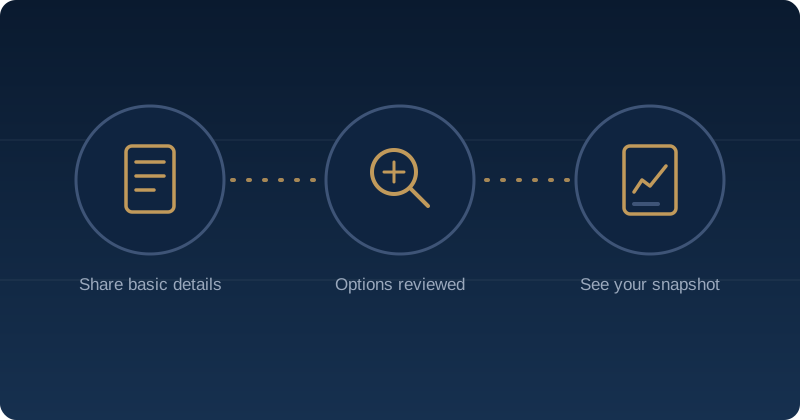
Before any of the comparing starts, there's a simpler question: what kinds of options might be on the table for a business like yours? That's the job of the free Business Funding Snapshot, available through our enrollment partner. You share basic details about your business, and the snapshot gives you an educational overview of the funding your business may qualify for — fast, with no obligation to continue. It's designed for established businesses seeking growth capital, and it is not an application or an approval: qualification and any funding offers depend on lender review and eligibility.
Free to start · No obligation · Subject to lender review and eligibility
Key takeaways
- Business funding is a family of tools — the structure should match what the capital is for.
- Lenders commonly weigh time in business, revenue, cash flow, industry, existing debt, and personal credit.
- Know the vocabulary — especially the difference between APR and factor rates — before comparing offers.
- Total cost, payment schedule, and guarantee terms matter more than headline numbers.
- No legitimate option guarantees approval or amounts — qualification depends on lender review and eligibility.
- A free Business Funding Snapshot is an educational, no-obligation way to see potential options.