
Published July 7, 2026 · Educational information — not legal, tax, lending, or financial advice.
Quick answer
Preparation for business funding comes down to being able to show a lender a clear, consistent picture: steady bank deposits, organized financial statements, clean separation between business and personal finances, a known credit picture on both the business and personal side, and documentation ready before it's requested. None of it guarantees approval — qualification always depends on lender review and eligibility — but preparation reduces surprises, speeds the process, and puts a business in position to compare offers rather than accept the first one.
Why preparation matters
Most funding problems aren't qualification problems — they're timing problems. A business that starts looking for capital the week it's needed has no room to fix a credit report error, no time to let a strong quarter show up in bank statements, and no leverage to compare offers. The same business, preparing three to six months ahead, walks into the same conversations with cleaner numbers and real choices.
This guide covers the preparation side. For the landscape of what you'd be applying for, start with What Is Business Funding in New Jersey? — and for choosing between the two most common structures, see Business Line of Credit vs. Term Loan.
What lenders expect to see
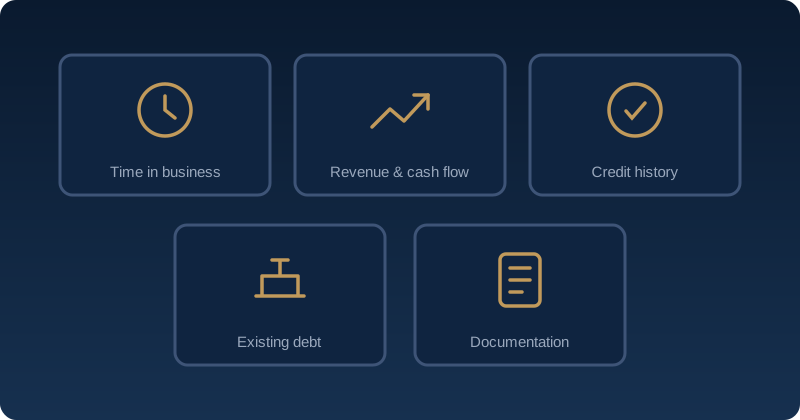
Underwriting varies by lender and product, but nearly every review is trying to answer the same few questions: Is this a real, operating business? Has it been operating long enough to evaluate? Does money come in steadily enough to support the payments? How much obligation already exists? And what does the credit history — business and personal — say about how obligations get handled? Preparation is simply arranging your evidence so those questions answer themselves.
Separate business and personal finances
If there's one structural step worth taking early, it's this. A dedicated business bank account — with revenue deposited there and expenses paid from there — produces the bank statements lenders actually want to read. Commingled accounts force underwriters to untangle which deposits are business revenue, and they usually resolve ambiguity conservatively. Clean separation also supports accurate financial statements, simplifies taxes, and is the foundation for building business credit in the business's own name.
Get your cash flow story straight
Bank statements are often the single most-read document in small-business underwriting, typically covering the most recent three to six months. Lenders look at more than totals: they notice deposit consistency, average daily balances, overdrafts and negative-balance days, and large unexplained transfers.
Practical implications. First, timing — if the business is seasonal, an application filed just after the strong season reads differently than one filed at the bottom of the slow one. Second, hygiene — a run of months without overdrafts is worth protecting in the window before applying. Third, honesty with yourself — if the statements show that payments on the amount you're considering would strain the account, that's information to act on before a lender acts on it for you.
Organize your financial statements
Two documents cover most requests: a profit-and-loss statement (revenue, expenses, and what's left, over a period) and a balance sheet (what the business owns and owes at a point in time). Some lenders also ask for a cash flow statement or accounts-receivable aging. They don't need to be elaborate — they need to be current, and they need to agree with your tax returns and bank statements. Inconsistent numbers across documents are among the most common and most avoidable red flags in underwriting. If bookkeeping has drifted, bringing it current before applying is time well spent.
Know your business credit
Businesses can build their own credit files with commercial bureaus — Dun & Bradstreet, Experian Business, and Equifax Business are the major ones. These files build through vendor and supplier accounts that report payment history, business credit cards and loans in the business's name, and public records. Many small businesses have thin or empty business files, which is precisely why lenders lean on the owner's personal credit instead.
Preparation here has two parts. Check what exists: business credit files can contain errors just as consumer files can, and outdated liens or misreported payments are worth correcting before a lender finds them. And build deliberately: paying vendors that report, on time, in the business's name, gradually creates a file that lets the business stand on its own record — a sequence walked through in How to Build Business Credit.
Know your personal credit
For small businesses, the owner's personal credit is very often part of the review — sometimes the biggest part. That makes the consumer-credit fundamentals genuine business preparation:
Know what's on your report before a lender reads it. How to Read Your Credit Report walks through every section. Checking your own credit is a soft inquiry and does not affect your score.
Fix errors early. Disputes take time to resolve — the process is covered in How to Dispute an Error on Your Credit Report — which is another argument for starting preparation months ahead rather than days.
Mind your revolving balances. Credit utilization is a meaningful score factor, and high personal card balances in the months before a funding application can work against an otherwise strong file.
Understand inquiries. Pre-qualification checks are often soft inquiries; formal applications may involve hard ones. Knowing the difference — and asking lenders which they use — keeps a comparison-shopping process from leaving unnecessary marks.
A free Credit Snapshot is an educational way to see your starting point, and credit monitoring keeps the picture current through a funding process that can stretch over weeks — since the three bureaus don't always show the same thing.
Time in business: what you can and can't control
Time in business is the one factor no amount of preparation accelerates — but it still involves choices. Many traditional products favor roughly two or more years of operating history; some alternative products consider younger businesses at higher cost. If your business is young, the practical questions are whether the need can wait until the file is stronger, whether a smaller or secured product fits the current stage, and whether the cost of youth-stage capital is justified by what it will earn. Applying to products whose stated minimums your business doesn't meet mostly produces declines and, sometimes, hard inquiries — targeting realistic products is part of preparation too.
Understand personal guarantees before you see one
A personal guarantee is the owner's personal promise to repay if the business cannot. It connects the business obligation to personal assets, and it's common in small-business lending — common enough that it's best treated as expected rather than exceptional. Before applying, it's worth knowing what you're prepared to sign: whether a guarantee is required, whether it's limited or unlimited, and what it would mean alongside any guarantees you've already given on existing obligations. Reading guarantee language carefully isn't distrust; it's the single most consequential paragraph in many funding agreements. Personal guarantees come up often with revolving products such as a business line of credit, where an unsecured line frequently relies on one.
The documentation checklist
Requirements vary by lender and product — online products may ask for little beyond bank statements, while SBA programs ask for substantially more — but assembling this set in advance covers most requests:
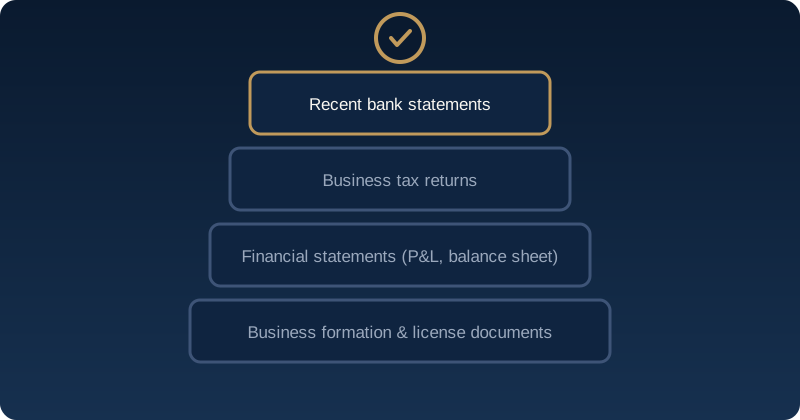
- Business bank statements — typically the most recent three to six months.
- Business tax returns — often one to two years; personal returns are sometimes requested too.
- Financial statements — current profit-and-loss and balance sheet that agree with the returns.
- Formation and license documents — articles of organization or incorporation, EIN, applicable licenses.
- A schedule of existing debt — balances, payments, and lenders for current obligations.
- Owner identification — and, for some products, a brief statement of what the funds are for.
Common mistakes that weaken applications
Applying in a rush
Urgency removes every advantage preparation creates: no time to fix errors, clean up statements, or compare offers. The most expensive capital tends to be the capital arranged in a hurry.
Inconsistent numbers
When the revenue on an application doesn't match the tax return, or the P&L doesn't reconcile with bank deposits, underwriters notice — and the burden of explanation lands on the applicant.
Commingled finances
Personal spending running through the business account muddies the deposits lenders want to read cleanly and undercuts the business's standalone identity.
Not knowing your own credit
An error or a surprise collection discovered during underwriting can stall or sink an application that a pre-check would have protected.
Scattershot applications
Applying everywhere at once, without asking which lenders use hard inquiries, can leave marks on the owner's report — and a burst of hard inquiries is itself visible to every subsequent lender. Hard inquiries remain on a credit report for two years.
Taking the first offer
Preparation exists to create options. Comparing at least two offers on total cost of capital, payment schedule, fees, and guarantee terms is the payoff for all the work above.
Chasing “guaranteed approval”
No legitimate funding is guaranteed. Offers promising approval regardless of review are a red flag, not a shortcut.
Key takeaways
- Start months ahead — timing, not qualification, sinks most funding attempts.
- Separate business and personal finances — clean bank statements are the most-read document in underwriting.
- Make every document agree: application, tax returns, financial statements, and deposits should tell one story.
- Check both credit pictures — the business file and the owner's personal report — before any lender does.
- Read personal guarantee language carefully — it's the most consequential paragraph in many agreements.
- Preparation creates options — and comparing options is where it pays off. Nothing guarantees approval.