
Published July 5, 2026 · Educational information — not legal, tax, lending, or financial advice.
Quick answer
A hard inquiry generally stays visible on your credit report for about two years, then ages off automatically. Its scoring influence runs on a shorter clock: any modest effect — typically a handful of points — tends to fade within about a year, often sooner. Rate shopping gets friendly treatment: multiple pulls for the same loan type within a compact window are generally scored as one event. Accurate inquiries can’t be removed early and don’t need to be; unauthorized ones — from applications you never made — can and should be disputed, and are worth treating as a prompt to sweep all three reports.
The two clocks: visibility vs. influence
The single most useful fact about hard inquiries is that they run on two different clocks. The visibility clock is the one most people ask about: the entry appears on your report when a lender pulls your file for an application you authorized, and it generally remains there for about two years before aging off on its own — no action needed. The influence clock is shorter and matters more: scoring models weigh inquiries most in the months right after they land, and any effect typically fades within about a year, with exact treatment varying by model and version. So an inquiry you can still see at month eighteen usually isn’t doing anything to the number anymore. The visibility serves lenders reading recent application activity; the score moved on long before the entry does.
How much do they actually matter?
Inquiries sit at the light end of the factor hierarchy — well behind payment history and utilization, the two that do the heavy lifting in what makes up your credit score. A single hard inquiry typically registers as a handful of points, and context shapes even that: a deep, established file barely notices one, while a thin or young file may feel it slightly more.
What changes the calculus is clustering — several unrelated applications (multiple new cards, say) in a short stretch reads as a pattern rather than an event, and lenders reviewing the file may ask about it; where that line actually sits is unpacked in how many hard inquiries is too many. One application for something you need is normal credit behavior, not a scoring emergency; the fear of inquiries costs people more in bad decisions (like not comparison-shopping a loan) than the inquiries themselves cost in points.
Rate shopping and the window
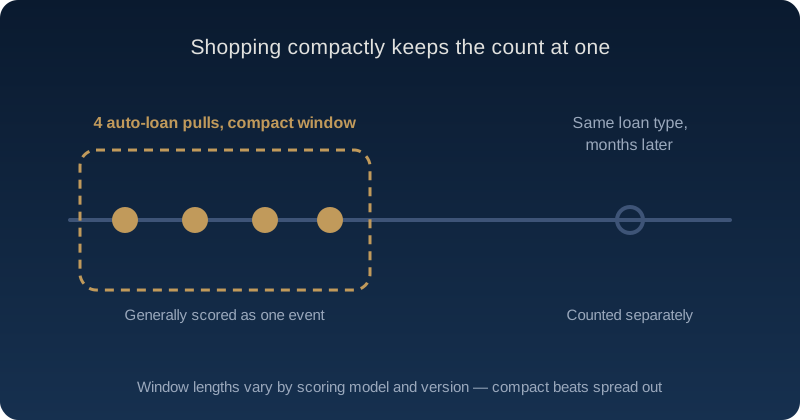
Comparison-shopping a mortgage, auto, or student loan is exactly what careful borrowers should do, and scoring models are built to accommodate it: multiple hard pulls for the same loan type within a shopping window are generally deduplicated into a single event for scoring purposes. Window lengths vary by model and version, which is why the practical guidance stays simple — keep serious shopping compact, ideally within a few weeks, rather than spreading applications across months. Two boundaries worth knowing: the grouping applies to same-type loans (five mortgage quotes, one event), not to unrelated credit (three new card applications are three events); and the dealership scenario is normal — a financing application shopped to a lender network can produce several pulls from names you never spoke to, all typically grouped when compact.
What can be removed (and what can’t)
The honest split: accurate hard inquiries — from applications you actually made — generally cannot be removed early, and services promising to “sweep” legitimate inquiries for a fee deserve skepticism; the entries age off on their own around the two-year mark and stop influencing scores well before that, so there’s usually nothing worth paying to fix.
Inaccurate or unauthorized inquiries are a different story: a pull from an application you never made can be disputed with the bureau reporting it, and hard inquiries generally require your authorization, which is exactly what makes an unauthorized one meaningful. The dispute itself is free and doesn’t require an intermediary — the same principle that applies to every report error, since the report, not the score, is where accuracy work happens, as laid out in credit report vs. credit score.
The inquiry you don’t recognize
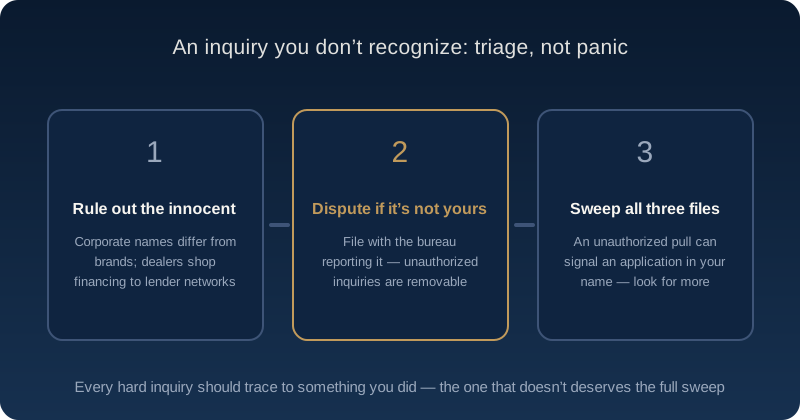
Triage before alarm. Step one: rule out the innocent explanations — companies often pull credit under corporate names that don’t match their storefront brand, and dealer- or retailer-arranged financing generates pulls from lenders you never met. Step two: if the entry truly traces to nothing you did, dispute it with the bureau reporting it — the full path, from verification through escalation, is in how to remove unauthorized hard inquiries from your credit report. Step three — the one people skip: treat an unauthorized inquiry as a prompt to read all three reports closely, because someone applying for credit in your name rarely stops at one attempt, and a new account can follow the inquiry. The distinction between the inquiry types doing all the work here — why soft ones are invisible and hard ones require consent — is covered in full in soft inquiry vs. hard inquiry.
How to manage inquiries before a big application
If a mortgage or major loan is on the horizon, inquiry management is mostly restraint plus sequencing: skip optional applications (new cards, store financing at the register) in the months beforehand, so the file shows purpose rather than appetite; do your rate shopping for the big loan compactly once you’re ready; and remember that checking your own credit costs nothing — self-checks are soft inquiries, a myth put fully to rest in does checking my own credit hurt my score. Reading your reports a few months out also gives you time to dispute anything unauthorized before an underwriter sees it. The same restraint pays off before applying for business funding, where lenders likewise review recent inquiry activity. Past that, inquiries take care of themselves: influence fades, entries age off, and the file’s heavyweight factors carry the story.
Two real-world examples
The eighteen-month worry. Preparing for a mortgage, Lena counts four hard inquiries on her report and assumes she should wait for them to disappear before applying. A closer look at the dates: all four are more than a year old — still visible, no longer influential. Her lender confirms what the two-clock rule predicts: the underwriter’s attention is on her payment history and balances, not on year-old inquiries. She applies on her original timeline; the visible-but-inert entries change nothing.
The dealership cluster. A week after buying a car, Marcus finds five hard inquiries from five lender names he doesn’t recognize and briefly assumes fraud. The dates tell the real story: all five landed the same afternoon he sat in the finance office — the dealership shopped his application to its network. Compact and same-type, they’re generally grouped as one scoring event. He verifies each name traces to that day, finds one from three weeks later that doesn’t — and disputes that one, which is removed. The cluster was normal; the straggler was the real finding.
Key takeaways
- Visible about two years; influential typically less than one — two different clocks.
- A single inquiry is a handful of points at most — clusters of unrelated applications are what read as a pattern.
- Rate-shop the same loan type compactly and it’s generally scored as one event.
- Accurate inquiries can’t be removed early and don’t need to be; unauthorized ones can be disputed free.
- An inquiry that traces to nothing you did is a prompt to sweep all three reports, not just fix one line.