
Published July 18, 2026 · Educational information — not legal, tax, lending, or financial advice.
Quick answer
There’s no fixed number of hard inquiries that’s officially “too many” — scoring models don’t publish a cutoff, and treatment varies by model and version. What models and lenders actually read is the pattern: one or two purposeful applications in a year are routine credit behavior, while several unrelated applications clustered into a few months can register as risk-seeking — particularly on a thin or young file. Rate shopping is the carve-out: multiple pulls for the same loan type within a compact window are generally scored as one event. If a major application is coming, the play is quiet months beforehand, compact shopping when ready, and remembering that checking your own credit never adds to the count.
Why there’s no magic number
The question assumes a threshold exists — three fine, four trouble — but that’s not how any commonly used scoring model works. Inquiries sit at the light end of the factor hierarchy, well behind payment history and utilization in what makes up your credit score, and models evaluate them as one signal among many rather than against a published limit. Two files with identical inquiry counts can be scored quite differently depending on recency, spacing, purpose, and everything else in the file. That’s why the honest answer isn’t a number — it’s a description of the patterns that read as routine versus the ones that read as risk.
What scoring models actually read
Three dimensions do most of the work. Recency: inquiries weigh most in the months right after they land, and any modest effect typically fades within about a year — the entry itself hangs around for about two, a split explained in how long hard inquiries stay on your credit report. Four inquiries spread across eighteen months and four landed last quarter are not the same signal. Relatedness: same-type pulls in a compact window group into one event, while unrelated applications each stand alone — the distinction the next two sections unpack. File depth: a deep, established file barely registers an inquiry or two, while a thin or young file — where each new data point is a larger share of the story — may feel the same activity more. None of this involves counting to a cutoff; it’s pattern reading. A sudden dip after an application usually has this modest, temporary character, one of the routine explanations covered in why credit scores drop overnight.
When lenders start asking questions
Here’s the part the score-focused framing misses: a human or automated underwriter reads the inquiry section directly, separately from whatever the score says. A burst of recent applications suggests two things a lender can’t see yet — new debt that hasn’t started reporting, and an appetite for credit that may mean the applicant is stretching. Some lenders apply their own internal guidelines about recent application velocity, and while those thresholds aren’t public and vary by institution, the practical effect is consistent: a cluster of unrelated inquiries can prompt questions, a request for explanation, or extra weight on a borderline decision even when the score itself moved only a little. Mortgage underwriting makes this concrete — recent inquiries routinely draw written-explanation requests, and many lenders re-check the file shortly before closing, as walked through in what happens during a mortgage credit check.
The rate-shopping carve-out
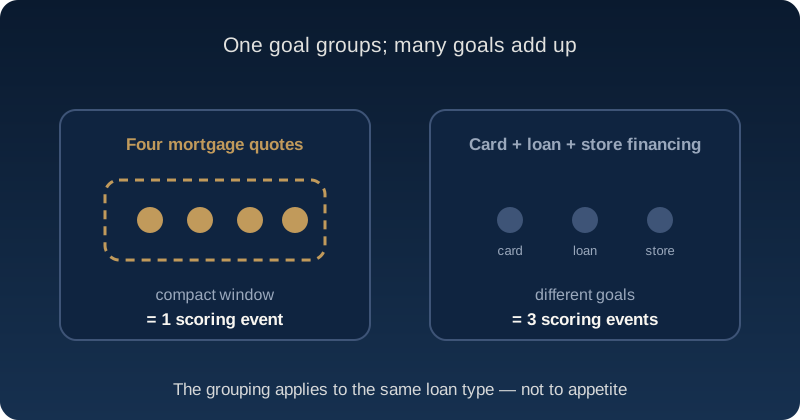
The exception that confuses people most is also the friendliest: comparison-shopping a mortgage, auto, or student loan is exactly what careful borrowers should do, so scoring models are built to deduplicate it. Multiple hard pulls for the same loan type within a compact shopping window are generally treated as a single event for scoring purposes — five mortgage quotes, one event. The grouping has boundaries worth respecting: it applies to same-type installment shopping, not to unrelated credit (three new card applications are three events, no matter how close together), and window lengths vary by model, which is why the standing guidance is to keep serious shopping inside a few weeks rather than trusting the widest window.
Context that changes the answer
The same inquiry activity means different things in different situations. On a thin or young file, restraint pays extra — each application is a bigger share of a short story. Ahead of a mortgage, the bar is highest: underwriters read inquiries closely, and the months before an application are the wrong time for optional credit. Before business funding, the same logic applies — lenders review recent personal-credit activity as part of the picture. And one kind of “inquiry” never counts anywhere: checking your own credit is a soft pull, invisible to lenders and free to repeat as often as you like — the full soft-versus-hard mechanics are in soft inquiry vs. hard inquiry, and the self-check myth is retired for good in does checking my own credit hurt my score.
One more contextual note: a count that seems too high for anything you remember doing is a different problem entirely. Match every entry in the inquiry section against your own applications — the section-by-section walkthrough in how to read your credit report shows where to look — and if one traces to nothing you did, follow the removal process in how to remove unauthorized hard inquiries from your credit report rather than worrying about the total.
Pacing applications before a big loan
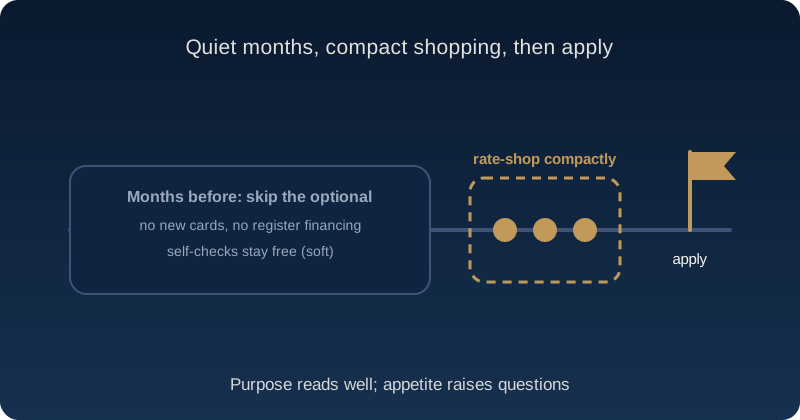
Inquiry management is mostly sequencing. In the months before a major application, skip the optional: new rewards cards, store financing offered at the register, anything that adds an application without serving the goal — the file should show purpose, not appetite. When you’re ready for the big loan, do the rate shopping compactly, inside a few weeks. Throughout, read your own reports freely — self-checks are soft — and use the runway to resolve anything on the report that would draw an underwriter’s eye. The Consumer Financial Protection Bureau’s credit reports and scores resources are a solid plain-language reference for how inquiries and the rest of the file fit together. After the application closes, the topic takes care of itself: influence fades within about a year, entries age off around two, and the heavyweight factors carry the file.
Two real-world examples
The card-churn cluster. Over one spring, Dana opens three rewards cards and takes zero-interest financing on a couch — four unrelated hard inquiries in eleven weeks. Her score dips modestly, but the real cost surfaces in the fall: applying for an auto loan, she’s asked to explain her recent application activity, and the lender prices the loan cautiously, noting the new accounts haven’t aged. Nothing was “too many” by any published rule — the cluster of unrelated applications simply read as appetite at exactly the moment she needed the file to read as purpose.
The counted-but-quiet file. Rafael tallies five hard inquiries on his report and worries he’s over some limit before his mortgage application. The dates and types tell a calmer story: three are mortgage pulls from the same two-week stretch — grouped as one event — and the other two are more than a year old, visible but no longer influential. Functionally, his file carries one recent scoring event. The underwriter asks one routine question about the mortgage shopping, accepts the obvious answer, and moves on to what actually decides the file: his payment history and balances.
Key takeaways
- No model publishes a cutoff — the pattern of inquiries matters more than the raw count.
- Recency, relatedness, and file depth are what models read — recent unrelated clusters weigh most.
- Lenders read the inquiry section directly — velocity can prompt questions even when the score barely moved.
- Same-type rate shopping in a compact window is generally one scoring event; unrelated applications each count.
- Before a big loan: quiet months, compact shopping, and free soft self-checks throughout.