
Published July 5, 2026 · Educational information — not legal, tax, lending, or financial advice.
Quick answer
Most credit scores are built from five kinds of information on your credit reports: payment history (whether accounts are paid on time — typically the heaviest factor), credit utilization (how much of your available revolving credit you’re using — usually next), length of credit history, credit mix, and new inquiries. The widely quoted percentages are illustrative of one model family, not a universal formula — FICO and VantageScore versions weigh things differently. What doesn’t change across models: pay on time, keep reported balances modest relative to limits, and let accounts age, and the biggest levers are working in your favor.
The five components at a glance
A credit score is a shorthand summary of your credit reports, and whatever the model, the same five concepts explain most of the number. Payment history typically carries the most weight, utilization is usually next, and length of history, credit mix, and new inquiries play smaller supporting roles. You’ll often see this presented as a tidy pie chart with exact percentages — treat those as illustrative of one model family rather than a universal recipe. FICO and VantageScore, and the versions within each, weigh the ingredients differently, which is part of why the same file can produce different numbers — a phenomenon covered in why your three credit scores are different. The ordering, though, is remarkably consistent: the top two factors dominate everywhere.
Payment history: the foundation
Whether accounts get paid on time is the single strongest signal in a credit file, because it’s the most direct answer to the question every scoring model is trying to approximate: how has this person handled credit obligations so far? On-time payments build the record month by month; late payments — particularly those reported 30 or more days past due — work against it, with severity generally increasing the later and more recent the event.
Two features of this factor are worth internalizing. First, it’s cumulative: a long, unbroken record is not built quickly and not erased quickly, in either direction. Second, it’s binary at the account level — paying the minimum on time protects payment history just as well as paying in full (interest cost is a separate matter). Automating at least the minimum payment is the simplest structural protection for the heaviest factor there is.
Credit utilization: the fast mover
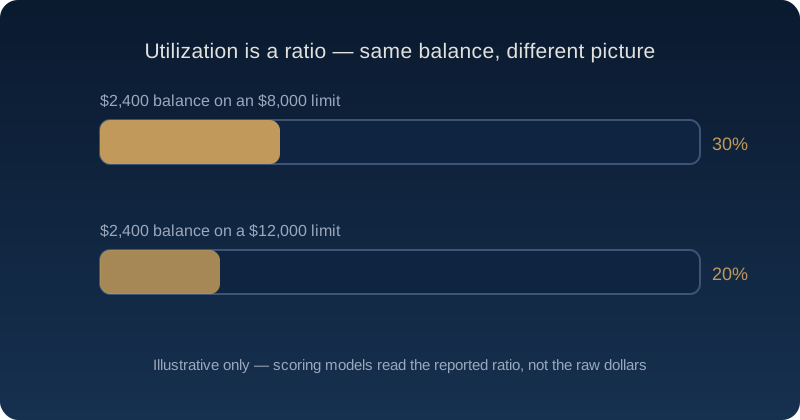
Utilization is the share of your available revolving credit you’re using, based on the balances your card issuers report — usually the statement balance, not your balance on any given afternoon. It’s a ratio, which produces some unintuitive results: the same $2,400 balance reads as 30% utilization against an $8,000 limit but 20% against $12,000. Lower is generally read more favorably, and the commonly referenced “under 30%” figure is a rule of thumb rather than a cliff — models read the ratio on a sliding scale.
Utilization is also the fastest-moving factor: it recalculates as new balances report, with no memory of last month. That’s why a vacation or a large purchase can nudge a score down one month and release the next — the mechanical pattern behind many of the sudden dips explained in why credit scores drop overnight.
Length of credit history: the slow builder
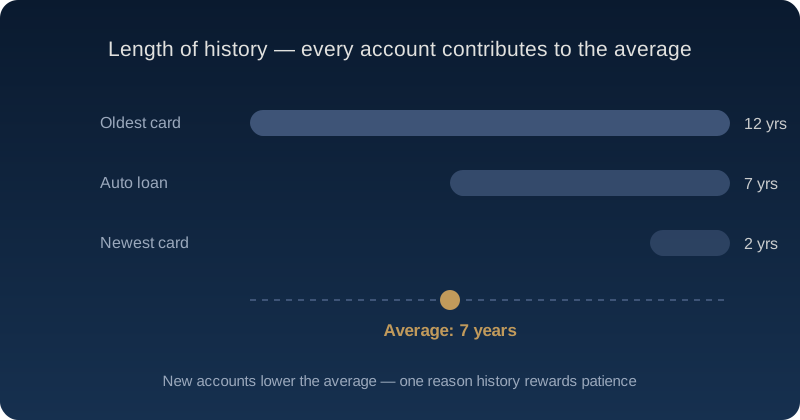
This factor considers how long your accounts have existed — the age of your oldest account, the age of your newest, and the average across the file. It rewards exactly one thing: time. A twelve-year-old card quietly anchors the average; opening a new account lowers it, which is one reason a flurry of new credit can temporarily soften a score even when every account is handled perfectly. Two practical notes follow. Keeping an old, no-fee card open (with occasional small use so the issuer keeps it active) preserves both its age contribution and its credit limit. And closed accounts in good standing generally remain on reports for years, continuing to contribute while they last — closure is not instant erasure, though the lost credit limit can raise utilization immediately.
Credit mix and new inquiries: the supporting cast
Credit mix reflects the variety of account types on your file — revolving accounts like cards alongside installment accounts like auto loans or mortgages. A demonstrated ability to manage both is read modestly favorably, but this is a small factor and never a reason to take on debt you don’t need; mix improves naturally as life happens. New inquiries covers hard inquiries from credit applications. Their effect is typically modest and temporary, checking your own credit doesn’t count at all, and rate shopping for the same loan type within a compact window is generally treated as a single event — the full story, including where the “checking hurts your score” myth comes from, is in does checking my own credit hurt my score.
What is not in your score
Just as useful as knowing the ingredients is knowing what isn’t one. Income, employment, savings, and assets don’t appear on credit reports and aren’t scoring inputs — lenders may weigh them separately in an application, but the score doesn’t see them. Neither do age, marital status, where you live, or debit card activity. Checking your own credit leaves no scoring trace. Two long-time absences are worth flagging because they’re changing: rent payments stay outside the score unless they’re reported, a path explained in can rent payments help you build credit, and pay-in-4 plans are moving from invisible to reported as covered in does buy now, pay later affect your credit score. The score is calculated entirely from the credit report behind it, which is why the report — not the number — is the thing worth reviewing for accuracy; our homepage’s reports vs scores comparison draws that line in more detail. And once the number exists, remember it’s read against ranges, not absolutes — what counts as strong is covered in what is a good credit score.
Two real-world examples
The perfect payer with the puzzling dip. Tanya has never missed a payment in nine years, yet her score sags 22 points in October. The culprit isn’t the foundation — it’s the fast mover. Her card statement closed right after she booked flights and a hotel, so a high balance reported and her utilization jumped. Payment history held; utilization moved. The balance reports lower the next cycle and the number recovers, no action required beyond understanding which factor did what.
The spring cleaner. After paying off a card he rarely used, Devon closes it to “simplify.” It was his oldest account and a third of his total credit limit. Nothing bad happens to his payment history — but his available credit shrinks immediately, pushing utilization up, and the account’s age contribution will eventually leave the file too. The account was handled flawlessly for years; the closure still reshaped two factors at once. Closing old accounts isn’t wrong, but it’s a decision to make with the mechanics in view.
Key takeaways
- Five components explain most of the number — payment history and utilization do the heavy lifting.
- On-time payments are cumulative and slow to build — automating at least the minimum protects the heaviest factor.
- Utilization is a fast-moving ratio based on reported balances — dips it causes typically ease as balances report lower.
- Age, mix, and inquiries are smaller factors — never a reason to open or carry debt you don’t need.
- Income isn’t a scoring input, exact weights vary by model, and the report behind the number is what deserves your review.