
Published July 5, 2026 · Educational information — not legal, tax, lending, or financial advice.
Quick answer
Credit utilization is the share of your available revolving credit you’re using: your reported card balances divided by your credit limits, measured per card and across all of them. It’s typically the second-heaviest scoring factor after payment history. Three things about it surprise people: it’s a ratio, so the same balance reads differently against different limits; it’s usually calculated from your statement balance, so even full monthly payers show utilization; and it has almost no memory — the ratio resets as new balances report, which is why utilization-driven score dips typically ease on their own. Lower is generally read more favorably, with “under roughly 30%” the common rule of thumb — a guideline, not a cliff.
So what exactly is utilization?
Utilization applies to revolving credit — cards and lines of credit, where the balance can rise and fall — not to installment loans like mortgages or auto loans, which are tracked differently. The math is division: reported balances over credit limits. Scoring models generally look at it two ways at once — per card and in aggregate — so a single maxed-out card can register even when overall utilization is low. Because it’s a ratio, dollars alone tell you nothing: a $1,200 balance is 24% of a $5,000 limit but 8% of a $15,000 limit. Utilization sits near the top of the factor hierarchy, typically second only to payment history — the full breakdown of all five factors is in what makes up your credit score.
Why the statement balance is what counts
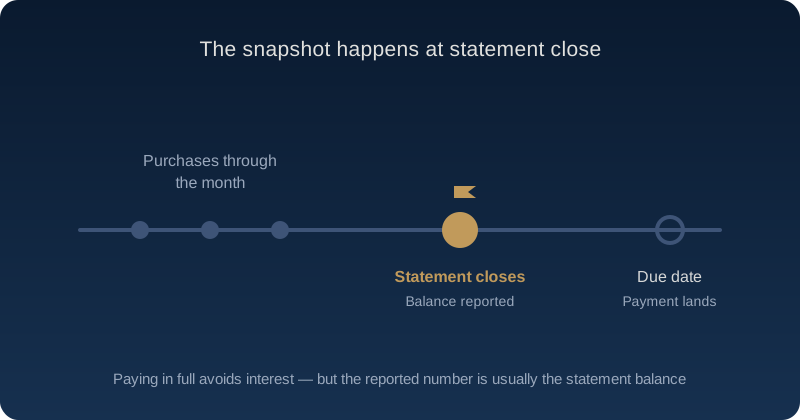
Here’s the mechanic that surprises careful payers: card issuers typically report your balance to the bureaus once per cycle, usually at statement close — and a payment made afterward, even in full and on time, doesn’t change what was already reported. You can pay every statement in full, never owe a cent of interest, and still show utilization equal to whatever the statement snapshot captured. That’s not an error on your report; it’s how the reporting calendar works.
The practical corollary: if the reported number matters to you in a given month — say, ahead of an application — paying the balance down before the statement closes changes the snapshot, while paying by the due date only avoids interest. And since issuers report on their own schedules to the bureaus they choose, the same card can show different balances across your three files — part of the story told in why your three credit scores are different.
The 30% rule of thumb (and what it isn’t)
“Keep utilization under 30%” is the most-quoted line in credit education, and it’s useful as long as you know what it is: a rough waypoint, not a scoring rule. Models read utilization on a sliding scale — generally, lower reads more favorably at every step, and there’s no ledge at 29% that vanishes at 31%. The guideline earns its popularity because it’s memorable and directionally right, but treating it as a hard boundary produces two mistakes: relaxing at 28% when lower would read better, and panicking at 34% when the difference is modest. As with everything scoring-related, exact treatment varies by model and version, and the same ratio lands differently on different files.
The factor with no memory
Payment history is cumulative — it remembers. Utilization, under most commonly used models, does not: the ratio is recalculated from the balances currently on file, and last month’s number typically plays no role once a new one reports. This is the mechanism behind one of the most common score-drop stories: a vacation or a large purchase lands on a statement, utilization jumps, the score dips — then the balance reports lower next cycle and the ratio, along with its influence, resets. Those dips look alarming and usually aren’t; they’re covered alongside the other overnight-drop causes in why did my credit score drop overnight. The no-memory property is also good news for anyone carrying high balances today: as the reported numbers come down, the ratio simply follows the data.
The levers that move the ratio
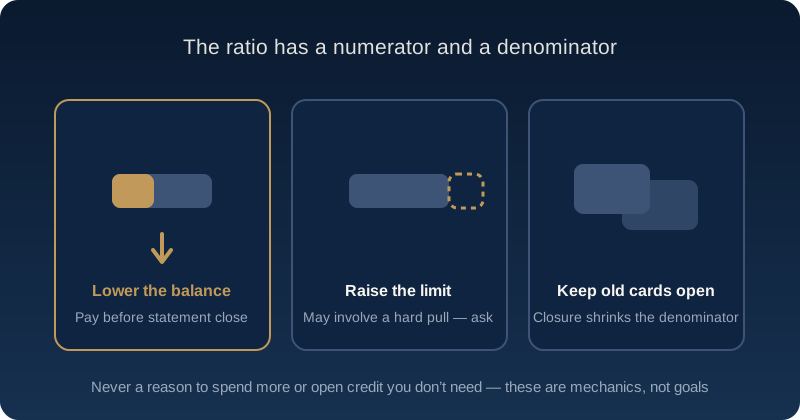
A ratio has a numerator and a denominator, which gives you exactly three honest levers. Lower the numerator: pay balances down, and if timing matters, do it before statement close so the smaller number is what reports. Raise the denominator: a higher credit limit lowers the ratio at the same balance — though a limit-increase request can involve a hard pull depending on the issuer, so it’s worth asking first (the soft/hard distinction is unpacked in soft inquiry vs. hard inquiry). Protect the denominator: closing a paid-off card removes its limit from your total available credit and can raise overall utilization without a single dollar of new spending. None of these is a reason to spend more or open credit you don’t need — they’re mechanics for managing what you already have. (The ratio is especially unforgiving on the small limits typical of secured credit cards used for rebuilding, where even modest spending reads as high utilization.)
Two real-world examples
The full payer with the 40% surprise. Priya charges everything to one card for the points and pays in full every due date — textbook behavior. But her statement closes right after her monthly rent-adjacent expenses hit, so the snapshot regularly reports around 40% utilization despite her never carrying a balance. Nothing is wrong and nothing needs fixing for daily life; when she wants the reported number lower ahead of a mortgage application, she simply makes her payment a week earlier — before the close instead of before the due date — and the next snapshot reports single digits.
The declutter that backfired. After paying off his oldest card, Jordan closes it — it felt like progress. That card held $6,000 of his $15,000 total limit, so his available credit drops to $9,000 overnight while his other balances stay put, and his overall utilization jumps from 20% to 33% with zero new spending. The lesson isn’t that closing cards is forbidden — sometimes an annual fee justifies it — but that the denominator is part of the ratio, and shrinking it has the same arithmetic effect as spending more.
Key takeaways
- Utilization is reported balances divided by limits on revolving credit — measured per card and overall.
- The statement balance is usually what reports — full monthly payers still show utilization.
- “Under roughly 30%” is a guideline on a sliding scale, not a cliff — lower generally reads better.
- Utilization has little memory — the ratio and its influence typically reset as new balances report.
- Three levers: pay before statement close, consider limit increases with eyes open, and think twice before closing old cards.