
Published July 5, 2026 · Educational information — not legal, tax, lending, or financial advice.
Quick answer
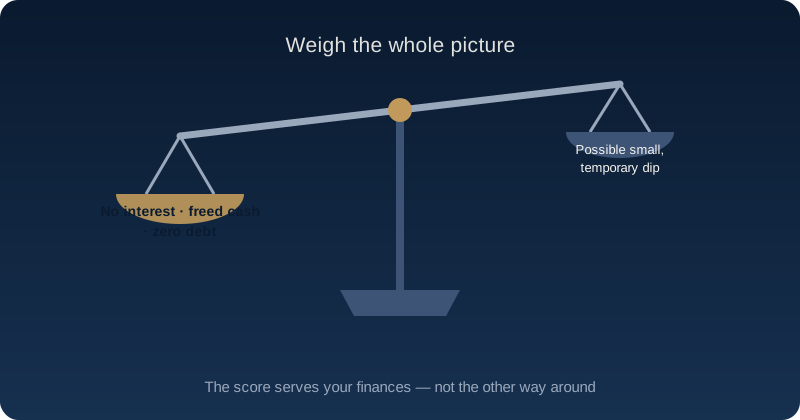
Yes, paying off debt can occasionally cause a small, temporary score dip — and no, that’s almost never a reason not to do it. The dip, when it happens, comes from structural side effects rather than any judgment of the payoff itself: a paid-off loan usually closes, which can thin your credit mix and eventually shift account-age math; a paid-off card that’s then closed removes its limit and can raise utilization. Meanwhile the myth that carrying a balance “helps” is exactly that — a myth that costs real interest for zero scoring benefit. The financial wins of payoff are lasting; the scoring quirk typically fades.
Why a good decision can dip a number
Credit scores don’t measure financial health — they estimate the likelihood that credit will be repaid, using patterns in the file. Occasionally those two things point in different directions for a moment. Paying off a loan is unambiguously good for your finances: interest stops, cash flow frees up, risk falls. But to a scoring model, the event can also mean an open account closed, an installment line went quiet, and the shape of the file changed. The model isn’t punishing the payoff; it’s re-reading a file whose structure just shifted. Knowing which of the five factors moved — the full map is in what makes up your credit score — is what turns the dip from alarming to explainable.
The three mechanics behind the dip
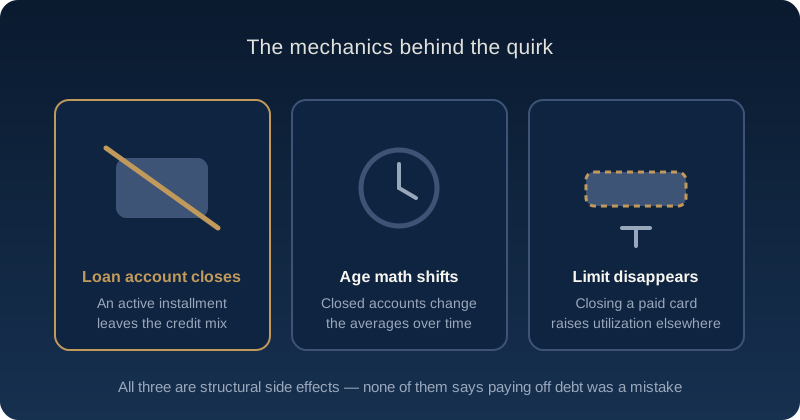
Mechanic one: the account closes. Installment loans — auto, student, personal — generally close automatically at payoff. If that was your only active installment account, your credit mix loses its live installment element, a small factor but a real one. Mechanic two: age math shifts. Closed accounts in good standing generally stay on the file for years and keep contributing while they remain, so this effect is slow and often invisible — but as closed accounts eventually age off, the averages can move. Mechanic three: the disappearing limit. This one belongs to cards: paying off a card does nothing negative, but closing it afterward removes its limit from your total available credit, shrinking the denominator of your utilization ratio — the full arithmetic is in what is credit utilization.
Loans vs. cards: the outcomes differ
The two payoff scenarios deserve separating, because their score behavior differs. Installment payoff is where the counterintuitive dip usually lives: the account closes by design, you can’t keep it open, and if it was your last active installment line, the mix effect lands. Nothing to fix — the on-time history remains on the file and keeps speaking for you.
Card payoff usually goes the other way: once the lower balance reports, utilization improves, which tends to help rather than hurt. The card trap is entirely optional — it’s the closure afterward, not the payoff. Paying a card to zero and leaving it open (with occasional small use so the issuer keeps it active) captures the benefit and skips the side effect. Which is why a payoff-adjacent dip on a card usually traces to a closure decision, one of the patterns catalogued in why did my credit score drop overnight.
The “carry a balance” myth
Somewhere along the way, the payoff-dip phenomenon mutated into folk advice: “keep a small balance so the card stays active in the scoring.” This is wrong in the expensive direction. Carrying a balance past the due date means paying interest, and scoring models offer no reward for it — none. What the myth garbles is a reporting mechanic: issuers typically report your statement balance, so a card used normally and paid in full every month already shows activity and utilization on the file without a dollar of interest. Use the card, pay the statement in full, done. Anyone telling you to pay interest for your score is describing a transaction where you lose money and gain nothing.
A note on paying collections
A related question with its own honest answer: paying a collection account generally does not remove it from the report. The entry typically updates to “paid” and continues aging off on its own schedule. That said, paid status isn’t meaningless — some newer scoring models treat paid collections more favorably than unpaid ones, and lenders reviewing a file manually often read them differently too. Whether and how to resolve a collection involves specifics beyond scoring — validation, statutes of limitation, negotiation — that are worth researching for your situation; what matters here is calibrated expectations: payment changes the entry’s status and sometimes its scoring treatment, not its existence.
When timing genuinely matters
There is exactly one common situation where the payoff-dip quirk deserves tactical respect: a major application in the next month or two. Underwriting reads the file as it stands, so if a mortgage or auto approval is imminent, keeping the file stable — no account closures, no structural changes — until after the decision is a reasonable precaution. Outside that window, the sequencing question mostly answers itself: pay the debt, keep paid cards open where it makes sense, and let the file re-settle. If you want to watch the re-settling happen — the balance updating, the account status changing — a regular report-reading rhythm covers it, laid out in how often should you check your credit report.
Two real-world examples
The last car payment. Renata makes her final auto loan payment and, three weeks later, notices her score down 14 points. The loan was her only installment account, so its closure thinned her mix — mechanic one, working as designed. She owes nothing, saves the interest, and her five years of on-time payments remain on the file, still counting. By the time she thinks to check again months later, the dip has faded into the noise. Nothing needed fixing, because nothing was broken.
The zero-balance victory lap. Des pays off both cards after a bonus — genuinely excellent — then closes them both to “stay out of temptation.” His utilization denominator collapses, and the balance on the one card he kept now reads as high utilization. The payoff helped; the closures cost. A middle path existed: pay to zero, keep the no-fee card open with a small recurring charge on autopay, and close only the card whose annual fee wasn’t earning its keep. Temptation management is legitimate — it just has cheaper implementations than surrendering limits.
Key takeaways
- Payoff dips are real but typically small and temporary — structural side effects, not verdicts.
- Loan payoffs close accounts by design; the on-time history stays on the file and keeps counting.
- Card payoffs generally help — the trap is closing the card afterward, not paying it off.
- Never carry a balance “for your score” — interest is real, the benefit is imaginary.
- The one timing exception: keep the file stable in the month or two before a major application.