
Published July 7, 2026 · Educational information — not legal, tax, lending, or financial advice.
Quick answer
A term loan is a lump sum repaid on a fixed schedule — built for defined, one-time investments where the amount is known. A business line of credit is revolving access up to a limit — draw, repay, draw again — built for recurring working-capital needs and cash flow timing. Neither is universally cheaper or easier to get; the right fit follows from what the capital is for. Both commonly involve a review of time in business, revenue, cash flow, and often the owner's personal credit, and qualification always depends on lender review and eligibility.
How each product works
These two products anchor most small-business funding conversations, and they solve genuinely different problems. If the broader landscape is new to you, the pillar guide What Is Business Funding in New Jersey? maps all the major categories; this article goes deep on the two you'll hear about most.
Term loan: borrow once, repay on schedule
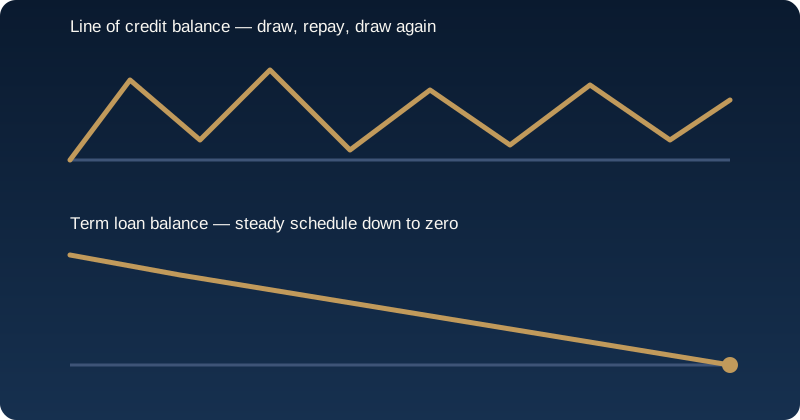
A term loan delivers the full amount up front — say, $100,000 — and the business repays it in regular installments, usually monthly, over a set term with interest. The payment amount is typically fixed, the end date is known, and interest accrues on the full outstanding balance from day one. When the last payment clears, the relationship is done unless you apply again.
Line of credit: borrow as needed, up to a limit
A line of credit approves the business for access up to a limit — say, $100,000 — but transfers nothing until you draw. Draw $20,000, and interest accrues on $20,000, not the limit. Repay it, and the full $100,000 becomes available again. The line revolves: it's a standing facility rather than a one-time transaction, though lenders typically review and renew lines periodically, and terms can change at renewal. For a fuller walkthrough of the mechanics, requirements, and costs, see How a Business Line of Credit Works.
Repayment: the biggest practical difference
On paper the products differ in structure; in daily life they differ in how repayment feels.
A term loan's payment is a fixed line item. It appears in the budget every month at the same amount, which makes planning straightforward — and makes the obligation rigid. The payment is owed in slow months and busy months alike, and it's owed on the full amount borrowed even if half the money is still sitting unused in the account.
A line of credit's payment moves with usage. Carry no balance and there's typically no interest to pay (though some lines carry maintenance or inactivity fees). Draw heavily, and minimum payments rise with the balance. That flexibility is the product's core value — and its core risk, because revolving balances that never get repaid can quietly become permanent, expensive debt. The dynamic mirrors credit utilization on the consumer side: revolving credit rewards discipline and punishes drift.
How costs compare
Neither product is universally cheaper. The comparison depends on four inputs:
Rate structure
Term loans often carry fixed rates; lines of credit frequently carry variable rates that move with the market. A variable rate that looks lower today can cost more over time if rates rise.
What interest applies to
Term loans charge interest on the full outstanding balance from funding day. Lines charge interest only on drawn amounts — a real saving if you only need capital occasionally.
Fees
Both can carry origination fees. Lines may add annual maintenance fees, draw fees, or inactivity fees; term loans may carry prepayment penalties. The fee schedule can matter more than the rate for light users of a credit line.
Time carried
A line drawn for three weeks a quarter costs little. A line carried near its limit year-round can exceed the cost of a comparable term loan. The honest question isn't “which product is cheaper” but “which is cheaper for the way my business will actually use it.”
Whichever structure you're weighing, the comparison habits are the same ones covered in the pillar guide: total cost of capital, payment schedule against real cash flow, collateral and personal guarantee terms, and how prepayment is handled.
Which one fits your situation?
Where a term loan tends to fit
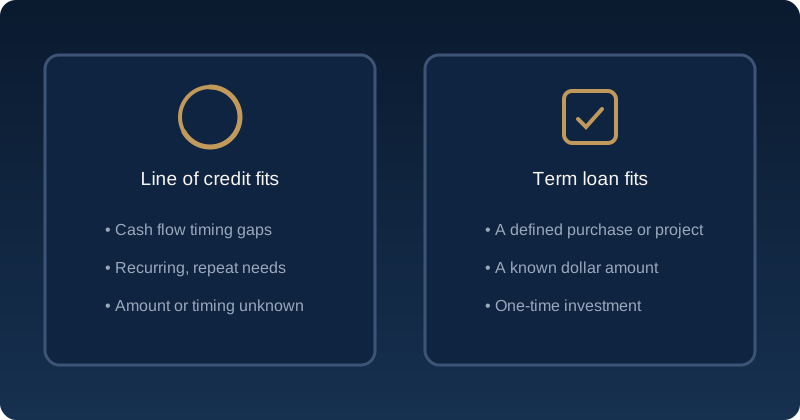
Buying equipment or vehicles. Funding a renovation or build-out. Acquiring another business. Purchasing a large, one-time inventory position. In each case the amount is known, the money deploys at once, and a predictable repayment schedule can be planned against the investment's expected return. (For equipment specifically, an asset-backed equipment loan is often the more natural structure.)
Where a line of credit tends to fit
Covering payroll while waiting on receivables. Smoothing seasonal revenue swings. Stocking inventory repeatedly through the year. Holding standby capacity for surprises and opportunities. In each case the need recurs or the timing is uncertain, and paying interest only when capital is actually in use is the efficient structure.
The trade-offs, honestly
Term loan — advantages
Predictable fixed payments. Often fixed rates. Typically suited to larger amounts and longer terms. A defined payoff date. Straightforward to budget around.
Term loan — disadvantages
Interest accrues on the full amount whether or not it's all deployed. Rigid payments regardless of revenue swings. Getting more capital later means a new application. Possible prepayment penalties.
Line of credit — advantages
Pay interest only on what you draw. Reusable without reapplying. Matches capital to need in real time. Valuable even unused, as standby capacity.
Line of credit — disadvantages
Often variable rates. Possible maintenance, draw, or inactivity fees. Limits can be reduced and terms changed at renewal. Revolving flexibility invites balance drift if usage isn't disciplined.
What lenders look for when you apply
Both products draw on the same familiar review: time in business, revenue and cash flow, industry, existing debt, business credit history, and — very commonly for small businesses — the owner's personal credit. The emphasis shifts by product. Because a line can revolve indefinitely, lenders lean hard on cash flow consistency: steady deposits demonstrate the business can service a balance whenever one exists. Term loan reviews often focus on the purpose of the funds and whether projected cash flow carries the fixed payment comfortably.
Two personal-credit notes worth knowing before applying. First, pre-qualification checks are often soft inquiries, while formal applications may involve hard inquiries — asking each lender which they use is routine. Second, since the owner's report so often enters the review, it pays to know what's on it first; How to Read Your Credit Report covers exactly that, and How to Prepare Your Business Before Applying for Funding in New Jersey walks the full preparation checklist on the business side.
A simple way to decide
Four questions sort most situations:
1. Is the need one-time or recurring?
One-time and defined points to a term loan. Recurring or ongoing points to a line of credit.
2. Do you know the exact amount?
A known figure suits a lump sum. An uncertain or variable figure suits a limit you draw against.
3. When will the capital produce a return?
Long-horizon investments pair with longer fixed schedules. Short cycles — buy inventory, sell it, collect — pair naturally with draw-and-repay revolving credit.
4. What does your cash flow tolerate?
Steady revenue can carry a fixed payment. Lumpy or seasonal revenue often fits better with a structure where the obligation shrinks when usage does.
Many established businesses eventually hold both — a term loan behind a specific investment and a line of credit for working capital. That's not indecision; it's matching each structure to the job it was built for. Just remember that every obligation counts against capacity for the next one when a lender reviews total existing debt.
Key takeaways
- Term loans deliver a lump sum on a fixed schedule; lines of credit revolve — draw, repay, draw again.
- Lines generally charge interest only on drawn amounts — but watch maintenance, draw, and inactivity fees.
- Neither is universally cheaper — cost depends on how your business will actually use the capital.
- One-time, defined needs point to term loans; recurring or uncertain needs point to lines of credit.
- Both commonly involve the owner's personal credit — know what lenders will see before they see it.
- Qualification always depends on lender review and eligibility — no structure guarantees approval.