
Published July 15, 2026 · Educational information — not legal, tax, lending, or financial advice.
Quick answer
An SBA loan is funding from a regular lender that carries a partial guarantee from the U.S. Small Business Administration, which lowers the lender’s risk and often means longer terms and competitive rates — in exchange for a more thorough application. There is no single credit score or fixed time-in-business rule set by the SBA; participating lenders apply their own standards, and most weigh personal credit, business financials, cash flow, collateral, and a clear use of funds. Personal guarantees from significant owners are typical. Nothing is guaranteed: eligibility and any approval depend on lender review and SBA eligibility. A practical first step is simply understanding your options — which is what a free Business Funding Snapshot is designed to help with.
What exactly is an SBA loan?
The name causes a common misunderstanding, so it’s worth clearing up first: in its main programs, the Small Business Administration does not hand out the money. It backs it. An SBA loan is made by a participating lender — usually a bank, credit union, or approved nonlender — and the SBA agrees to cover a portion of the lender’s loss if the borrower defaults. That partial guarantee is the whole point. It shifts some of the risk off the lender, and lenders respond by extending terms they might not otherwise offer.
In practice, that trade shows up as longer repayment periods and competitive rates compared with many conventional or alternative products — balanced against a more detailed application, more documentation, and an eligibility review that follows the SBA’s rules on top of the lender’s own. So an SBA loan tends to reward preparation and patience. It is often a strong fit for established businesses planning significant, non-urgent investments, and a poorer fit when money is needed next week. If you’re still mapping the wider landscape, our plain-English guide to what business funding is puts SBA loans in context alongside the other options.
The main SBA programs: 7(a), 504, and Microloan
“SBA loan” isn’t one product. It’s a set of programs built for different jobs, and choosing the right one matters as much as qualifying. Three cover most of what small businesses encounter.
The 7(a) program
This is the SBA’s flagship and its most flexible option. A 7(a) loan can be used for a broad range of purposes — working capital, equipment, inventory, refinancing certain existing debt, buying a business, and even commercial real estate. Because it’s so general-purpose, it’s where most first-time SBA borrowers start. Loan amounts run up to several million dollars, and terms are set partly by what the funds are used for, with longer terms available for real estate than for working capital.
The 504 program
The 504 program is purpose-built for major fixed assets — commercial real estate, land, and large, long-life equipment. Its structure is distinctive: financing is typically split between a conventional lender and a Certified Development Company (a nonprofit that works with the SBA), often with the business contributing a down payment. That design makes 504 well suited to owner-occupied property purchases and big equipment investments, but it’s not the tool for everyday working capital.
The Microloan program
Microloans are smaller loans — up to a modest cap — delivered through nonprofit, community-based intermediaries rather than large banks. They’re often more accessible to startups, newer businesses, and very small firms, and the intermediaries frequently pair funding with business guidance. Microloans commonly go toward working capital, inventory, supplies, and equipment. If your need is smaller and your business is young, the Microloan program is often the most realistic SBA starting point.
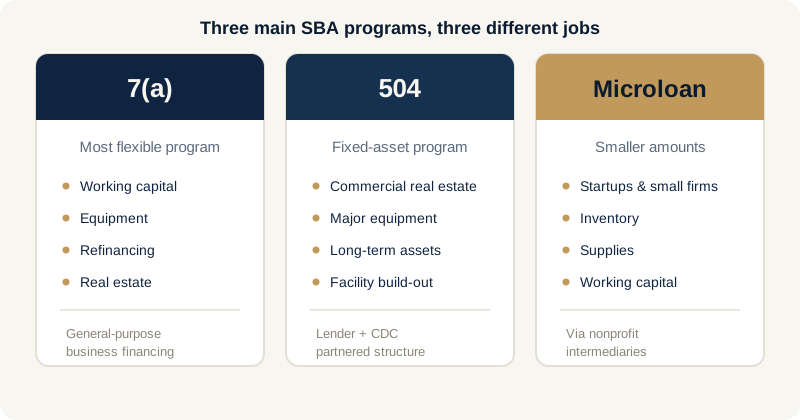
Program parameters — maximum amounts, allowable uses, and terms — are set by the SBA and can change, and each participating lender layers its own criteria on top. Treat the descriptions above as an orientation, not a rulebook, and confirm current specifics with a lender.
Credit score expectations
This is the question owners ask first, and the honest answer is that the SBA does not publish a single minimum score for its main programs. Instead, participating lenders set their own credit standards, so “the requirement” genuinely varies from one lender to the next. That said, patterns exist. Many lenders look for solid personal credit from the owners — often in the upper-600s or higher — because for smaller businesses the owner’s personal credit is a meaningful signal of how obligations get handled.
Two nuances matter. First, credit is one input among several, not a pass-fail gate: strong cash flow and collateral can offset a less-than-ideal score with some lenders, while thin financials can sink an application even when credit looks fine. Second, both personal and business credit can come into play. If you want to understand the personal side before a lender does, our guides to what counts as a good credit score and how to read your credit report are useful groundwork, and the deeper question of what credit score you need for business funding applies here too. Checking your own credit first is a soft inquiry that doesn’t affect your score.
Time in business
The SBA doesn’t impose a universal minimum operating history, and some programs are open to startups with strong plans and experienced owners. Lender preferences are a different matter. Because a track record gives underwriters real financials to evaluate, many lenders favor roughly two or more years in business for 7(a) and 504 requests. That isn’t a wall — younger businesses are considered — but they generally face closer scrutiny of projections, the business plan, and the owner’s relevant experience.
This is one place the Microloan program stands apart: its community-based intermediaries are often more comfortable working with newer businesses. If your business is early-stage, matching the program to your reality — rather than reaching for the largest 7(a) loan — is usually the more productive path.
Revenue and cash flow
If credit is the question owners ask first, cash flow is often the question that actually decides the outcome. The central thing a lender wants to answer is straightforward: can this business comfortably support the new payment on top of everything it already owes? To answer it, lenders study revenue and, more importantly, cash flow — how money actually moves through the business over time, not just the top-line number.
Two businesses with identical annual revenue can look very different in underwriting. Steady, predictable deposits read as lower risk than the same total arriving in unpredictable spikes, because consistent cash flow makes a fixed payment easier to sustain. Lenders typically review bank statements and financial statements together to see both the level and the steadiness. Existing debt matters here too: new payments stack on top of current obligations, and lenders look at how much room is left. Getting these numbers organized in advance is a core part of preparing your business before applying for funding.
Personal guarantees and collateral
Two features surprise first-time SBA applicants, so it’s better to know them going in. The first is the personal guarantee. The SBA generally requires a personal guarantee from anyone who owns a significant share of the business — commonly a 20 percent or greater stake. A personal guarantee is exactly what it sounds like: the owner personally promises to repay if the business can’t. It connects business obligations to personal assets, which is why it deserves careful reading rather than a quick signature — it’s the main place business and personal credit connect.
The second is collateral. Depending on the program and the loan size, a lender may ask for collateral to secure the loan — business assets, and sometimes personal assets such as real estate for larger requests. SBA rules don’t always require a loan to be fully collateralized to be approved, but available collateral is part of the picture, and its absence can matter more as the amount grows. Both the guarantee and any collateral terms come from the lender within the SBA’s framework, so read them closely and ask questions before committing.
The documentation you’ll need
SBA loans are paperwork-intensive by design — that thorough documentation is part of what earns the favorable terms. The exact list varies by lender and program, but a familiar core shows up almost everywhere. Assembling it early is one of the highest-leverage things an applicant can do.
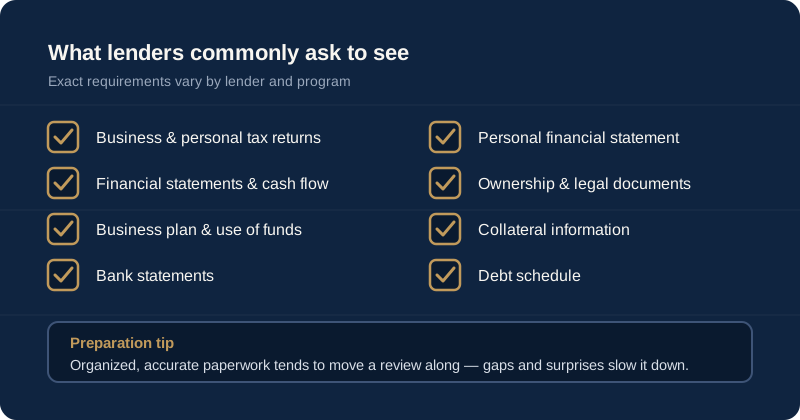
Commonly requested items include several years of business and personal tax returns; business financial statements and cash flow information; recent bank statements; a business plan with a clear, specific use of funds; a personal financial statement for each significant owner; ownership and legal documents such as formation paperwork, licenses, and relevant agreements; a business debt schedule listing current obligations; and details on any collateral being offered. Lenders may ask for more depending on the situation. The theme across all of it is consistency: numbers that agree across documents build confidence, while gaps and contradictions invite questions and delay.
Common reasons SBA loans are denied
Understanding why applications fall short is more useful than chasing a magic number, because most declines trace back to a handful of recurring issues — many of them addressable.
Cash flow that doesn’t support the payment
The most common sticking point. If the business’s cash flow looks too thin or too erratic to comfortably absorb the new payment, lenders hesitate regardless of how strong other pieces look.
Limited time in business or thin financials
Not enough operating history — or history that isn’t documented in clean financials — gives underwriters too little to evaluate, especially for larger 7(a) and 504 requests.
Credit concerns
Recent derogatory marks, high balances, or a limited credit history on the personal or business side can weigh against an application, particularly when other factors are already borderline.
Insufficient collateral for the size of the request
As loan amounts rise, the absence of available collateral can become a larger obstacle, even if it wouldn’t block a smaller request.
An unclear use of funds
Lenders want a specific, credible plan for the money and how it will help the business generate the cash to repay. A vague purpose reads as risk.
Incomplete documentation or eligibility issues
Missing paperwork stalls files, and some businesses run into SBA eligibility rules around business type, size, or ownership. A decline from one lender isn’t a verdict from all — criteria differ — but it’s a signal worth reading carefully.
How to improve your chances
None of the following guarantees an outcome — approval always depends on lender review and SBA eligibility — but each addresses a real factor lenders weigh, and together they make an application easier to say yes to.
- Know your numbers first — review your personal and business credit and your cash flow before a lender does.
- Organize documentation early so the numbers agree across tax returns, statements, and financials.
- Write a specific use of funds that connects the money to how the business will repay it.
- Match the program to your reality — Microloan for smaller or newer needs, 504 for major fixed assets, 7(a) for general purposes.
- Consider more than one lender — criteria differ, and a decline from one is not a verdict from all.
If your credit is the piece that needs the most work, that’s a solvable problem with time and information — and it’s worth reading whether you can pursue business funding with bad credit while you strengthen it. Preparation is rarely wasted: the same groundwork that helps an SBA application also clarifies whether a different structure, like a line of credit or a term loan, might fit your timeline better.
Where the Business Funding Snapshot fits
SBA loans are one path among several, and they’re not always the fastest or the best fit — which is exactly why it helps to see the wider set of options before committing to a single route. That’s the job of the free Business Funding Snapshot, available through our enrollment partner. You share basic details about your business, and the snapshot gives you an educational overview of the funding your business may qualify for — fast, with no obligation to continue. It’s designed for established businesses, and it is not an application or an approval: qualification and any funding offers depend on lender review and eligibility.
Free to start · No obligation · Subject to lender review and eligibility
Key takeaways
- An SBA loan is a lender’s loan with a partial government guarantee — longer terms and competitive rates in exchange for a thorough application.
- The 7(a), 504, and Microloan programs do different jobs — match the program to the amount and purpose.
- There’s no single SBA credit score or time-in-business rule — participating lenders set their own standards, and requirements vary.
- Cash flow, a personal guarantee from significant owners, and complete documentation are central to most SBA reviews.
- Most denials trace to cash flow, thin history, credit, collateral, an unclear use of funds, or incomplete paperwork — many are addressable.
- Nothing here guarantees approval — eligibility and any offer depend on lender review and SBA eligibility.