
Published July 7, 2026 · Educational information — not legal, tax, lending, or financial advice.
Part of the Home Buying & Credit Resource Center.
Quick answer
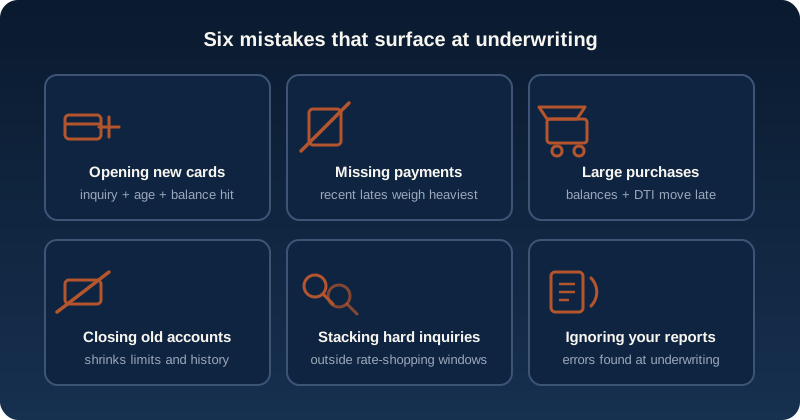
The credit mistakes that sink or complicate mortgage applications are rarely exotic — they’re ordinary financial moves made at the wrong time. The six that surface most at underwriting: opening new credit cards (one application lands three dents at once), missing payments (recent lates weigh far more than old ones), large financed purchases (balances and debt-to-income move late in the game), closing old accounts (tidiness that shrinks limits and history), stacking hard inquiries outside protected rate-shopping windows, and ignoring your reports until the lender reads them for you. The common thread: the file needs to be accurate early and motionless late. Every one of these is avoidable with runway and restraint — and the discipline holds through closing, since many lenders re-check credit before the keys change hands.
Mistake 1: Opening new credit cards
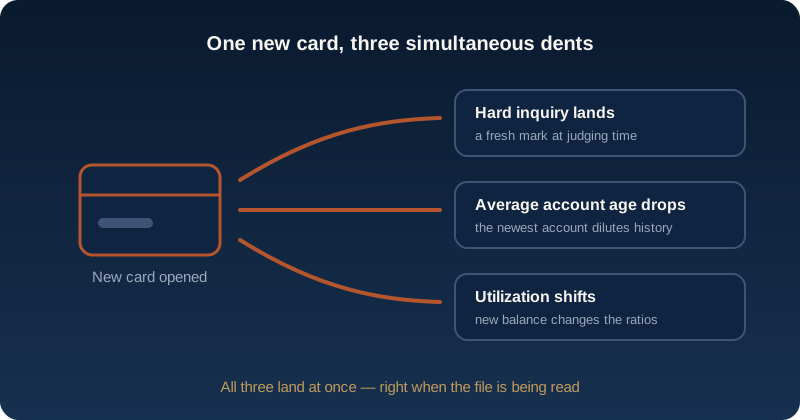
The store card at the register, the travel card with the signing bonus, the retail card offering 10% off the appliances — each is a routine decision in ordinary months and a self-inflicted wound in the mortgage window. One new account lands three effects simultaneously: a hard inquiry, a drop in average account age as the newest account dilutes your history, and a new balance shifting your utilization.
Any one alone is modest; all three at once, at exactly the moment your middle score is setting your rate tier, is the kind of small avoidable dent that can cost a pricing tier — and as covered in what credit score do you need to buy a house, the tier prices decades of payments. The rule is simple: in the final months, nothing new opens. The signing bonus will still exist after closing.
Mistake 2: Missing payments
Payment history is the heaviest factor in what makes up your credit score, and recency multiplies its weight: a 30-day late in the year before applying raises questions on an underwriter’s desk that a five-year-old late does not — and it stays on the report for years afterward, as laid out in how long late payments stay on your credit report.
The mortgage window is also when missed payments happen for the most mundane reasons: attention is consumed by house hunting, moving logistics scramble mail and due dates, and the account you rarely use is the one that slips. The fix costs nothing: autopay for at least the minimum on every account, set before the application window opens, and left running through closing. Perfect payment history in the final year isn’t a bonus — it’s the baseline the file is judged against.
Mistake 3: Large purchases
The furniture, the appliances, the car that “makes sense before the move” — large purchases hurt twice. On the credit side, financed purchases add balances that move utilization and may add accounts and inquiries. On the underwriting side, new monthly obligations change your debt-to-income ratio — often the tightest constraint in the file — and large cash outflows shrink the reserves lenders want to see after closing. Even purchases that feel unrelated to credit can matter: underwriters review bank statements, and unexplained large withdrawals generate documentation requests at best. The discipline is time-boxed, not permanent: the same purchase that complicates the file in the 90 days before closing is a non-event the week after. Furnish the house you own, not the one you’re applying for.
Mistake 4: Closing old accounts
The tidy-up instinct — “let me simplify before the big application” — works against you here. Closing a paid-off card reduces your total available credit, which raises utilization on every dollar you still carry elsewhere, and in time trims the account age your history is built on; the full mechanics are in can closing a credit card hurt your credit score. In the mortgage window, the better move is almost always the opposite: pay balances down, leave accounts open, and let the old cards do the quiet work of anchoring your available credit and history. If an annual fee makes a card genuinely not worth keeping, the closure will cost the same after closing — and the timing risk disappears.
Mistake 5: Stacking hard inquiries
Two facts that get conflated. First: shopping multiple mortgage lenders is generally protected — scoring models typically treat mortgage inquiries within a shopping window as a single event, so comparing rate offers doesn’t require inquiry anxiety, and comparing offers is one of the highest-value moves a borrower makes. Second: that protection covers same-type loan shopping, not everything else. A card application here, an auto loan there, a financing offer at checkout — each unrelated inquiry counts separately, and a cluster of them in the pre-application months reads as credit-seeking behavior at the worst possible time (the timing details live in how long hard inquiries stay on your credit report, and the soft-vs-hard distinction in soft inquiry vs. hard inquiry). Shop the mortgage freely; freeze everything else.
Mistake 6: Ignoring your credit reports
The quietest mistake on the list, and the one that turns fixable problems into emergencies. Errors, old collections showing wrong balances, accounts you don’t recognize — none of it announces itself, and mortgage lenders read all three bureaus’ files whether you did or not. An error discovered a year out is routine: a dispute, an investigation, a correction, done. The same error discovered at underwriting is a scramble with no runway, and a dispute still open during the process can itself complicate approval. The remedy is the reading habit — all three reports, line by line, starting about a year out — with continuous monitoring covering the months in between so nothing new lands unnoticed; the case for the watch is in why monitor your credit year-round.
Catching an error early is what gives you options later. If a genuine mistake surfaces once you are already in the loan, a lender may be able to request a rapid rescore to get the correction reported in days — but that only works when the change is documented, so the reading has to happen either way.
The window doesn’t close at application
The most overlooked fact in the whole sequence: approval isn’t the finish line. Many lenders re-verify credit shortly before closing, and some run final checks days before funding. Every rule above — nothing new opens, nothing big gets bought, nothing old gets closed, every payment on time — holds from application through the day the keys change hands.
Buyers who relax after the approval letter and finance the furniture in week three of a five-week escrow are the classic late casualty: the loan usually survives, but the re-verification triggers questions, conditions, and delays that a debit card and four weeks of patience would have avoided. Treat the whole escrow as the quiet period. The full countdown — what to do at 12, 6, and 3 months and 30 days out — is in preparing your credit before buying a home. And if one of these mistakes has already cost you an application, why mortgage applications get denied because of credit covers what the denial notice is telling you and what to fix before reapplying.
Two real-world examples
The protected shop and the unprotected stack. Nadia compares four mortgage lenders in three weeks — four hard pulls that scoring models treat as one shopping event. Her coworker Dev, applying the same season, adds a travel card in month one, financing for a mattress in month two, and an auto loan inquiry in month three. Nadia’s file shows a borrower comparing one loan; Dev’s shows a borrower accumulating credit — and only one of those reads well at the pricing desk.
The week-three furniture run. Sam gets his approval letter and celebrates by financing a living room set — new account, new inquiry, new balance — eighteen days before closing. The lender’s final credit check catches all three. The loan closes, but only after a week of documentation requests, a debt-to-income recalculation, and a conversation with his loan officer that begins with “what changed?” The identical purchase, made eighteen days later on the same couch, would have been nobody’s business but his.
Key takeaways
- One new card lands three dents at once — inquiry, account age, utilization — right when the file is being judged.
- Recent lates weigh far more than old ones — autopay for minimums is cheap insurance through the whole window.
- Large purchases hit credit and debt-to-income both — furnish the house you own, not the one you’re applying for.
- Keep old accounts open; shop the mortgage freely inside the rate-shopping window, and freeze all other applications.
- Read all three reports early and watch continuously — and hold every rule through closing, not just to application day.