
Published July 14, 2026 · Educational information — not legal, tax, lending, or financial advice.
Part of the Home Buying & Credit Resource Center.
Quick answer
A rapid rescore is a request your mortgage lender submits — you cannot start one yourself — asking the credit bureaus to update your file ahead of the normal monthly reporting cycle. It exists for one narrow situation: something on your report is out of date, you can prove it with creditor documentation, and a loan decision is waiting on it.
Here is the part that gets lost. A rapid rescore accelerates the truth; it does not change it. It cannot remove a late payment that genuinely happened or erase an accurate collection. Used at the right moment — when your middle score sits just under a pricing threshold and you have a documented change in hand — that speed can be worth a great deal. Used as a hoped-for rescue at the end of a strained file, it disappoints.
What a rapid rescore actually is
Start with the problem it solves. Credit reporting runs on a monthly rhythm: creditors update the bureaus roughly once a billing cycle, so the report a lender pulls today shows wherever your creditors last left you — not where you stand now. Usually that lag is harmless. During a mortgage application, it is expensive. You pay a card to zero on the 3rd, your lender pulls your file on the 5th, and the report still shows last statement’s balance. Nothing is wrong, exactly. The file is just stale.
A rapid rescore fixes that lag. Your loan officer collects proof from the creditor — a letter, an updated statement, a zero-balance confirmation — and submits it through the credit reporting reseller their shop uses. The bureaus refresh the data, and your scores are recalculated from the corrected file, typically in a few business days rather than a full cycle.
Two structural facts explain nearly every misconception here. First, only a lender can initiate it — the pipeline runs through mortgage industry resellers, and consumers have no direct access. Second, documentation is the entire engine. The bureaus take nobody’s word for anything; they update a record because a creditor confirmed a change. No proof, no rescore. That is what keeps this an accuracy tool rather than a loophole — and it means a rescore lives entirely inside an active loan file, between the credit pull and the moment your terms are set. If that sequence is unfamiliar, what happens during a mortgage credit check walks through it.
How it differs from credit repair
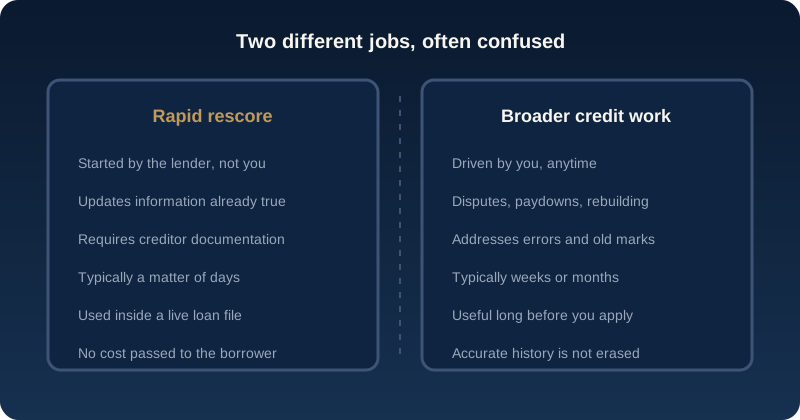
These two get confused constantly — usually at the worst moment, when someone is weeks from closing and hoping a rescore will make a real problem disappear. They are different jobs.
Broader credit work is something you drive, long before a lender is involved: reading all three reports, disputing genuine errors, paying balances down, building an unbroken run of on-time payments. It is patient work measured in months, it is the only thing that meaningfully reshapes a weak file — and it never requires a paid intermediary, as do you need a credit repair company lays out. If that is your situation, the honest path runs through rebuilding your credit after financial hardship and improving your credit before applying for a mortgage — not a rescore.
A rapid rescore is narrower: a lender-initiated administrative step inside a live application that moves one documented change into the bureaus’ systems faster than the calendar would have. It has no opinion about whether your credit is good. And what the two share is where most false hope lives: neither removes accurate negative information. A late payment that happened, happened. What can change is its status — a collection updated to show as paid, for instance.
When mortgage lenders use one
Loan officers do not reach for a rescore casually — it costs the lender money and staff time, so it appears when a clear payoff sits on the other side. That payoff takes one of three shapes.
Crossing a pricing tier. Mortgage rates are set in score bands, and the band you land in prices the loan for as long as you hold it. A borrower sitting a few points beneath a boundary is highly leveraged: one documented correction can reprice decades of payments. The mechanics are in how your credit score affects mortgage interest rates.
Clearing a program minimum. Programs and lenders apply different score floors, with overlays on top. A borrower just under the threshold has an eligibility problem rather than a pricing one, and a documented change that closes the gap can be the difference between a file that proceeds and one that stalls. Thresholds by program are covered in what credit score do you need to buy a house.
Correcting something that is simply wrong. A duplicate account. A card whose limit reports far below its real limit, inflating your credit utilization for no reason. An account belonging to someone with a similar name. Found mid-application, these cannot always wait for a routine dispute cycle — and reading your reports before you apply, the habit in how to read your credit report, is what surfaces them in time. All three cases share a shape: a specific gap, a documented fix, a decision waiting on the result. Remove any one and a rescore is not the answer.
What changes can qualify
The qualifying list is short, and every item shares one trait: it is already true, and a creditor will confirm it in writing.
A paid-down card balance is the most common rescore by a wide margin, because utilization has no memory — scoring responds to what is reported now, not what you owed last year. An incorrect credit limit is the quiet one: if a limit reports lower than it truly is, your utilization looks worse than it is on every calculation the model runs. An account that is not yours, or a duplicate, can be updated once the creditor confirms the error. A resolved dispute carries a wrinkle worth knowing: an active dispute flag can itself stall underwriting, since some programs will not proceed while an account is formally in dispute.
A paid or settled collection can be updated to its true status — but temper expectations. Whether paying helps depends on the scoring model the lender uses, and paying does not remove it. The nuances live in can you get a mortgage with a collection on your credit report and how long do collections stay on your credit report. Same for a charge-off: paying updates the balance and status, but the charge-off remains for its normal reporting period.
And the things that will never qualify, no matter who asks: accurate late payments, accurate collections and charge-offs, the age of your accounts, the hard inquiries you have accumulated, and any change you cannot document.

Realistic timelines and limitations
Ask a loan officer how long a rescore takes and you will hear “a few business days.” Fair enough for the rescore step — but it skips the part that sets your real timeline: getting the documentation. The bureaus can only update what a creditor confirms, and creditors move at their own pace. A large card issuer might produce a paid-in-full letter within a day; a collection agency with no incentive to hurry may take far longer. The rescore is fast. The paperwork in front of it is the bottleneck — and the part you control least.
Second: timing inside the loan. A rescore only has value if it lands before the terms are set — before the rate is locked, before final underwriting. An improvement arriving after those doors close is a nice fact about your credit and nothing more, which is why the conversation belongs early, while you are still discussing pre-approval. Pre-approval vs. pre-qualification sets out what happens when.
Third, and hardest to hear: the outcome is not guaranteed. A rescore updates data; the model recalculates from it, and the result depends on your whole file. Usually the movement runs in the expected direction; sometimes it is smaller than hoped. Your loan officer can offer an informed estimate — nobody can offer a promise. Bureaus also do not move in lockstep: an update may land at two and lag at the third, and since lenders qualify you on the middle score, a rescore reaching only one bureau may not move the number that matters — a divergence explored in why are my three credit scores different.
When it can help you reach better terms
Two illustrative situations — composites, not promises, and both dependent on the lender, program, and file.
A few points under a pricing boundary. A buyer’s middle score lands just beneath the threshold where their lender’s pricing improves. They are carrying a card near its limit, which they can pay down without touching their down payment or reserves. Because utilization is a current-state factor, that paydown could plausibly move the score — but the balance will not report for weeks, and the loan will not wait. Here a rescore does what it exists to do: deliver a change that is already true, in time to matter.
A distorted file. A second buyer discovers during underwriting that one card reports a $2,000 limit when the real limit is $10,000. Their utilization looked terrible on every calculation the lender ran, and it was never accurate. The issuer confirms the true limit, a rescore delivers it, and the math re-runs on real numbers. Both cases carry the lesson of this article: the borrower already deserved the better outcome. The rescore created nothing — it removed a delay. Which is why it helps most the people who reviewed their reports early enough to have something documentable in hand — the habit in preparing your credit before buying a home.
Common misconceptions
- “I can order one myself.” You cannot — it requires a lender to initiate. A service marketing rapid rescores directly to consumers is not describing this process.
- “It will clean up my report.” It will not. Accurate negative information stays for its normal reporting period. A rescore corrects errors and updates status; it does not rewrite history.
- “It guarantees my score goes up.” It does not. It updates the data; the model recalculates. The direction is usually expected, the magnitude is not, and no one can promise a number.
- “I should have to pay for it.” You should not. The cost belongs to the lender, and passing the fee for updating credit file information to the consumer is not permitted. Being asked to pay is a reason to ask questions.
- “It is a plan.” It is a contingency — no substitute for the months of preparation that build the file. Relying on one to rescue a weak application usually means applying too early.
Key takeaways
- A rapid rescore accelerates a credit change that is already true and documented — it never changes what is true.
- Only a mortgage lender can start one, and the cost should never reach you.
- Documentation is the engine — paid-down balances, corrected limits, accounts that were never yours. No proof, no rescore.
- Typically a few business days, but the creditor’s paperwork is the real bottleneck — and it must land before the rate is locked to be worth anything.
- It is a contingency, not a strategy. The buyers it helps most prepared early enough to have something documentable to fix.