
Published July 5, 2026 · Educational information — not legal, tax, lending, or financial advice.
Quick answer
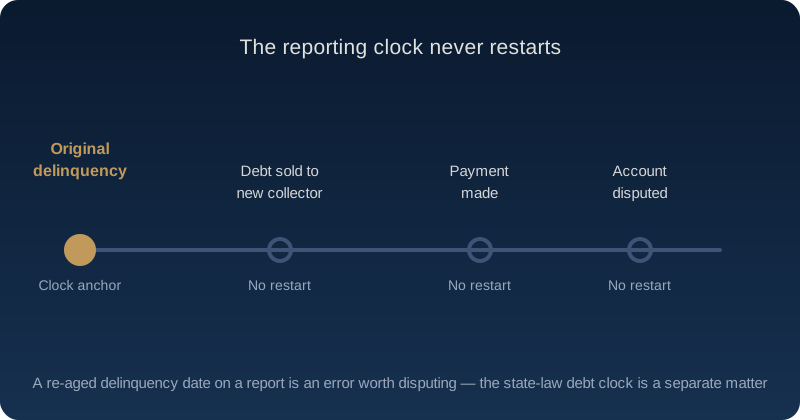
A collection account generally stays on your credit report for about seven years from the original delinquency on the underlying debt — in practice roughly seven and a half years, counting the missed-payment period before the account went to collections. The clock is anchored to that first delinquency and never restarts: not when the debt is sold to a new collector, not when you make a payment, not when you dispute it. Paying typically updates the entry to “paid” rather than removing it — with medical collections a notable, gentler exception. And the reporting clock is separate from your state’s statute of limitations on the debt itself, a distinction worth understanding before acting on old debt.
How did this end up in collections?
A collection is what happens after a debt goes seriously unpaid: the original creditor either assigns the account to a collection agency or sells it outright, and the collector may then report the account to the bureaus as its own tradeline. That means a single unpaid debt can produce two related entries on a report — the original account (often shown as charged off) and the collection — which is confusing but not necessarily duplicative, as they describe two stages of the same debt. The path there runs through the late-payment tiers first: 30, 60, 90, 120+ days, typically followed by charge-off and collection — the front half of that story is covered in how long do late payments stay on your credit report, and the handoff itself — plus your rights once a collector takes over — in what happens when a debt goes to collections.
When does the seven-year clock start?
Federal law generally limits how long a collection can be reported: about seven years, measured from the original delinquency — the first missed payment that started the chain, on the original account. Because accounts typically spend around 180 days delinquent before charge-off and collection, the practical window is often described as seven and a half years from that first miss. Note what the anchor is not: it isn’t the date the collector acquired the debt, opened its tradeline, or last contacted you. When the window closes, the entry ages off automatically — no request needed. Like late payments, a collection’s scoring influence also tends to fade well before it disappears, particularly as newer positive history accumulates around it — payment history being the heaviest of the factors mapped in what makes up your credit score.
Can anything restart the clock?
This is the fact that protects people from a common misunderstanding — and occasionally from a reporting error. The seven-year window does not reset when the debt is sold or transferred to a new collector (each new owner inherits the original delinquency date), when you make a payment, when you set up a payment plan, or when you dispute the entry.
If a collection on your report shows a delinquency date newer than the true first missed payment — a practice called re-aging — that’s an inaccuracy worth disputing with the bureau, because it illegitimately extends the entry’s life. Catching it requires knowing your own dates, which is one more argument for reading reports on a rhythm rather than waiting for a reason — the cadence is laid out in how often should you check your credit report.
What does paying actually change?
Honest expectations: paying a collection generally does not remove it. The entry updates to “paid” and continues aging off on its original schedule. That said, paid status isn’t worthless — some newer scoring models treat paid collections more favorably than unpaid ones (treatment varies by model, and not every lender uses the newer models), and underwriters reading a file manually often view a resolved debt differently from an open one — which is exactly why getting a mortgage with a collection so often comes down to the specifics. It is a reminder that the report behind the number is what gets read, as unpacked in credit report vs. credit score.
You also generally have the right to request validation from a collector — documentation that the debt is yours and the amount is right — before paying, which is a reasonable step given how often collection files contain errors. What deserves skepticism: anyone promising to delete accurate collections for a fee. Accurate entries generally can’t be removed early; inaccurate ones don’t require paying anyone to dispute. Whether paying is the right move at all — and when it matters most — is weighed in should you pay off a collection account.
Medical collections: gentler rules
Medical debt gets distinctly softer treatment under bureau policies as commonly implemented: paid medical collections are generally removed from reports entirely (unlike other paid collections, which merely update), medical collections under roughly $500 are generally not reported at all, and unpaid medical debt is subject to a waiting period before it can appear — time meant for insurance billing to resolve. Regulatory attention to medical debt reporting has been active in recent years, so specifics are worth verifying at the time you need them. The practical takeaway for anyone with a medical bill in dispute with an insurer: the system is built with more forgiveness here than most people assume, and paying a legitimate medical collection can actually clear it from the file.

Two clocks: reporting vs. the legal one
The seven-year reporting window is not the statute of limitations on the debt, and confusing them can be costly. The reporting clock governs how long the entry appears on your credit reports. The legal clock — which varies by state and debt type — governs how long a collector can successfully sue to collect. They run on different schedules: a debt can be legally time-barred while still visible on reports, or off the reports while still (in some states) legally collectible.
One more wrinkle: in some states, actions like making a partial payment or acknowledging the debt in writing can affect the legal clock — which is why understanding your state’s rules before engaging with a very old debt is genuinely important, and why questions about a specific old debt are worth taking to a consumer-law resource rather than settling by folklore.
Two real-world examples
The debt that changed hands twice. A card Talia stopped paying in March 2021 charged off, went to one collector in 2022, and was sold to another in 2024 — each appearing in her mail as if the story were starting over. On her report, though, the anchor never moved: the original delinquency is March 2021, so the entry ages off around 2028 regardless of who owns it. When the second collector’s tradeline appeared showing a 2024 delinquency date, she recognized it as re-aging, disputed it with the bureau, and the date was corrected to the original.
The $340 ER bill. Marcus gets a collection notice for an emergency-room balance his insurance was supposed to cover. Before paying anything, he requests validation and works the insurance angle — and learns the amount, under $500, generally wouldn’t appear on his reports at all under current bureau treatment of small medical debt. The insurer eventually pays most of it; he pays the remainder. Nothing ever reaches his file. The gentler medical rules did what they were designed to do: keep a billing tangle from becoming a seven-year entry.
Key takeaways
- Collections generally report for about seven years from the original delinquency — roughly 7½ years in practice.
- The clock never restarts — not for sales, payments, or disputes. A newer delinquency date is a dispute candidate.
- Paying updates the entry to “paid” rather than removing it — except medical, where paid collections are generally removed.
- Request validation before paying a collector, and know that accurate entries generally can’t be deleted for a fee.
- The reporting window and the state-law statute of limitations are separate clocks — understand both before acting on old debt.