
Published July 7, 2026 · Educational information — not legal, tax, lending, or financial advice.
Quick answer
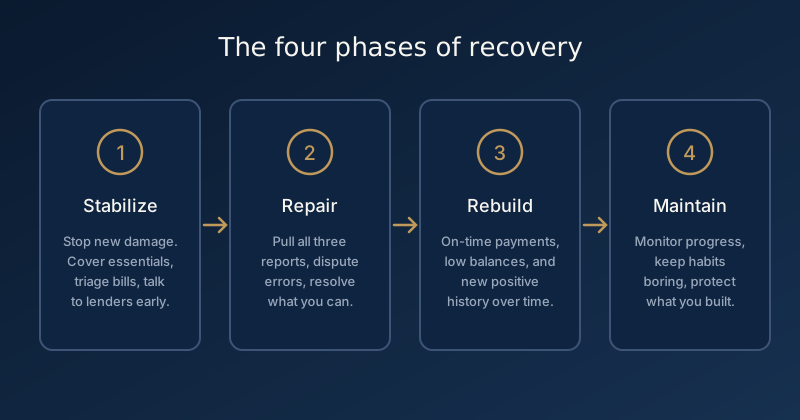
Credit rebuilds in phases, not overnight. First stabilize: cover essentials, protect accounts that are still current, and contact lenders about hardship options before more payments slip. Then repair the record: pull all three credit reports, dispute anything inaccurate, and decide deliberately what to do about legitimate unpaid debts. Then rebuild: stack up on-time payments, keep reported balances low, and add fresh positive history carefully — secured cards and credit-builder loans exist for exactly this, and becoming an authorized user on a well-managed account can add aged history alongside them. Negative entries fade in influence as they age and eventually fall off entirely, usually about seven years from the original delinquency. There’s no shortcut and no guaranteed timeline — but the direction of a credit file responds reliably to boring, consistent behavior.
What “rebuilding” actually means
A credit file after hardship usually has two separate problems, and it helps to name them separately. The first is the negative entries themselves — the late payments, collections, charge-offs, or public records now sitting on the report. The second is the absence of recent positive history — months or years where nothing on the file says “this person pays on time.” Rebuilding addresses both, but on different clocks. Accurate negatives can’t be forced off early; they fade in influence as they age and fall off on schedule. Fresh positive history, on the other hand, starts accumulating the first month a payment posts on time. Most of a recovery’s momentum comes from the second lever, which is entirely in your hands.
One reframe worth adopting early: scoring models are not moral judges keeping a grudge. They’re prediction machines that weigh recent behavior most heavily, because recent behavior predicts best. That design is exactly what makes recovery possible — the same math that punished the setback rewards the streak that follows it.
Phase 1: Stabilize the situation
Nothing about credit repair matters while the underlying finances are still bleeding — and when you do reach that stage, the honest toolkit is free: a goodwill letter for an accurate one-time lapse, and no paid company required for any of it (do you need a credit repair company explains why). Stabilizing means three things, roughly in order. First, cover essentials — housing, utilities, food, insurance, transportation — before any unsecured debt, because losing the foundation costs far more than any credit entry. Second, protect what’s still current: if some accounts have clean payment histories, keeping them clean is the highest-value move available, since each new late payment starts its own seven-year clock. Third, call lenders early, before payments slip rather than after. Hardship programs, deferrals, modified payment plans, and due-date changes exist at most major lenders, and the version of you who calls at 15 days behind gets meaningfully better options than the version who calls at 90.
If the hardship is ongoing — a job search still in progress, medical treatment still unfolding — stabilization may be the whole plan for a while. That’s not failure; it’s sequencing. A recovery started from a stable base holds. One started mid-freefall usually doesn’t.
Phase 2: Repair the record
Once the situation is stable, the work shifts to the reports themselves — and it starts with reading them, not reacting to them. Pull all three files (Equifax, Experian, and TransUnion report independently, and they frequently differ) and inventory every negative entry: what it is, who reports it, the balance shown, and above all the date of first delinquency, since that date — not the charge-off date, not the sale to a collector — anchors the roughly seven-year reporting window.
Then separate the inaccurate from the accurate, because they get handled completely differently. Errors after a hardship are common: balances that didn’t update, accounts showing open that were closed, the same debt reported by two collectors, delinquency dates that mysteriously moved newer. Every inaccuracy is disputable at no cost, and the process is more straightforward than most people expect — the mechanics, documentation, and timelines are walked through in how to dispute an error on your credit report. Accurate negatives are a different conversation: they generally cannot be removed early, whatever anyone charging a fee may promise, but they can be resolved — paid, settled, or brought current — which stops balances from growing, ends collection pressure, and changes how future lenders read the file.
The setbacks, one by one
Every hardship leaves a different fingerprint on a credit file, and knowing what yours actually did is half the plan.
Late payments
The most common damage and often the most recoverable. Lates report in tiers — 30, 60, 90, 120+ days — with each tier read as more serious, and each entry aging off about seven years from the miss. A single 30-day late on an otherwise clean file stings early and fades relatively fast; a string of 90s takes longer to outweigh. The full aging schedule and what bringing an account current does (and doesn’t do) is covered in how long do late payments stay on your credit report.
Collections
A collection entry means a debt moved to a collector — and it carries its own rules worth knowing before engaging: the reporting clock runs from the original delinquency and never restarts when a debt is sold, paying updates the status without removing the entry, and newer scoring models treat paid collections more favorably than unpaid ones. Medical collections follow gentler rules still. The details live in how long do collections stay on your credit report, and whether to pay one down as part of the rebuild is weighed in should you pay off a collection account.
Charge-offs
A charge-off sounds terminal and isn’t — it’s the original lender’s accounting write-off of a seriously delinquent account, and the debt remains owed, collectible, and (within state time limits) suable. For rebuilding purposes the key facts are that the entry ages from the original delinquency, that paying updates it to “paid charge-off” without erasing it, and that resolving it stops the balance from climbing. The full anatomy is in what is a charge-off.
Medical debt
Medical debt gets more forgiving treatment than almost any other category: paid medical collections are generally excluded from reports entirely, unpaid ones typically get a waiting period before reporting, and smaller balances are often excluded altogether under current bureau practices. If medical bills drove the hardship, verify what’s actually reporting before assuming the worst — and check every medical entry against your records and insurance explanation of benefits, because billing errors in this category are notoriously common.
Bankruptcy
The heaviest single entry a report can carry — generally reporting up to ten years for Chapter 7 and seven for Chapter 13 — and also, counterintuitively, sometimes the start of the cleanest rebuild. A discharge stops collections and zeroes out the included debts, which means the file stops taking new damage. From there the pattern is the same as any other recovery, just on a longer arc: secured products early, flawless payment behavior, low balances, patience. Many lenders have explicit post-bankruptcy seasoning periods; those are waiting games, not verdicts. The chapter-by-chapter clocks, the post-discharge verification step, and the full first-year sequence are mapped in rebuilding your credit after bankruptcy.
Divorce
Divorce damages credit indirectly but persistently, because divorce decrees don’t bind creditors — a joint account stays a joint obligation to the lender no matter which spouse the decree assigned it to, and an ex’s missed payment on a joint account lands on both reports. The rebuilding-specific work: inventory every joint account and authorized-user relationship, separate or close what can be separated (knowingly — see the mistakes section), and watch all three reports closely for surprises during and after the process, a scenario where year-round monitoring earns its keep.
Job loss and income shocks
Unemployment itself never appears on a credit report — only its downstream effects do: the climbing balances, the missed payments, the accounts that slipped while income was gone. That’s actually good news for the rebuild, because it means the recovery is purely mechanical. Once income returns, the sequence is triage (protect what’s current), then utilization (work the accumulated balances back down — the mechanics are in what is credit utilization), then time. Balances are the fastest lever in all of credit scoring: utilization has no memory, so a balance paid down is reflected as soon as the new figure reports.
Phase 3: Rebuild with fresh history
With the situation stable and the record accurate, the rebuild proper begins — and it runs on one fuel: new on-time payment history. Every tool in the rebuilding toolbox is just a different delivery mechanism for that same ingredient.
Secured credit cards are the standard on-ramp. You place a refundable deposit that becomes the credit limit, the card reports to the bureaus like any other, and months of on-time payments accumulate exactly as they would on an unsecured card. Look for one with no annual fee that reports to all three bureaus, and treat it like a debit card — small recurring charge, paid in full, every month. The full selection-and-usage guide — deposits, the low-limit utilization trap, and graduation — is in secured credit cards for rebuilding credit.
Credit-builder loans invert the normal loan: the lender holds the borrowed amount in an account while you make the payments, and you receive the funds at the end. The point isn’t the money — it’s the twelve or twenty-four on-time installment payments now sitting on your reports, plus a savings cushion at the finish line.
Rent reporting puts a payment you’re already making to work. Rent doesn’t touch your file by default, but a landlord platform, reporting service, or bureau tool can furnish it as verified payment history — recent positives without new debt, which is precisely what a rebuild needs. The three paths, costs, and limitations are compared in can rent payments help you build credit.
Authorized-user status on a well-managed account belonging to a spouse, parent, or trusted family member can import that account’s history onto your file. It helps most on thin files, it depends entirely on the primary user’s behavior, and it should never involve paying a stranger for “tradeline” access — a practice lenders actively screen for.
Rent and utility reporting services can add payments you’re already making to some credit files and scoring models. Coverage is uneven across bureaus and models, so treat it as a supplement, not a strategy.
Whatever the tools, the discipline is the same: add one at a time, keep reported balances low relative to limits, and automate at least the minimum on everything. A rebuild dies faster from one new 30-day late than it grows from any product you can open.

How long will this take?
The honest answer to “how long?” is: it depends on what happened, what the rest of your file looks like, and what you do next. A rough shape: reported balances update within a cycle or two of being paid down, making utilization the fastest-moving lever. Isolated recent negatives lose their sting over months as clean history stacks on top. Serious or repeated negatives — charge-offs, collections, bankruptcy — influence a file for years, but with steadily declining weight, and everything ages off eventually. Anyone quoting you an exact score by an exact date is guessing or selling. The full breakdown of what sets the pace — and the misconceptions that distort expectations — is in how long does it take to rebuild your credit.
The habits that carry it
Recoveries are won by routine, and the routine is short. Automate at least the minimum payment on every open account, because the single most damaging event in a rebuild is a fresh late. Keep reported balances low — not just paid on time, but low relative to limits when the statement cuts.
Leave older accounts open where fees don’t make that foolish, since account age and available credit both help quietly. Add new credit sparingly and deliberately. And review all three reports on a schedule rather than in moments of panic — progress you can see is progress you’ll sustain, and errors caught early are errors that never compound. Whether a paid monitoring service earns its fee in your situation is a fair question with an honest answer that depends on your circumstances — it’s examined squarely in is credit monitoring worth paying for.
Mistakes that stall recoveries
Closing everything in a purge. Shutting cards feels like discipline but shrinks available credit (raising utilization) and eventually trims account age. Close accounts for real reasons — fees, temptation — not symbolism.
Paying old debts before protecting current ones. When money is tight, a dollar keeping a current account current usually does more for the file than a dollar sent to a years-old collection. Triage in order.
Disputing everything indiscriminately. Blanket disputes of accurate information don’t remove it and can get filings flagged as frivolous. Dispute what’s wrong, resolve what’s right.
Paying for promises. No one can lawfully remove accurate negative information early or guarantee a score increase. Anyone claiming otherwise is charging for the passage of time.
Applying for a burst of new credit. A cluster of applications adds inquiries and new accounts at exactly the moment the file needs stability. One rebuilding product, managed well, beats four opened at once.
Quitting the habits after the first good news. The same behavior that rebuilt the file maintains it. The finish line is a habit, not a number.
Key takeaways
- Rebuild in phases: stabilize the finances, repair the record, then stack fresh on-time history.
- Accurate negatives can’t be forced off early — but their influence fades long before they age off.
- Errors are common after hardship and disputable for free — read all three reports before acting on any of them.
- Utilization is the fastest lever; payment history is the biggest one. Protect current accounts first.
- No specific score or timeline can be promised — consistency is the only lever fully in your control.