
Published July 21, 2026 · Educational information — not legal, tax, lending, or financial advice.
Quick answer
A goodwill letter asks a creditor to remove an accurately reported late payment as a courtesy — not as a right. That distinction shapes everything about it. Because the information is true, the creditor owes you nothing, some decline every request as policy, and no letter can guarantee removal. But the ask costs nothing, and the requests that succeed share a recognizable profile: a longtime customer, one isolated lapse with an understandable one-time cause, and an account paid on time ever since. Keep the letter to a page — name the account and the specific payment, take responsibility plainly, point to the clean record around the lapse, and make one clear ask. Send it to the creditor, not the bureaus. If the answer is no, nothing is lost: the entry ages off on its own schedule, and its weight tends to fade as newer on-time history stacks up on top of it.
What a goodwill letter is — and isn’t
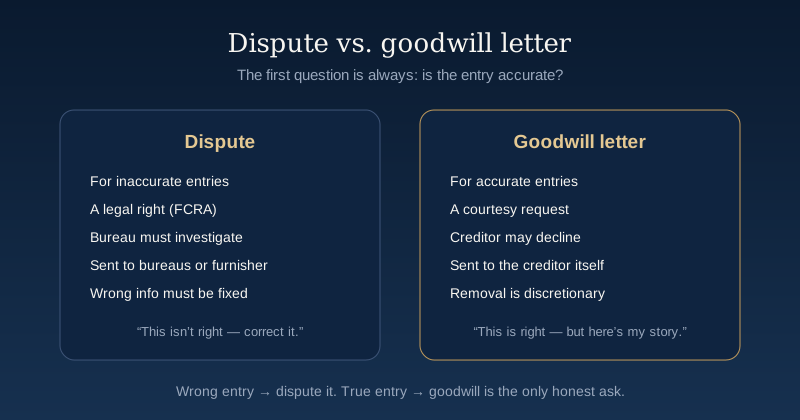
A goodwill letter is a short written request asking a creditor to stop reporting a negative item that is, uncomfortably, true — most often a single late payment on an otherwise well-kept account. It is not a dispute, not a negotiation, and not a legal claim. The Fair Credit Reporting Act protects your right to an accurate file; it doesn’t entitle you to a flattering one, which is why accurate negatives generally stay for their full reporting window, as laid out in how long do late payments stay on your credit report. What a goodwill letter does is step outside the rules entirely and make a human case: this lapse was not who I am as a customer, here’s the record that proves it, and I’m asking you to let it go. Creditors can honor that request — furnishers control what they report — and some occasionally do. Others decline every goodwill request as standing policy. Both outcomes are legitimate, which is the honest frame for everything that follows. The Consumer Financial Protection Bureau’s credit reporting resources cover what creditors must do; goodwill lives entirely in the space of what they may do.
Goodwill vs. dispute: accuracy decides
One question sorts every unwanted entry into the right lane: is it accurate? If the late payment is wrong — you paid on time, the amount is off, the account isn’t yours — you don’t ask for a favor; you exercise a right. That’s the dispute process, the bureau must investigate, and the full playbook is in how to dispute an error on your credit report. If the entry is accurate, the dispute tool is the wrong one — filing disputes against information you know is true wastes the mechanism and can undermine your credibility with the furnisher you’re about to ask for a favor. Goodwill is the only honest ask for a true entry. Run the accuracy check first, every time: pull your reports, confirm the month, the amount, and the account, and only then decide which letter you’re writing.
When goodwill requests tend to work
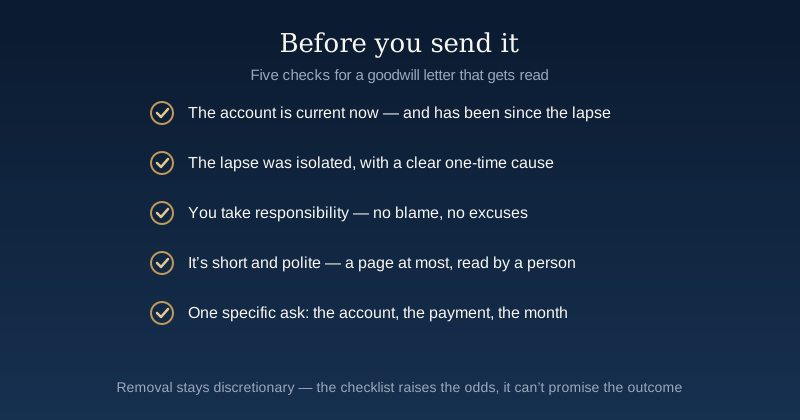
Nobody outside a creditor’s policy team can tell you the odds — but the requests that succeed share a profile, and it’s worth checking yours against it before you write a word. The relationship is long: years as a customer carry more weight than months. The lapse is isolated: one late payment surrounded by on-time months reads as an accident; a pattern reads as a pattern. The cause is a one-time event: a hospitalization, a move where mail went astray, an autopay that broke when a bank changed — something that plainly happened once and got fixed. The account has been current ever since: nothing supports the claim “this isn’t who I am” like a clean record after the slip. If your situation fits that profile, a goodwill letter is a reasonable, no-cost ask. If it doesn’t — multiple lates, an account still behind, a cause that’s ongoing — the letter is unlikely to land, and the better use of the same energy is the broader sequence in how to rebuild your credit after financial hardship: stabilize first, then build the positive record that eventually outweighs the negatives.
What belongs in the letter
One page. A person — not an algorithm — will skim it, and the letters that get read are the ones that respect that person’s time. Open with who you are: name, account number, contact information, and how long you’ve been a customer. Name the exact item: the payment reported late for March 2025 on account ending 4417 — vagueness makes the request impossible to act on. Explain the cause in two or three sentences, honestly: what happened, why it was a one-time event, and what changed so it won’t recur. Take responsibility without hedging — “the payment was late, and that’s on me” outperforms every excuse ever drafted. Point to the record: on-time before, on-time since. Then make one specific ask — that the creditor remove the late notation from the account’s reporting as a gesture of goodwill — and thank them. Two things to avoid: form-letter templates, which goodwill reviewers have seen by the thousand and tend to discount on sight, and invented hardships, which are dishonest and, when detected, convert a maybe into a permanent no.
Where to send it — and how to follow up
Send the letter to the creditor — the furnisher that reported the payment — never to the credit bureaus. The bureaus’ job is to reflect what furnishers report; they have no authority to delete accurate information on request, so a goodwill letter addressed to a bureau accomplishes nothing. Use the correspondence address on your statement or the creditor’s secure message center, and keep a copy of what you sent and when. Then expect quiet: many creditors respond in a few weeks, some with a form decline, some not at all. One polite follow-up is reasonable — a second letter, or a phone call asking whether goodwill adjustments have a review path — because a first response is sometimes just the front-line script. Repeated identical letters, escalating tone, or weekly calls are not: they convert a courtesy request into a nuisance file. If the entry is removed, expect it to update on your reports within a reporting cycle or two — and verify on all three bureaus, since furnishers occasionally update one and miss another.
If the answer is no
A declined goodwill request costs you nothing and changes nothing — which is precisely the consolation. The late payment was already on its clock: it ages off on schedule, generally about seven years from the delinquency, and its practical weight tends to fade well before that as newer on-time months accumulate on top of it. So the plan after a no is the plan that was always underneath: keep the account current, keep balances low, and let the record you’re building now do the arguing. If the setback was bigger than one late payment, the full triage sequence in what should you do first after your credit takes a hit sorts the order of operations, and if collections entered the picture, should you pay off a collection account walks the separate decision that deserves its own care. One thing a no should never trigger: paying someone who claims they can force the removal. Nobody can — accurate information stays unless the furnisher chooses otherwise, and that choice was exactly what your letter asked for.
Key takeaways
- A goodwill letter is a courtesy request to remove an accurate late payment — the creditor may say yes, may say no, and owes you neither.
- Accuracy decides the tool: wrong entries get disputed as a legal right; true entries get goodwill or time — nothing else.
- The winning profile: longtime customer, one isolated lapse, a one-time cause, and on-time payments ever since.
- One page, one specific ask, full responsibility, no templates, no invented hardships — sent to the creditor, never the bureaus.
- A no costs nothing: the entry ages off on schedule, its weight fades as new on-time history stacks up — and nobody can force a removal for a fee.