
Published July 7, 2026 · Educational information — not legal, tax, lending, or financial advice.
Quick answer
First, diagnose: pull all three credit reports and identify exactly what caused the hit — a late payment, a collection, a balance spike, a closed account, an error, or unfamiliar activity that suggests fraud. Second, correct: dispute anything inaccurate (free, and typically investigated within about 30 days — no paid service required, as do you need a credit repair company explains). Third, protect: triage payments so essentials and still-current accounts stay covered, and contact lenders early if payments are at risk. Fourth, reduce: work reported balances down, since utilization is the fastest-recovering factor. Fifth, monitor: watch all three files so you catch changes early and can see the recovery trend. The order matters — most recovery mistakes come from acting before diagnosing.
Before anything: don’t react to the number
A score is a symptom, not a diagnosis. The same 60-point drop can mean a reported late payment, a new collection, a maxed-out card, a closed account that shrank your available credit, a bureau error — or someone else opening accounts in your name. Those situations call for completely different responses, several are fully reversible, and one is urgent for reasons that have nothing to do with scoring. Which is why the first move is never “apply for something,” “pay something,” or “dispute everything.” It’s read the file.
Step 1: Pull all three reports
Get your full reports from Equifax, Experian, and TransUnion — all three, because they’re maintained independently, lenders don’t uniformly report to each, and the problem may exist on one file and not the others. Federal law entitles you to free reports through AnnualCreditReport.com, and the bureaus currently make them available weekly. You’re reading for four things on each: account statuses (anything marked late, delinquent, or in collection), balances and limits (what utilization the file currently shows), inquiries and new accounts (anything you don’t recognize), and personal information (addresses and names that aren’t yours). If reading a full report feels like decoding, the field guide is how to read your credit report.
Step 2: Identify exactly what happened
Now match the score drop to its cause, and be precise, because the response depends on it. A newly reported late payment means the priority is stopping the slide — each deeper tier reports as more serious — and if it was one accurate slip on an otherwise clean account, a courtesy ask is possible: how to write a goodwill letter covers when and how. A collection or charge-off appearing means an older delinquency escalated; understanding what that entry actually is — and what’s still owed — comes before deciding what to do about it (what is a charge-off covers the most misread version, and what happens when a debt goes to collections covers the collector handoff and your rights). A balance spike with no negative entries is the best-case diagnosis: purely utilization, fully recoverable. An account closure can drop available credit and raise utilization without you spending a dollar more. And anything you don’t recognize — accounts, inquiries, addresses — moves you off this checklist and onto the identity-theft one, where speed genuinely matters.
Step 3: Dispute what’s inaccurate
Anything wrong on the file — a payment marked late that was on time, a balance that didn’t update, an account that isn’t yours, a delinquency date that moved — is disputable with each bureau reporting it, free, no company required. Bureaus generally must investigate within about 30 days and remove or correct what can’t be verified. Be surgical: dispute the specific inaccuracy with documentation, not the entire report on principle — blanket disputes of accurate information don’t work and can get filings flagged as frivolous. The full process — what to write, what to attach, what happens after — is walked through step by step in how to dispute an error on your credit report.
Step 4: Triage and protect payments
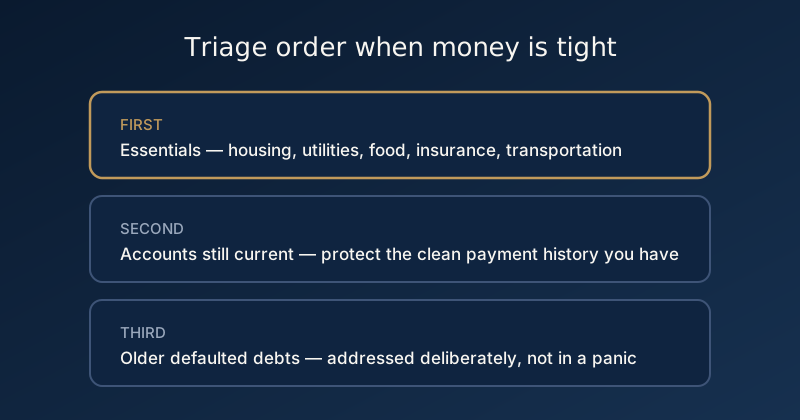
If the hit came with genuine financial strain, sequence the money deliberately. Essentials first — housing, utilities, food, insurance, transportation — because the foundation costs more to lose than any credit entry. Still-current accounts second: every account with a clean history is an asset, each new late starts its own seven-year clock, and a dollar keeping a current account current generally does more for the file than a dollar sent to an old collection. Older defaulted debts third, addressed with a plan rather than panic — amounts, ages, and your state’s statute of limitations all matter there. And throughout: if a payment is about to slip, call the lender before it does. Hardship programs, deferrals, and due-date changes are far more available at day 10 than day 90.
Step 5: Work balances down
Utilization — reported balances relative to limits — is the fastest-recovering factor in credit scoring, because most models recalculate it from whatever the file shows now, with no memory of last month. That makes balance paydown the highest-leverage mechanical move after a hit: as lower figures report, typically within a statement cycle or two, that portion of the damage reverses. Two tactical notes: the balance that matters is usually the one on your statement, so paying before the statement cuts can lower what gets reported; and spreading paydown to get every card under its next threshold often beats zeroing one card while others sit high. The full mechanics live in what is credit utilization.
Step 6: Monitor the recovery
The first response ends by setting up the feedback loop. You want to know, on a schedule rather than by surprise: did every account report on time this month, where do balances sit, did the disputed items get corrected, and did anything new appear. Checking your own credit is a soft inquiry and never hurts your score — check as often as you like. Whether you do that manually with free weekly reports or through a paid service watching all three bureaus continuously is a real cost-benefit question, and an honest look at when paying makes sense (and when it doesn’t) is in is credit monitoring worth paying for.
What comes after the first response
Everything above is triage — the first weeks. What follows is the actual rebuild: resolving or riding out the legitimate negatives, stacking fresh on-time history, keeping balances low, and letting time do the part only time can do. That longer arc — including how recovery differs after collections, bankruptcy, divorce, and job loss, and the tools built for rebuilding — is the subject of the pillar guide, how to rebuild your credit after financial hardship (with the bankruptcy-specific path in rebuilding your credit after bankruptcy). And for calibrating expectations about the road ahead, how long does it take to rebuild your credit covers what moves fast, what moves slowly, and why.
Key takeaways
- Diagnose before reacting: the same score drop can have causes needing opposite responses.
- Pull all three reports — the problem may only be visible on one of them.
- Dispute inaccuracies surgically and for free; resolve accurate items deliberately.
- Triage payments: essentials, then still-current accounts, then old defaults — in that order.
- Balances are the fastest lever; monitoring is how you see the recovery actually happening.