
Published July 20, 2026 · Educational information — not legal, tax, lending, or financial advice.
Quick answer
A credit-builder loan flips the usual order: the borrowed amount — commonly a few hundred to around a thousand dollars — goes into a locked account, you make fixed monthly payments over a set term (often 6–24 months), and the lender reports each payment to the credit bureaus. When the term ends, the money is released to you. Because you never touch the funds mid-loan, the lender’s risk is minimal — which is why approval is realistic even with a damaged or empty file, often with no credit check at all. What you’re actually buying is the stream of reported on-time installment payments, which builds the heaviest scoring input (payment history) and rounds out a file that may only have revolving accounts. The one real risk: a missed payment on a credit-builder loan reports like a missed payment on anything else. Automate it, size it small, and it’s one of the safest rebuilding tools there is.
The loan in reverse: how it actually works
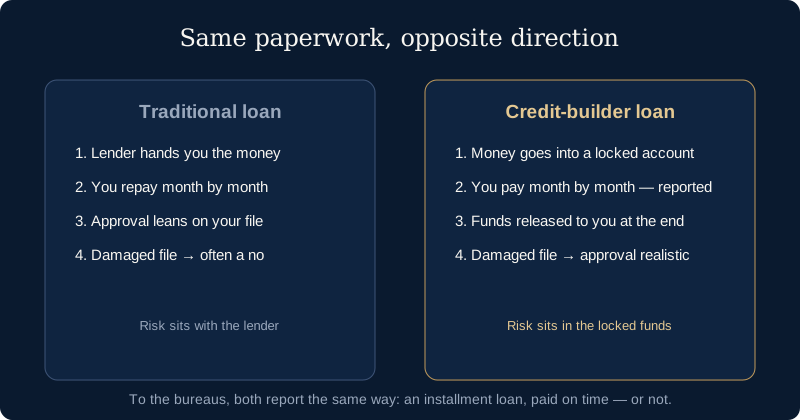
A traditional loan hands you money and trusts you to pay it back. A credit-builder loan holds the money hostage — politely — until you’ve already proven you can. When you’re approved, the lender deposits the loan amount into a locked savings account or certificate of deposit in your name. You then make fixed monthly payments, principal plus interest, for the length of the term. Each month, the lender reports your payment to the credit bureaus, exactly as it would on any installment loan. When the final payment clears, the locked funds are released to you — your own forced savings, returned with a completed loan on your file. You never touch the money mid-loan, and that’s the entire trick: since the lender is barely at risk, it can say yes to files that would sink a normal application. The stream of reported on-time months is the product — and payment history is the single heaviest factor in what makes up your credit score. The Consumer Financial Protection Bureau studied the product directly; its research report on credit-builder loans found they were most effective for people without existing debt.
Credit-builder vs. traditional loan
To the credit bureaus, there’s no difference at all — both report as an installment loan, with a balance, a payment, and a monthly verdict of on-time or late. The difference is who can get one. A traditional personal loan leans on the strength of your credit file, which is precisely what a damaged file can’t provide yet; a credit-builder loan leans on the locked funds instead, so many lenders skip the credit check entirely and just verify identity and income. One more distinction worth naming: a credit-builder loan is not a way to borrow money you need now. If you need cash today, this is the wrong product — the money arrives at the end, not the beginning. It’s a rebuilding instrument disguised as a loan, closer to a reported savings plan than to borrowing.
Where to get one
Credit-builder loans live in the quieter corners of lending. Credit unions are the classic source — many offer them as a member service with low fees, though you’ll typically need to join first. Community banks and Community Development Financial Institutions (CDFIs) serve the same role, particularly in underserved areas. And a newer generation of online fintech lenders offers app-based versions with fast signup. Whatever the source, the selection checklist is short and non-negotiable: confirm the lender reports to all three credit bureaus (a loan reported to one bureau builds one file and leaves two thin — and you can’t control which one a future lender pulls); read the fee schedule in full; and confirm what happens if you need to exit early — reputable lenders will close the loan and return what’s accumulated, minus what’s owed.
What it costs
You’re paying for the reporting, and the price should be modest. Expect interest on the loan amount — and note the quiet math in your favor: because the “borrowed” funds are sitting in an interest-bearing locked account at many lenders, part of what you pay comes back with the release, and some lenders explicitly refund a portion of interest for on-time completion. Some charge a small setup or administrative fee. What you’re watching for is the fee-heavy version of the product: monthly “membership” charges, large upfront fees, or padded interest that turns a rebuilding tool into an expense with a savings account attached. Compare total cost over the full term — a well-chosen credit-builder loan typically costs tens of dollars, not hundreds, for its year of reported history.
What it does for your credit
Three things, in descending order of weight. First and biggest: payment history. Every on-time month is a positive entry on all three reports, and payment history is the heaviest input in every major scoring model. Second: credit mix. Scoring models give modest credit for handling different account types well, and a file that’s all credit cards — or all-empty — gains its first installment account. Third, a structural point: unlike a credit card, a credit-builder loan has no utilization ratio to manage. There’s no balance-to-limit math, no statement-timing games — just a fixed payment and a monthly verdict. That makes it the lowest-cognitive-load tool in the rebuilding kit. What it can’t do is outrun the rest of your file: no specific score change is guaranteed, and fresh negatives elsewhere will keep dragging while the loan quietly builds. For where this tool fits in the full arc — after collections, hardship, or bankruptcy — the sequence is mapped in how to rebuild your credit after financial hardship, with realistic pacing in how long does it take to rebuild your credit.
Using it right
The winning pattern has two rules. Size it small: choose a monthly payment you could make in your worst realistic month, not your best — $25 to $50 payments are common, and a small loan reports exactly the same on-time month as a large one. The bureaus grade consistency, not size. Automate it: set the payment on autopay from an account that always has the money, then leave it alone. The rebuild is won by the streak, and streaks die to forgetfulness far more often than to hardship. Do those two things and the loan runs itself: twelve or twenty-four months later you get your money back, and your file gets a completed installment loan with a perfect record.
The one real risk
Here’s the sharp edge, and it deserves its own section: a credit-builder loan can hurt the exact thing it exists to build. If a payment goes 30 or more days past due, the lender can report it late — and a fresh late payment is precisely the negative entry you took the loan out to recover from, with the long reporting tail described in how long do late payments stay on your credit report. This is why the sizing rule above isn’t optional advice; it’s the design. And if money genuinely tightens mid-loan, act before a payment slips: contact the lender, explain, and ask about closing the loan early. Because your own funds are sitting locked, most reputable lenders can unwind the loan and return the accumulated balance minus what’s owed — a far better outcome than a reported late payment. A credit-builder loan should never be the bill that breaks the budget; if it might be, it’s the wrong month to start one.
Companions: the rebuild pair
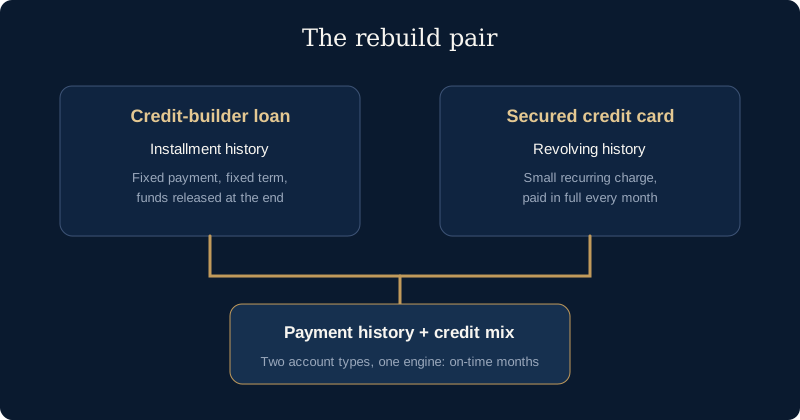
A credit-builder loan covers the installment side of a file; a secured credit card covers the revolving side, and together they’re the standard rebuild pair — two account types, two streams of on-time history, and the credit-mix bonus for handling both. A third path adds history without adding a payment at all: becoming an authorized user on a well-managed account owned by someone you trust, which can layer aged, clean history onto a thin file — the mechanics, the risks in both directions, and how to choose the right account are covered in becoming an authorized user to rebuild credit. And in some cases certain recurring payments can be reported through opt-in services, with rent the biggest of them — see can rent payments help you build credit. Add tools one at a time; the goal is a set of payments you never think about, not a portfolio you have to manage.
Key takeaways
- The funds sit locked until the end — you’re buying reported installment history, not borrowing cash you can use now.
- Approval is realistic even with a damaged or empty file — many lenders skip the credit check entirely.
- Selection checklist: reports to all three bureaus, modest total cost, clear early-exit terms.
- Size it small and automate it — the streak matters, the amount doesn’t.
- The one real risk is a missed payment reporting late — if money tightens, contact the lender before a payment slips.