
Published July 7, 2026 · Educational information — not legal, tax, lending, or financial advice.
Part of the Home Buying & Credit Resource Center.
Quick answer
Your credit score doesn’t just decide whether you get a mortgage — it decides what the mortgage costs. Lenders generally price in score tiers under a system called risk-based pricing: each tier receives a different rate offer, and higher tiers pay less. Because a mortgage runs for decades, even a fraction of a percentage point moves the monthly payment noticeably and moves total interest paid dramatically — often by tens of thousands of dollars over the life of the loan. Lenders typically qualify and price on the middle of your three bureau scores, so all three files matter. The highest-leverage position in the process is sitting a few points below a tier boundary: paid-down balances or a corrected error can cross it, and crossing it reprices decades.
How lenders price your rate (in plain English)
A mortgage rate isn’t a reward or a punishment — it’s a price, and the thing being priced is risk. Lenders lend the same dollars to every borrower; what differs is the statistical likelihood, based on the file in front of them, that those dollars come back on schedule. Files that have historically defaulted more often cost more to lend to, so they’re charged more.
That’s risk-based pricing, and your credit score is its shorthand: a three-digit summary of how your file compares to the patterns lenders have seen before. The practical upshot is more hopeful than it sounds — because the rate is a price attached to the file, changing the file changes the price. The score isn’t a verdict on you; it’s a snapshot of paper, and paper can be improved. (What goes into the number is broken down in what makes up your credit score.)
How score tiers work
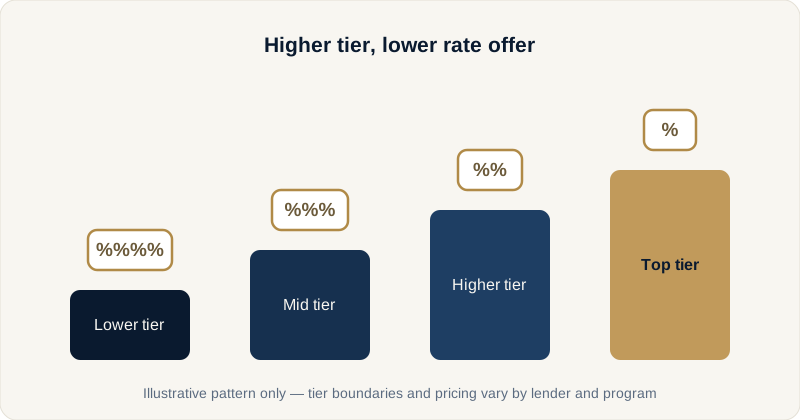
Lenders don’t price every individual score differently — they price in tiers, bands of scores that share the same offer. Move anywhere within your tier and the pricing typically doesn’t change; cross a tier boundary and it does. This has two consequences worth internalizing. First, “my score went up 15 points” may or may not matter for your rate — it matters if those points crossed a boundary.
Second, the question that actually prices your loan isn’t “is my score good?” but “which tier am I in, and how far is the next one?” Tier boundaries vary by lender and program and shift with market conditions, which is why the same score can draw different offers from different desks — and why comparing lenders is part of the answer, not a detour. (The extreme case is the VA program, where there’s no program score floor at all and every number belongs to the lender — see VA loan credit requirements explained.) The program-level floors that get you in the door are covered in what credit score do you need to buy a house; this article is about what happens to the price after the door opens.
Why small rate differences become big money
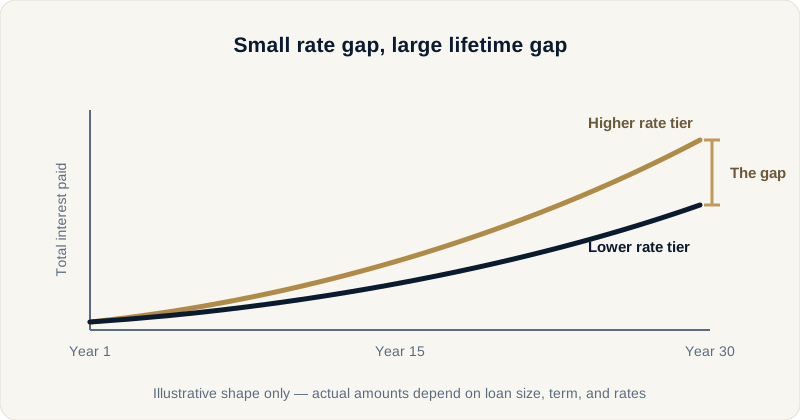
On a small, short loan, a fraction of a percentage point is pocket change. On a mortgage, it isn’t — because the balance is large and the clock runs for 15 to 30 years, and interest compounds against both. A rate difference that looks trivial on paper changes the monthly payment enough to notice and changes total interest paid over the life of the loan enough to matter — commonly a five-figure difference on a typical loan, and more as loan size grows.
This is the single most underappreciated fact in home-buying credit: the gap between “approved” and “approved in a better tier” is often worth more than the down payment assistance, closing-cost credits, and rate promotions that get far more attention. It’s also why the months before applying are so valuable — they’re the only window where the tier is still negotiable.
The middle score sets your price
Mortgage lenders typically pull your reports and scores from all three bureaus and have commonly qualified and priced borrowers on the middle of the three — with co-borrowers, often the lower of the two middle scores. Three things follow. First, all three of your files matter: the middle score is defined by all of them, so an error dragging down one bureau’s file can drag your qualifying score — and your rate — with it (the fix is in how to dispute an error on your credit report).
Second, the number in your banking app may not match the number on the underwriter’s screen, because mortgage lending can use different scoring model versions than consumer apps display — a normal gap, not an error, unpacked in why are my three credit scores different. Third, checking your own files along the way costs nothing: self-checks are soft inquiries, invisible to lenders and ignored by scoring models.
The levers that move your tier
If you’re near a boundary, the levers rank roughly by speed. Utilization is the fast one: card balances relative to limits are re-read every reporting cycle, so paying balances down and letting the lower numbers report can move a score within a month or two — the mechanics are in what is credit utilization. Corrected errors are nearly as fast: disputes are typically investigated in about 30 days, and removing an inaccurate derogatory can jump a file across a boundary in one move.
Not adding damage is free: no new applications, no new accounts, no big financed purchases, no closed cards in the final months — the full list of self-inflicted wounds is in common credit mistakes before applying for a mortgage. Time is the slow lever: inquiries aging out, late payments fading, history lengthening. The 12-month sequencing of all four is laid out in preparing your credit before buying a home.
And if you are already inside a live application when a lever finally moves — a balance paid down, an error corrected — the change may not reach your report before your rate is locked. That is the narrow situation a rapid rescore exists for: a lender-initiated request to get a documented change to the bureaus quickly enough to matter.
Rate shopping without hurting the file
Borrowers routinely leave money on the table by accepting the first offer, often out of fear that more applications mean more score damage. The fear is mostly misplaced: scoring models generally treat multiple mortgage inquiries within a rate-shopping window as a single event, specifically so borrowers can compare offers. The window varies by model, but the practical guidance is simple — do your shopping in a short, focused burst rather than scattering applications across months. The mechanics of how inquiries are counted are in soft inquiry vs. hard inquiry. Since tier boundaries and pricing differ from lender to lender, the same file genuinely draws different prices at different desks — comparing them is one of the few moves in this process with upside and essentially no cost.
Two real-world examples
The boundary crosser. Dana’s middle score sits just under a pricing tier boundary, and her cards are reporting balances near half their limits. She pays them down hard for two statement cycles before applying. The lower balances report, her middle score crosses the boundary, and her rate offer improves — a monthly difference that, multiplied across a 30-year term, exceeds what she spent paying the balances down.
The one-bureau error. Marcus’s files at two bureaus are clean, but the third carries a collection that isn’t his — and because lenders price on the middle score, that one file is setting his price. He disputes it with documentation; the bureau removes it after investigation. His middle score is now his second-best file instead of his worst, his tier improves, and the loan gets cheaper — all from correcting paper that was wrong to begin with.
Key takeaways
- Rates are risk-based pricing: the score is the lender’s shorthand for the file’s risk, and changing the file changes the price.
- Pricing moves at tier boundaries, not point by point — the question is which tier you’re in and how far the next one is.
- A fraction of a percentage point compounds across decades — commonly a five-figure difference in total interest on a typical loan.
- Lenders typically price on the middle of your three bureau scores — one bureau’s error can set your price, so all three files deserve a read.
- Utilization and corrected errors are the fast tier levers; rate-shopping in a short window compares prices without stacking score damage.