
Published July 7, 2026 · Educational information — not legal, tax, lending, or financial advice.
Part of the Home Buying & Credit Resource Center.
Quick answer
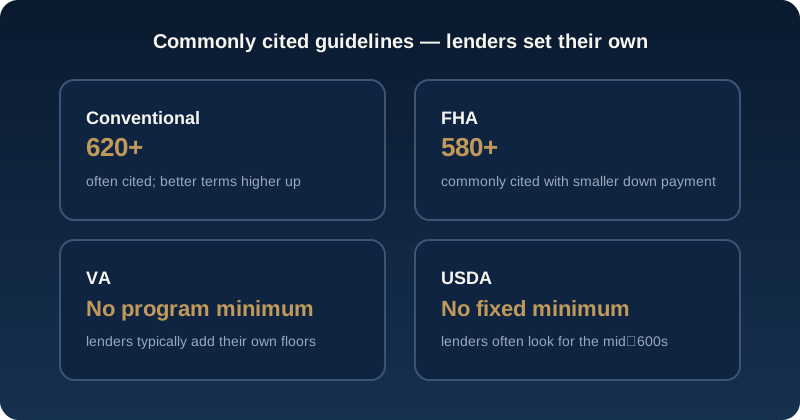
There is no single required score — the honest answer is a range that depends on the loan program and the lender. Commonly cited guidelines: conventional loans often look for 620 or higher; FHA commonly cites 580 with a smaller down payment; VA sets no program-wide minimum, though lenders typically add their own floors; and USDA has no fixed program minimum, with lenders often looking for the mid-600s.
Two caveats carry the real weight: individual lenders layer their own stricter standards (“overlays”) on top of program guidelines, and clearing a minimum only gets you in the door — your score tier then shapes the rate you’re offered, and over a multi-decade loan, that tier is often worth more than the approval itself. Score is also just one factor among several: income, debts, down payment, and the full contents of your reports all get read.
Why there’s no single number
Mortgage credit standards are set at two levels, and both move. The program level — conventional guidelines and the government-backed FHA, VA, and USDA programs — publishes baseline expectations. The lender level then adds overlays: individual lenders can require more than the program does, and many do, tightening or loosening with market conditions. That’s why one lender declines a file another approves, and why any article promising “the number” is oversimplifying. What the guidelines below offer is orientation — where the commonly cited floors sit — not a promise about any specific lender’s desk. (For where scores in general fall on the quality spectrum, see what is a good credit score.)
The four main programs at a glance
Conventional — loans not backed by a government agency, typically following Fannie Mae and Freddie Mac guidelines. A 620 minimum is the commonly cited floor, but conventional pricing is strongly tiered: the loan gets meaningfully cheaper as scores climb, so 620 and 760 are both “approved” and live in very different loans. FHA — insured by the Federal Housing Administration and built for flexibility: 580 is the commonly cited threshold with a smaller down payment, and some lenders work below that with more money down, though overlays frequently raise the practical floor.
FHA loans carry mortgage insurance costs that are part of the real comparison — the program’s floors, overlays, and waiting periods get a full walkthrough in FHA loan credit requirements explained. VA — for eligible veterans, service members, and certain surviving spouses: the program itself sets no minimum score, but the lenders issuing VA loans typically apply their own, often in the low-to-mid 600s (the benchmarks, the 12-month rule, and residual income are unpacked in VA loan credit requirements explained). USDA — for eligible rural and some suburban areas with income limits: no fixed program minimum, with lenders often looking for the mid-600s for streamlined processing. Across all four, the pattern repeats: program guideline, lender overlay, and your file’s whole story deciding where you land.
Score is one factor, not the decision
Underwriting reads a whole file, and the score is its summary line, not its contents. Alongside it, lenders typically weigh your debt-to-income ratio — monthly obligations against monthly income, often the make-or-break number for how much house you can finance; income stability — employment history and the reliability of what you earn; down payment and reserves — both the money in and the money left after closing; and the reports themselves — recent late payments, collections, and the story behind any derogatory marks, which underwriters read directly rather than taking the score’s word for it (what they’re reading is mapped in how to read your credit report).
The practical consequence cuts both ways: a strong score can’t rescue a debt-to-income ratio that doesn’t work, and a modest score with clean recent history, solid income, and real reserves is a very approvable file. The score opens the conversation; the file finishes it. When a file doesn’t finish it, the lender has to say why — the reasons they most often cite are unpacked in why mortgage applications get denied because of credit.
Tiers, rates, and what they do to the payment
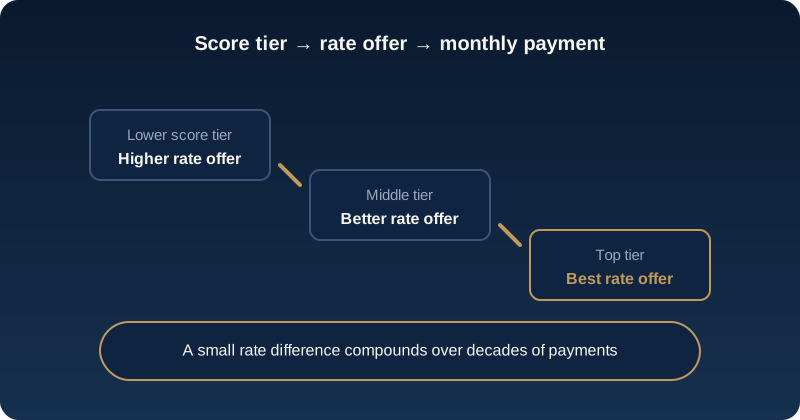
Here’s where score matters most — and where “I cleared the minimum” costs money. Lenders generally price in score tiers, with each step up earning a better rate offer. On a loan measured in hundreds of thousands of dollars and repaid over decades, even a fraction of a percentage point changes the monthly payment noticeably and changes the total interest paid dramatically — often by tens of thousands of dollars over the loan’s life.
This is why the smart question isn’t “what score do I need to qualify?” but “what tier am I in, and how far is the next one?” A borrower sitting a few points below a tier boundary has one of the highest-leverage positions in personal finance: modest file improvements — utilization paid down, an error corrected — can reprice decades of payments. The factors that move scores are laid out in what makes up your credit score, and the full tier-pricing mechanics are unpacked in how your credit score affects mortgage interest rates.
Which score do lenders actually use?
The number in your banking app and the number on an underwriter’s screen are often different — and both are real. Mortgage lenders typically pull reports and scores from all three bureaus, and have commonly qualified borrowers on the middle of the three (with co-borrowers, often the lower of the two middle scores).
The scoring models used in mortgage lending can also differ from the versions consumer apps display, so a gap between what you see and what they see is normal, not an error — the reasons are unpacked in why are my three credit scores different. The practical takeaways: all three of your files matter, because the middle score depends on all of them; an error dragging down one bureau’s file can drag your qualifying score with it; and self-checks along the way are soft inquiries that cost nothing.
Improve first or apply now?
If your score sits near a tier boundary, a few months of preparation can be worth decades of cheaper payments; if you’re comfortably inside a tier, waiting buys less. The variables worth weighing: how far you are from the next tier, whether the gap is closable with fast levers (paid-down balances, a corrected error) or slow ones (aging inquiries, building history), and what rates and home prices are doing while you wait — a better tier in a worse market isn’t automatically a win.
This is a genuinely case-by-case call, and a loan officer can tell you precisely where your middle score sits relative to their pricing tiers. Whichever way you decide, the full preparation sequence — what to do at 12, 6, and 3 months and 30 days out — is in preparing your credit before buying a home.
There is also a middle path worth knowing about. If you are close to a threshold and have a documented change that has not yet reached your report — a paid-down balance, a corrected limit — your lender may be able to request a rapid rescore, which updates the file in days rather than weeks. It cannot manufacture a score you have not earned, but it can stop a stale report from pricing your loan.
Two real-world examples
The tier hunt. Alicia’s middle score is a handful of points below a pricing tier boundary, and her card balances are reporting high relative to limits. She pays them down two months before applying and lets the lower balances report. Her middle score crosses the boundary, her rate offer improves, and the monthly savings — multiplied across a 30-year term — dwarf the interest she “lost” by waiting eight weeks.
The file that beat its number. Rob’s score is modest — an old rough patch still ages on his reports — but his last three years are spotless, his income is stable, his debt-to-income is low, and he’s saved a solid down payment with reserves left over. An FHA lender approves the file the score alone might not suggest, because underwriting read the whole story: old trouble, new pattern, strong fundamentals.
Key takeaways
- No single number: commonly cited floors are 620 (conventional) and 580 (FHA), with VA and USDA setting no fixed program minimums — and lender overlays sit on top of all of them.
- Score is one factor: debt-to-income, income stability, down payment, reserves, and the reports themselves all get read.
- The tier prices the loan: clearing a minimum gets approval; the tier sets the rate, and the rate compounds for decades.
- Lenders typically qualify on the middle of your three bureau scores — so all three files matter, and one bureau’s error can set your price.
- Near a tier boundary, months of preparation can reprice decades — the countdown plan is in the home-buying prep article.