
Published July 18, 2026 · Educational information — not legal, tax, lending, or financial advice.
Part of the Home Buying & Credit Resource Center.
Quick answer
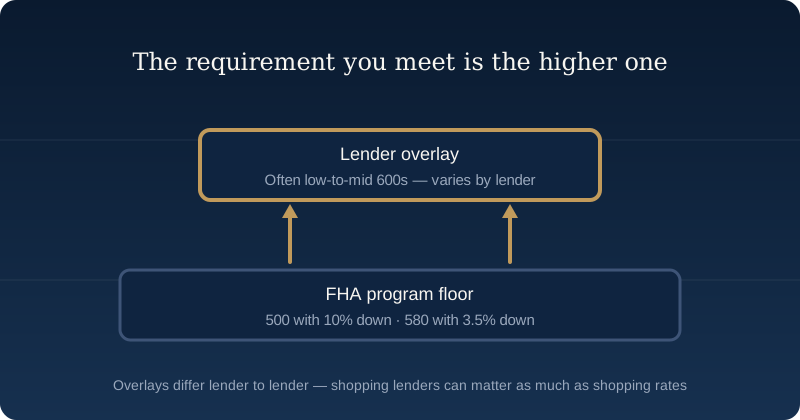
FHA credit requirements work at two levels. The program’s floor: a 580 minimum score qualifies you for the signature 3.5% down payment, and scores of 500–579 can still qualify with at least 10% down. The lender’s floor: most lenders add “overlays” — their own minimums, often in the low-to-mid 600s — on top of the program rules. The requirement you actually have to meet is whichever one is higher, and since overlays vary lender to lender, one lender’s no is not the program’s no.
Beyond the score, FHA underwriting reads your file with unusual patience: recent on-time payment history matters more than old scars, collections often don’t have to be paid off, waiting periods after bankruptcy or foreclosure are shorter than most programs’, and thin files can sometimes qualify through nontraditional credit. This article walks through each piece — and what to do with the months before you apply.
What an FHA loan is — and why credit rules differ
An FHA loan is a mortgage issued by a regular lender — a bank, credit union, or mortgage company — and insured by the Federal Housing Administration, an agency within the U.S. Department of Housing and Urban Development (HUD). That insurance is the whole reason the credit rules are different: because the government absorbs part of the risk if a loan defaults, lenders can say yes to files that conventional guidelines would price harshly or decline — lower scores, smaller down payments, rougher histories.
The insurance isn’t free. FHA borrowers pay an upfront mortgage insurance premium and an annual premium built into the monthly payment, and for most borrowers with the minimum down payment, that annual premium runs for the life of the loan unless they later refinance out of it. That trade — friendlier credit treatment in exchange for insurance cost — is the honest frame for everything below. FHA isn’t automatically the “bad credit loan”; it’s a program whose credit flexibility you pay for, which is worth it for some files and not others (the CFPB’s FHA overview is a good neutral reference).
Where FHA fits among the score ranges of the other major programs — conventional, VA, USDA — is mapped in what credit score do you need to buy a house. This article goes deep on the FHA column.
The score floors: 580 and 500
The program itself draws two lines. At a middle credit score of 580 or above, you’re eligible for FHA’s signature feature: a down payment as low as 3.5%. At 500–579, the program still allows a loan — but the required down payment rises to at least 10%. Below 500, the program itself says no.
Two details make those numbers less simple than they look. First, “your score” here means the score your lender pulls — typically the middle of your three bureau scores, which is why an error dragging down a single bureau’s file can quietly set your price (and why your three scores differ in the first place). Second — and more important in practice — very few lenders actually lend down to the program floor. That gap between what FHA allows and what lenders offer is the overlay problem, and it deserves its own section.
Lender overlays: the requirement above the requirement
An overlay is a requirement a lender adds on top of the program’s rules to manage its own risk. The most common FHA overlay is a higher minimum credit score — many lenders set their internal FHA floor somewhere in the low-to-mid 600s regardless of what the program permits — but overlays can also tighten debt-to-income limits, collection treatment, and documentation standards. Overlays are legal, common, and lender-specific, and they explain a confusion that trips up many buyers: how someone can be “FHA eligible” on paper and still hear no.
The practical consequence is one of the most useful things a lower-score buyer can know: one lender’s decline is not the program’s decline. Because each lender draws its own line, the same file can be declined at one shop and approved at another — so if your score sits between the program floor and a typical overlay, it can be worth asking several lenders directly, “What is your minimum FHA score?” before submitting anywhere. Just pace the actual applications thoughtfully: shopping conversations cost nothing, while formal applications add hard inquiries, and mortgage inquiries made within a focused shopping window are typically treated as one event by scoring models.
If applications have already come back declined, the pattern of reasons lenders cite — and which ones improve fastest — is walked through in why mortgage applications get denied because of credit.
What underwriters read beyond the score
The score gets you in the door; the underwriter then reads the file behind it, and FHA underwriting reads with a distinctive emphasis: recency over history. A file whose last 12–24 months show clean, on-time payments reads well under FHA even when older years are rough — that’s much of what the program’s “flexibility” actually means in practice. The reverse also holds: recent late payments, especially any late mortgage or rent payments in the last year, are heavy marks that flexibility doesn’t erase.
Alongside payment history, the underwriter weighs your debt-to-income ratio — where FHA is again comparatively forgiving, often allowing higher ratios than conventional guidelines when the rest of the file supports it — plus your down payment funds, employment stability, and reserves. And for buyers with thin or no traditional credit, FHA permits something many programs don’t: manual underwriting with nontraditional credit, where documented histories of rent, utilities, phone, and insurance payments can stand in for a traditional file. Not every lender offers it, and the documentation bar is real — but under FHA, a thin file is a challenge, not a verdict.
The full anatomy of what happens when a mortgage lender pulls and reads your reports — tri-merge pulls, the middle score, conditions — is covered in what happens during a mortgage credit check.
Collections, charge-offs, and disputes
Here’s a place where FHA’s reputation for flexibility is genuinely earned: the program generally does not require every collection account to be paid before closing. Underwriters look at the size, age, and type of what’s on the report. Small and old collections may simply be excluded from consideration; larger non-medical balances can trigger a capacity review or a documented payment arrangement; medical collections are commonly treated more leniently than other types. The details flex with the file and with lender overlays — but “I have a collection” and “I can’t get an FHA loan” are very different sentences (the general landscape, program by program, is in can you get a mortgage with a collection on your credit report).
Two cautions belong next to that good news. First, whether to pay a collection before applying is a genuine strategy question — sometimes it helps the file, sometimes the money serves you better as reserves — and it deserves the full walk-through in should you pay off a collection account plus a loan officer’s read on your specific numbers. Second, active disputes can complicate FHA underwriting: accounts in dispute may be temporarily excluded from the score the lender sees, and underwriters may require disputes to be resolved before closing. That’s not a reason to leave real errors uncorrected — it’s a reason to run the dispute process early, months before you apply, so nothing is mid-flight when the file goes to underwriting.
Waiting periods after bankruptcy or foreclosure
Major credit events don’t disqualify you from FHA forever — they start a clock. The typical seasoning guidelines: about two years after a Chapter 7 bankruptcy discharge; about one year into a Chapter 13 repayment plan, with on-time plan payments and court permission; and about three years after a foreclosure. Documented extenuating circumstances — a serious illness, a death in the household, events genuinely beyond your control — can shorten some of these timelines, while lender overlays can stretch them. These are meaningfully shorter waits than conventional guidelines typically impose, which is one of the main reasons buyers rebuilding from a major event often route through FHA.
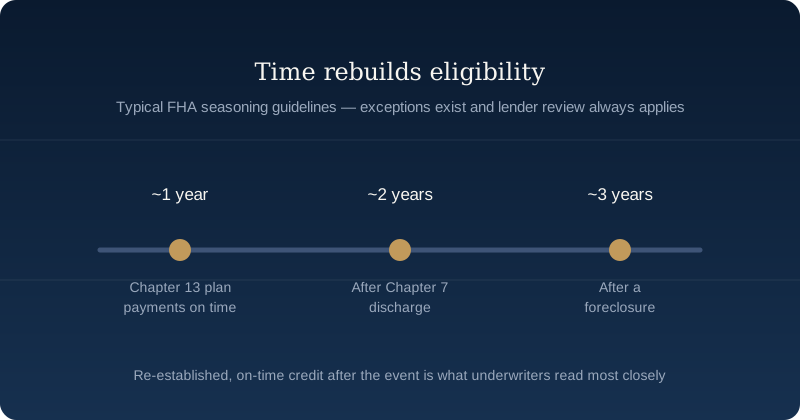
The clock alone isn’t the qualification, though — what underwriters study is the credit you’ve rebuilt since the event. Two years of silence after a discharge reads very differently from two years of a secured card, a small installment account, and a spotless payment record. If you’re inside one of these windows now, the waiting period is the rebuilding period; how to rebuild your credit after financial hardship maps that work.
Preparing an FHA-ready file
The preparation playbook for FHA is the standard mortgage playbook with the FHA specifics layered in. Start with the reports — all three, since the middle score qualifies you and one bureau’s error can set your price (how to read your credit report decodes the layout). Dispute genuine errors immediately so nothing is unresolved at underwriting time. Protect the recent payment record above everything — autopay minimums on every account — because recency is what FHA underwriting rewards most. Pay card balances down where you can: utilization is the fastest score lever, and lower balances help your DTI at the same time.
Then have the FHA-specific conversations early: ask lenders where their FHA overlays sit, how they treat your specific collections, and — if your file is thin — whether they manually underwrite nontraditional credit. If your score is near 580 or near a lender’s overlay boundary, a few months of focused work can change which side of the line you apply from; the general playbook and its timeline live in should you improve your credit before applying for a mortgage. And if you’re comparing programs, the companion article on VA loan credit requirements covers the other major government-backed path — one with no program score floor at all.
Key takeaways
- The program floor is 580 for 3.5% down and 500–579 with 10% down — but most lenders’ overlays sit higher, often in the low-to-mid 600s.
- Overlays vary lender to lender — one lender’s decline is not the program’s decline, so ask lenders directly where their FHA minimums sit.
- FHA underwriting rewards recency: a clean last 12–24 months carries more weight than old scars.
- Collections often don’t have to be paid off, and waiting periods after bankruptcy or foreclosure are shorter than most programs’ — roughly 1, 2, and 3 years for Chapter 13, Chapter 7, and foreclosure.
- The flexibility is paid for through mortgage insurance premiums — FHA is a trade, not a freebie, and whether it’s the right trade depends on your file.