
Published July 7, 2026 · Educational information — not legal, tax, lending, or financial advice.
Part of the Home Buying & Credit Resource Center.
Quick answer
Debt-to-income ratio (DTI) is your total monthly debt payments divided by your gross monthly income — $1,800 in payments on $6,000 of income is a 30% DTI. Lenders use it to answer one question a credit score can’t: how much room does this income have left for a mortgage payment? They typically read two versions — a front-end ratio counting only the proposed housing payment, and a back-end ratio adding every other monthly debt — and the back-end number is the one most decisions ride on.
DTI is not a credit score: the score measures your track record and prices the loan; the ratio measures your capacity and sizes it. Improving DTI is arithmetic with two levers — retire monthly payments (especially large payments on small balances) or grow documentable income — and both take months to move, which is why the ratio belongs at the start of a home-buying timeline, not the end.
So what exactly is DTI?
DTI is the plainest math in mortgage lending: add up your monthly debt payments, divide by your gross monthly income (before taxes), and read the percentage. Earn $6,000 a month with a $450 car payment, $350 in student loans, and $150 in card minimums, and your DTI is $950 ÷ $6,000 — about 16% before a housing payment enters the picture. The ratio’s defining quirk is that it counts payments, not balances.
A $30,000 student loan costing $280 a month and a $4,000 card balance costing $280 a month occupy identical space in the ratio, even though one balance is nearly ten times the other. That single fact drives most good DTI strategy: the ratio doesn’t care how much you owe — it cares how much of each month’s income is already spoken for before the mortgage asks for its share.
What counts — and what doesn’t
The debt side generally includes recurring obligations a lender can see or verify: the proposed housing payment (principal, interest, property taxes, insurance, and any HOA dues), car loans, student loans, personal loans, minimum payments on credit cards, and court-ordered obligations like child support or alimony. It generally excludes everyday living costs — utilities, groceries, phone plans, streaming, health insurance — which is why a DTI that looks comfortable on paper can still feel tight in real life; the ratio measures qualification, not comfort.
Two details worth knowing: lenders count card minimums, not balances, so a card you pay in full each month may still contribute its minimum to the math depending on how it reports; and the debt numbers come from your credit reports, so a reporting error that inflates a balance or payment quietly inflates your ratio — one more reason to read your reports early and dispute anything wrong before a lender does the math with bad inputs.
How lenders use it: front-end and back-end
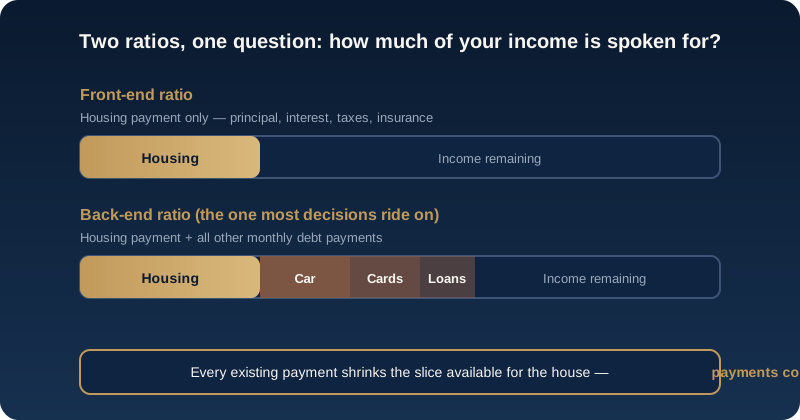
Lenders typically compute two versions of the ratio. The front-end ratio counts only the proposed housing payment against income — a measure of how large the house itself sits in your month. The back-end ratio adds every other monthly debt on top of the housing payment — the full picture of what your income is carrying — and it’s the number most qualification decisions ride on.
Programs and lenders set varying limits: guidelines commonly reference back-end ratios in the low-to-mid 40s as a general zone, with some programs stretching higher when compensating factors — strong reserves, a larger down payment, a strong credit profile — support the file (VA loans add a check of their own here, residual income, which can carry a higher ratio when the monthly cushion is strong — see VA loan credit requirements explained). The practical takeaway isn’t any single threshold; it’s the mechanic. Every existing monthly payment shrinks the mortgage payment your income can absorb, which caps the loan, which caps the house. For many buyers, DTI — not credit score — is the binding constraint on the purchase, and it’s the constraint least visible until a lender runs the numbers.
DTI is not a credit score
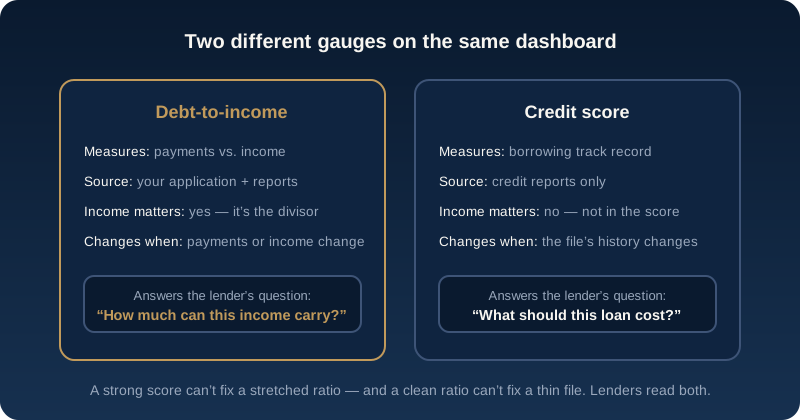
The two numbers get conflated because both live in a mortgage file, but they measure different things from different sources. A credit score is built entirely from your credit reports — payment history, utilization, account age, mix, inquiries — and income appears nowhere in it. A person earning $250,000 and a person earning $40,000 with identical credit files have identical scores. DTI is the reverse: income is the divisor, and the ratio comes from your application plus the payment lines on your reports.
The division of labor in underwriting is roughly this — the score prices the loan; the ratio sizes it. A strong score can earn a better rate but can’t manufacture room in a stretched ratio, and a clean ratio can’t discount a loan priced against a thin or damaged file. They also move on different clocks: a score shifts as the file’s history changes, while DTI moves the month a payment is retired or income rises. The score side of the mortgage question is covered in what credit score do you need to buy a house; the point here is that neither number substitutes for the other, and lenders read both.
Improving your ratio over time
DTI is a fraction, so there are exactly two levers — and both reward patience over heroics. Shrink the numerator: retire monthly payments, targeting debts with the largest payment relative to their balance. A car loan with $2,400 left and a $400 payment frees ratio at $400 per month for $2,400 spent — often the best exchange rate on the file. Paying down revolving balances helps twice, trimming the reported minimum while also improving utilization for the score side; whether and how much to pay off is its own calculation, worked through in should you pay off debt before buying a house.
One wrinkle worth asking a lender about: installment loans with only a handful of payments remaining are sometimes excluded from the ratio entirely, so a nearly finished loan may need no early payoff at all. Grow the denominator: raises, documented overtime, a second income on the application — lenders generally want income they can verify with history behind it, so this lever moves on a timeline of months to years, not weeks. And one defensive rule while either lever works: no new monthly payments. A financed couch or a new car in the months before applying hands back ratio you spent months freeing — the same discipline that runs through common credit mistakes before applying for a mortgage.
See it with real numbers
Dana earns $6,500 gross with a $480 car payment, $310 in student loans, and $190 in card minimums — $980 a month, a 15% DTI before housing. The homes she’s shopping would carry roughly a $2,200 payment with taxes and insurance, putting her back-end ratio near 49% — above what her loan program allows.
Her loan officer runs the levers: the car has nine payments left, and her lender confirms it can’t be excluded, so she retires it — $480 of ratio for about $4,300, dropping her back-end number to roughly 41%. She pays her cards down but keeps them open, banks the rest as reserves, adds nothing new on payments, and waits two reporting cycles for the file to catch up. Same income, same house — the ratio, not the score, was the wall, and arithmetic took it down.
Key takeaways
- DTI is monthly debt payments divided by gross monthly income — and it counts payments, not balances.
- Lenders read front-end (housing only) and back-end (everything) ratios — the back-end number usually decides.
- DTI is not a credit score: the score prices the loan, the ratio sizes it, and neither can substitute for the other.
- The best payoff targets are big payments on small balances — and near-finished loans may not count at all. Ask first.
- Report errors inflate the debt side of the ratio — read all three reports early and dispute anything wrong.