
Published July 17, 2026 · Educational information — not legal, tax, lending, or financial advice.
Quick answer
Credit monitoring is a service that continuously watches your credit files at the bureaus and alerts you when something changes — a new account or inquiry, a balance or status change, a new derogatory item, or a move in your score. Think of it as a smoke detector for your credit: it does not put out fires, but it tells you early so you can act. It is an awareness tool, not a repair tool — it never raises your score or fixes anything by itself, and watching your own credit is a soft inquiry that does not lower your score. Coverage ranges from free single-bureau basics to professional three-bureau services; the right fit depends on your goals, so review any service's features, pricing, and cancellation terms before enrolling.
What credit monitoring is
Most people picture their credit as a single number that sits still until they go looking for it. In reality, your credit is a set of living files — one at each of the three major bureaus, Experian, Equifax, and TransUnion — that lenders and other data furnishers update throughout the year. Balances move, statuses change, new accounts appear, and sometimes an error or a stranger’s activity slips in. Credit monitoring is the service that keeps watch over those files so you don’t have to remember to check them yourself.
The core idea is simple: instead of you periodically logging in to see what changed, monitoring does the looking on an ongoing basis and sends you an alert when something worth noticing happens. That’s the whole job — awareness, delivered promptly. It doesn’t make decisions for you, and it doesn’t change anything on your file; it closes the gap between when something happens and when you find out. If you want the deeper case for keeping that watch going all year rather than glancing once in a while, we make it in why monitor your credit year-round.
It helps to place monitoring next to two things it is often confused with. It is not the same as a credit report or credit score — those are the record and its summary; monitoring is the service that watches them. And it is not credit repair: monitoring shows you what’s there, while any correcting or rebuilding is separate work you or a professional do based on what you see.
What monitoring actually watches for
“Watching your credit” sounds vague until you see the specific things a monitoring service is actually looking for. Most services track a recognizable set of changes and send an alert when one shows up.
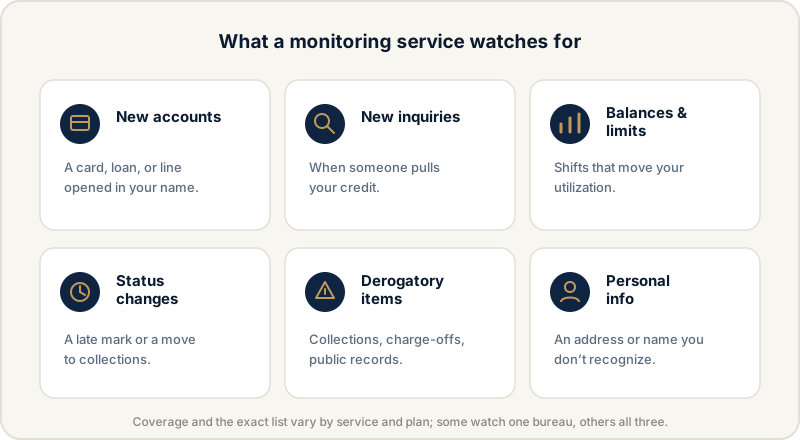
- New accounts. A credit card, loan, or line opened in your name — a normal event if it’s yours, and an early warning if it isn’t.
- New inquiries. When someone pulls your credit. A hard inquiry you didn’t authorize can be the first sign of attempted fraud.
- Balance and limit changes. Rising balances or a cut credit limit both move your utilization, one of the larger factors in most scores.
- Account status changes. A payment marked late, an account sent to collections, or a status flipping from current to derogatory.
- New derogatory items. Collections, charge-offs, or public records appearing on a file.
- Personal-information changes. A new address, name, or employer you don’t recognize — often a quiet tell that something is wrong.
- Score movement. Many services also surface changes in your score, so you can connect a shift to the event that likely caused it.
What any single service catches depends on the service and the plan — some watch one bureau, others all three — which is exactly why the mechanics of alerts are worth understanding on their own. We walk through how those notifications work, and how to read them without panic, in how credit alerts help you stay informed.
How credit monitoring works
Under the hood, monitoring is less mysterious than it sounds. A service maintains a secure connection to one or more of the bureaus and periodically compares your file against its last known state. When it detects a difference — a new tradeline, a balance jump, an inquiry — it flags that change and pushes you an alert by email, text, or app notification. Every one of those checks is a soft inquiry, so none of it touches your score, no matter how often it happens.
Two details matter for setting expectations. First, timing: bureaus update on their own schedules as furnishers report, so a change can appear on one bureau days before another, and an alert reflects when the bureau’s file changed, not the instant an event occurred in the real world. Second, coverage: single-bureau monitoring only sees changes on the file it watches, which is a big reason the three bureaus can show different scores and different information. Three-bureau monitoring exists precisely to close that blind spot.
None of this replaces reading your actual report now and then. Monitoring is the alarm; your full report is the audit. You’re entitled to free reports from all three bureaus at AnnualCreditReport.com, and knowing how to read your credit report turns an alert into something you can actually act on.
Free vs. professional monitoring
You’ll run into two broad tiers. Free monitoring — from banks, card issuers, and free apps — usually watches a single bureau and covers the essentials: a score, some alerts, a basic view of your file. For a lot of people, that’s genuinely enough. Professional monitoring typically watches all three bureaus at once, alerts on a broader set of changes, and often layers on identity-protection features such as dark-web scanning, resolution support, or identity-theft insurance on applicable plans.
The honest answer to “which do I need?” is: it depends on what’s at stake for you right now. If you’re preparing for a major application or you’ve had a fraud scare, three-bureau breadth earns its keep; if you’re just keeping a sensible eye on things, free may cover you. We lay out the trade-offs in detail in free vs. professional credit monitoring and is credit monitoring worth paying for, so you can decide on the merits rather than the marketing. The Consumer Financial Protection Bureau also publishes neutral guidance on credit reports and scores that’s worth reading alongside any service’s sales page.
Wherever you land, review the features, pricing, billing, and cancellation terms before you enroll in anything paid. Credit Consultants Group recommends and provides education around MyFreeScoreNow, an independent third-party platform, for readers who want professional three-bureau monitoring — but the right choice is always the one that fits your situation. Our full reasoning is in why we recommend MyFreeScoreNow.
What monitoring can — and can’t — do
Being clear about the limits is what keeps monitoring genuinely useful. Here’s the honest boundary line.
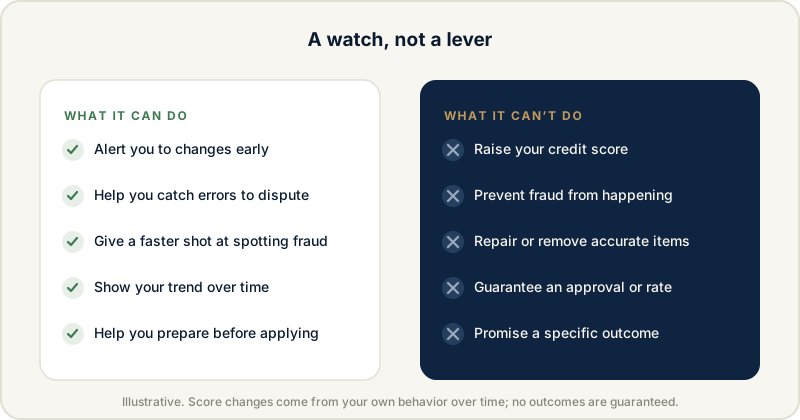
What it can do: alert you to changes early, so problems don’t wait until your next application; help you catch errors worth disputing; give you a faster shot at spotting fraud, which is where recognizing identity theft begins; and show you your trend over time so steady habits become visible. That awareness is real, practical value.
What it can’t do: monitoring does not raise your score, and no monitoring feature does — score changes come from your own behavior over time. It doesn’t prevent fraud; it helps you notice it sooner (a credit freeze is the tool for actually blocking new-account fraud). It doesn’t repair your credit or remove accurate negative items. And it never guarantees an approval, a rate, or a particular score — those depend on each lender’s review and your full profile. Credit Consultants Group provides education and does not promise scores, score increases, approvals, or outcomes of any kind.
Who benefits, and when it helps most
Monitoring isn’t equally valuable to everyone at every moment, and we’d rather say so. It tends to matter most in a few situations:
- Anyone preparing for a big application. Before a mortgage, seeing changes early gives you runway to fix problems — we map that stage by stage in how monitoring helps before buying a home, building on preparing your credit before buying a home. For business owners, whose personal credit often factors into approval, the same awareness matters on an even shorter clock — mapped in how monitoring helps before applying for business funding, alongside the wider prep work across the Business Funding Center.
- People rebuilding after a setback. When you’re working back from hardship, a visible trend keeps you honest and motivated; our guide to rebuilding credit after financial hardship leans on exactly that kind of feedback.
- Anyone with fraud or data-breach exposure. If your information has been exposed, earlier awareness shortens how long a thief can operate unnoticed.
- Anyone who simply wants fewer surprises. Even in calm times, knowing before someone else does is the quiet benefit that makes monitoring worth the small habit.
And who might not need to pay for it? If you already review all three bureaus on a schedule, understand your file, and have no near-term applications or fraud concerns, free tools may be plenty. Weigh it honestly against your own goals rather than a fear of missing out.
Key takeaways
- Credit monitoring is a service that watches your credit files and alerts you to changes — awareness, not repair.
- It typically watches new accounts, inquiries, balances, status changes, derogatory items, personal-info changes, and score movement.
- Every check is a soft inquiry, so monitoring never lowers your score — and it never raises it, either.
- Free single-bureau tools suit many people; professional three-bureau services add breadth and identity features — choose by your goals.
- Monitoring doesn’t prevent fraud, repair credit, or guarantee approvals; it helps you notice and act. Review any plan’s terms before enrolling.