
Published July 8, 2026 · Educational information — not legal, tax, lending, or financial advice.
Part of the Home Buying & Credit Resource Center.
Quick answer
Often, yes. A collection account is a factor lenders review — not an automatic no. What matters is the story around it: what kind of debt it is, how large the balance is, how old it is, whether it’s paid, and what the rest of your file says about you. Government-backed programs like FHA and VA tend to review collections case by case, while conventional underwriting sometimes asks for larger balances to be resolved before closing.
The worst response to a collection is assuming the door is closed and never asking. The best response is understanding exactly what’s on your reports, knowing how the programs generally treat it, and letting a loan officer read your specific file before you decide anything. This article walks through all three.
What a collection actually is
A collection account appears when an original creditor — a card issuer, a medical provider, a utility — gives up on collecting a past-due balance itself and either assigns or sells the debt to a collection agency. At that point, a new line appears on your credit report: the collection account, usually alongside the original account that went unpaid. It’s the credit report’s way of recording that a debt traveled from “late” to “handed off.”
Two details about that line matter more than most people realize. First, a collection is tied to the original delinquency date — the first missed payment that started the slide — and it generally falls off your reports up to seven years from that date, no matter who owns the debt now or how many times it’s been sold (the full clock is unpacked in how long do collections stay on your credit report). Second, a collection is not the same thing as a charge-off, though the two often travel together — a charge-off is the original creditor’s accounting decision, while a collection is the pursuit of the balance afterward.
For a homebuyer, the important reframe is this: a collection is one line in a file that a human underwriter will read in full. It has a size, an age, a type, and a status — and every one of those details changes how much it matters.
Paid vs. unpaid collections
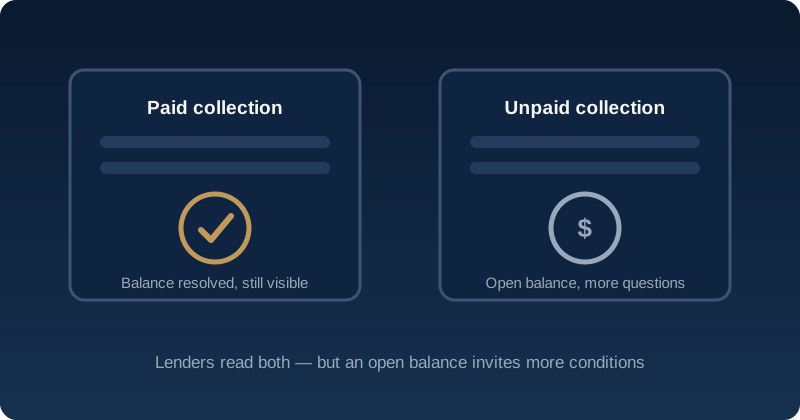
Lenders draw a meaningful line between a collection that’s been resolved and one that’s still open. A paid collection tells a simple story: something went wrong, and you dealt with it. The account stays on your reports — paying doesn’t remove it — but its status updates to paid or settled, the balance shows zero, and it stops raising the question every underwriter otherwise has to ask: is this debt going to compete with the mortgage payment?
An unpaid collection leaves that question open. It doesn’t automatically sink an application — plenty of files are approved with unpaid collections in place, particularly small or old ones — but it invites more scrutiny. Depending on the program and the balance, a lender may ask for a letter of explanation, factor a payment toward the debt into your debt-to-income math, or condition the approval on resolving the account before closing. There’s also a legal dimension worth knowing: an unpaid debt within your state’s statute of limitations could still produce a judgment or lien, and liens are the kind of thing that genuinely complicates a home purchase.
One nuance that surprises people: settled and paid in full are both resolved, but they aren’t identical. Settling means the collector accepted less than the full balance. For mortgage purposes, resolved is the headline either way — but the reports will show which one happened, and it’s worth knowing what yours say before a lender reads them.
How FHA, VA, and conventional loans treat collections
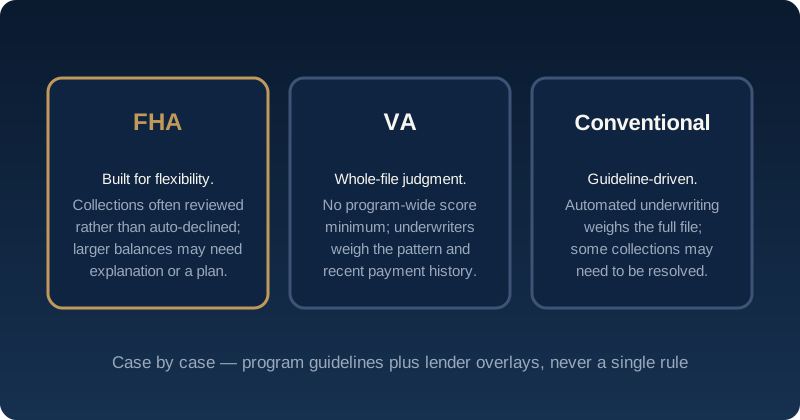
FHA — the program built for flexibility — has historically been the most workable path for buyers with collections. FHA guidelines generally do not require collections to be paid off as a blanket rule. Instead, larger non-medical collection balances may trigger a closer look: underwriters may factor a portion of the outstanding balance into your debt calculations or ask for a documented payment arrangement, and medical collections are frequently treated more leniently. The pattern is review, not reflex (the program’s full credit picture — score floors, overlays, and waiting periods — lives in FHA loan credit requirements explained).
VA — for eligible veterans, service members, and certain surviving spouses — takes a whole-file view. The program sets no universal rule requiring collections to be resolved; underwriters weigh the age of the collection, the reason behind it, and — heavily — what your payment history looks like since. A collection from a rough patch three years ago, followed by three clean years, reads very differently than one from last spring (how VA review works end to end — benchmarks, the 12-month rule, residual income — is covered in VA loan credit requirements explained).
Conventional loans — typically following Fannie Mae and Freddie Mac guidelines — run most files through automated underwriting, which weighs collections as part of the total risk picture rather than applying one fixed rule. In practice, smaller balances often pass through, while larger open collections are more likely to come back as a condition: resolve before closing. And across all three programs, remember the layer on top: individual lenders add their own overlays, so one lender’s “must be paid” is another’s “acceptable with explanation.” That’s not a flaw in the system — it’s a reason to shop.
What lenders actually review
When an underwriter encounters a collection, they’re not reacting to the word — they’re asking a short list of questions. How old is it? A collection from five years ago carries far less weight than one from five months ago, both in scoring and in human judgment. What kind of debt is it? Medical collections are widely viewed as less predictive of mortgage risk than defaulted credit cards or loans, and reporting practices for medical debt have shifted in recent years — smaller and newer medical collections often don’t appear on reports at all. How big is the balance? A small utility bill and a five-figure defaulted loan are simply different conversations. Is it isolated or part of a pattern? One collection surrounded by on-time accounts reads as an episode; several recent collections read as a trend.
And underneath all of it: what does the rest of the file say? The collection is one input alongside your debt-to-income ratio, income stability, down payment, reserves, and recent payment history. The mechanics of how all of this gets pulled and read — the tri-merge report, the middle score, the underwriter’s walkthrough — are laid out in what happens during a mortgage credit check. The score question specifically — what number gets you in the door for each program — lives in what credit score do you need to buy a house.
Common misconceptions
“A collection means an automatic denial.” It doesn’t. No major program applies a blanket ban on files with collections; every one of them reads the details. “Paying it makes it disappear.” It doesn’t — the account stays for up to seven years from the original delinquency, with an updated status. What paying changes is the underwriting conversation, not the report’s memory. “Paying an old collection always helps my score.” Not reliably — score reactions vary by scoring model, and paying can update the account’s recent activity. It may still be the right move for your mortgage file; it’s just not a guaranteed score boost, and the order of operations matters.
“If I pay the collector, they’ll delete the account.” Sometimes negotiated, never guaranteed — and any promise to delete should be in writing before money moves. “The collection isn’t mine, so lenders will ignore it.” They won’t ignore what’s on the report — but you don’t have to live with an error. If the account isn’t yours, is the wrong amount, or shows the wrong dates, the dispute process exists exactly for this, and it’s free: how to dispute an error on your credit report walks through it step by step.
Practical preparation
Start with the reports themselves — all three of them, since mortgage lenders pull all three and typically qualify you on the middle score. Read every collection line carefully: who reports it, the balance, the original delinquency date, the status. Verify it’s accurate before you plan around it (the layout is decoded in how to read your credit report). If something is wrong, dispute it early — disputes take time to resolve, and an open dispute during underwriting can itself complicate a file.
If the collection is legitimate, resist the urge to immediately throw money at it. Get the facts organized first: what happened, when, and what’s changed since — the raw material of a letter of explanation, which underwriters read routinely and without drama. Then have a conversation with a loan officer before deciding whether to pay. This ordering feels backwards to people who want to “clean up first,” but it’s the sequence that avoids expensive mistakes: the loan officer can tell you whether the account matters for your target program, whether it needs to be resolved at all, and whether resolving it now or at closing serves you better. The general trade-offs of paying — and the cautions that come with it — are laid out in should you pay off a collection account.
Meanwhile, pour your energy into the parts of the file you control completely: an unbroken streak of on-time payments, balances paid down, no new credit. A collection is history; the file you build around it is current events — and underwriters weight current events heavily. The full countdown lives in preparing your credit before buying a home.
Mistakes to avoid
Paying a collection blind, right before applying. Well-intentioned, sometimes counterproductive — timing and score-model quirks mean this deserves a loan officer’s eyes first. Ignoring the collection and hoping it isn’t noticed. It will be; the tri-merge report sees everything, and surprises during underwriting cost more than honesty up front. Disputing accurate information as a strategy. Disputes are for errors; disputing legitimate debt can stall your file and doesn’t make the history untrue.
Draining your down payment to resolve a collection nobody asked you to resolve. Cash reserves are themselves an underwriting strength; trading them for an optional payoff can weaken the file overall. Opening new credit or moving big money during the process. The standard pre-mortgage discipline applies doubly when your file already has a line that invites questions — the full don’t list is in common credit mistakes before applying for a mortgage.
Realistic expectations
Here’s the honest picture. A small, old, or medical collection on an otherwise solid file is frequently a non-event — noted, explained, and moved past. A large, recent, unpaid collection on a thin file is a genuine obstacle — not always a dealbreaker, but something that will shape the programs available to you, the conditions attached, and possibly the rate you’re offered. Most situations live between those poles, which is exactly why the case-by-case review exists.
A composite example of how this often plays out: a buyer with a two-year-old $800 collection from a medical bill, followed by two years of clean payment history, applies FHA. The underwriter requests a short letter of explanation, the letter tells a simple story — unexpected bill, resolved circumstances, clean record since — and the loan proceeds. No drama, no denial. The collection cost the buyer a paragraph, not a house.
The expectation to set isn’t “the collection won’t matter” or “the collection ruins everything.” It’s this: the collection will be read, in context, by a process designed to read it — and the context is largely yours to build. If a collection did contribute to a denial, it’s rarely the only reason — why mortgage applications get denied because of credit covers the full list a lender is likely to have cited.
Key takeaways
- A collection is a factor, not a verdict — no major loan program automatically declines a file for having one.
- Paid and unpaid read differently: paying doesn’t erase the account, but a resolved balance raises far fewer underwriting questions.
- FHA and VA generally review collections case by case; conventional underwriting is more likely to condition approval on resolving larger balances.
- Age, type, size, and pattern decide the weight — an old medical collection and a recent defaulted loan are entirely different conversations.
- Talk to a loan officer before paying anything — the right sequence saves money, protects your reserves, and avoids underwriting surprises.