
Published July 18, 2026 · Educational information — not legal, tax, lending, or financial advice.
Part of the Home Buying & Credit Resource Center.
Quick answer
The VA itself sets no minimum credit score for its home loan program — a genuine structural difference from FHA and conventional lending. What the VA asks for is a “satisfactory” overall credit picture, which each lender translates into its own benchmark. In practice, those lender benchmarks commonly land somewhere around 580–640, and they vary meaningfully from shop to shop — which means one lender’s decline is never the program’s decline.
VA underwriting also reads a file differently: roughly the last 12 months of payment history carries the most weight, collections usually don’t all have to be paid, waiting periods after bankruptcy or foreclosure are among the shortest of any program, and a VA-specific check called residual income — the cushion left after the bills — can carry a file that raw ratios wouldn’t. This article walks through each piece for eligible buyers.
How a VA loan works — and who’s eligible
A VA loan is a mortgage made by a private lender and partially guaranteed by the U.S. Department of Veterans Affairs. Eligibility is earned through service — veterans, active-duty service members, many members of the National Guard and Reserves, and certain surviving spouses — and is documented with a Certificate of Eligibility (COE), which can be requested through VA.gov or pulled by most lenders directly in minutes.
Here’s the distinction that untangles most confusion about VA credit rules: the COE establishes program eligibility, and it says nothing about credit. Credit review is a separate step that belongs entirely to the lender. The VA guarantee absorbs part of the lender’s risk — that’s what makes the program’s famous terms possible — but the lender still underwrites your ability and willingness to repay. Eligible and approved are two different gates, and this article is about the second one.
No program minimum — so where do the numbers come from?
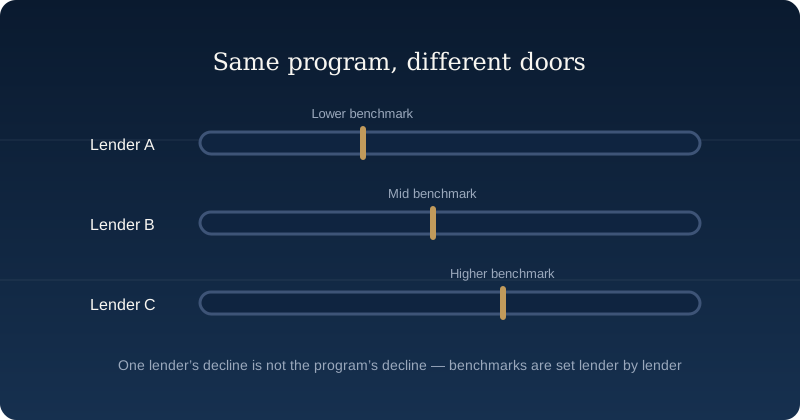
Unlike FHA, with its 500 and 580 lines, the VA publishes no minimum credit score at all. Its underwriting standards ask lenders to evaluate the overall picture: satisfactory credit history, stable income, and sufficient residual income. Every specific score number you’ve seen attached to VA loans — “most lenders want 620,” “some go to 580” — is a lender benchmark, the VA-world equivalent of an overlay, set shop by shop to manage that lender’s own risk.
The practical spread is real: benchmarks commonly land around 580–640, with some lenders above and some specialized lenders below that range, and each lender also differs in how it treats collections, thin files, and manual underwriting. For a buyer, that variability is an asset. If your score sits in the contested zone, the highest-leverage move is often not another month of optimization but another phone call — asking several VA lenders directly, “What is your minimum score, and how do you handle a file like mine?” Shopping conversations are free; just pace formal applications thoughtfully, since each adds a hard inquiry (mortgage pulls inside a focused shopping window are typically scored as one event).
The 12-month rule: what VA underwriting reads
When a VA underwriter opens your reports, the reading is weighted hard toward recency: roughly the last 12 months of payment history carries the most weight in the satisfactory-credit judgment. A file that’s been clean for the past year — every account paid on time, no new derogatory marks — reads as satisfactory under VA standards even when older years carry scars. The inverse is equally true: recent late payments, especially on housing (rent or a prior mortgage), are the marks VA underwriting takes most seriously, and no amount of older good history offsets a rough recent stretch.
That weighting turns preparation into something concrete: the single most valuable thing an eligible buyer can do is manufacture a spotless 12 months. Autopay minimums on every account so a late payment is structurally impossible, keep balances moving down — utilization is the fastest score lever and helps the debt ratios at the same time — and let the calendar do the rest. What the lender actually sees when they pull the file — the tri-merge report, the middle score, the conditions process — is walked through in what happens during a mortgage credit check.
Residual income: the VA’s extra check
VA underwriting runs a check no other major program requires: residual income. After the projected housing payment, debts, and estimated living expenses are subtracted from monthly income, a minimum cushion must remain — an amount that varies by region, family size, and loan size. It’s a fundamentally different question than a ratio: not “what share of your income goes to debt?” but “what’s actually left over each month?”
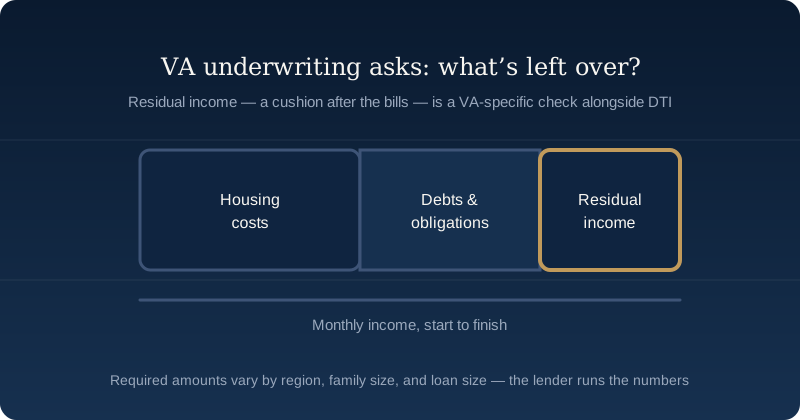
For borrowers, residual income cuts both ways — and mostly in your favor. It’s a major reason VA underwriting can approve files with debt-to-income ratios above the program’s general guideline of around 41%, as long as the leftover cushion is comfortably strong. It also means that paying down monthly obligations before applying does double duty on a VA file: every recurring payment eliminated improves the DTI and the residual math at the same time. If your income is solid but your obligations are heavy, this is the lever to work first.
Collections, bankruptcy, and foreclosure under VA review
Consistent with the recency emphasis, VA underwriting is generally patient with old damage. Collections usually don’t all have to be paid before closing — underwriters weigh the size, age, and pattern of what’s on the report, and an isolated old collection reads very differently from a recent cluster (the cross-program picture is in can you get a mortgage with a collection on your credit report, and whether paying one helps or not is a real strategy question covered in should you pay off a collection account).
After major events, typical VA seasoning guidelines are about two years after a Chapter 7 discharge, about one year into a Chapter 13 plan with on-time payments and trustee approval, and about two years after a foreclosure — among the shortest waits of any program, with documented extenuating circumstances sometimes shortening them further and lender benchmarks sometimes stretching them. One VA-specific note: a past foreclosure on a previous VA loan can reduce the entitlement available for the next one, which is an eligibility-math question a lender can run for you. As with every program, the clock alone isn’t the qualification — the credit rebuilt since the event is what gets read, and how to rebuild your credit after financial hardship maps that work.
No down payment, no monthly MI — but credit still prices the loan
The program’s famous terms are real: most eligible borrowers with full entitlement can buy with no down payment, and VA loans carry no monthly mortgage insurance — the structural cost advantage that makes VA loans, for those who’ve earned access, frequently the strongest financing available. Most borrowers instead pay a one-time VA funding fee, which can be rolled into the loan; some borrowers, including many receiving VA disability compensation, are exempt from it entirely.
Here’s why credit still matters enormously anyway: none of those features set your interest rate. Lenders price VA loans on risk like any other loan, and your credit profile shapes the rate you’re offered — a difference that compounds across decades exactly as it does on every mortgage (the mechanics are in how your credit score affects mortgage interest rates). Zero down means credit preparation isn’t about reaching the closing table; it’s about what the next thirty years cost once you’re there.
Preparing a VA-ready file
The playbook follows directly from how VA review works. Get the COE question answered early — through VA.gov or a lender — so eligibility is settled and the work can focus on credit. Pull and read all three reports at the start (how to read your credit report decodes the layout), dispute genuine errors immediately so nothing is unresolved during underwriting, and then protect the thing VA underwriting weighs most: a spotless recent 12 months, secured by autopay on every account. Work monthly obligations down where you can — on a VA file, each eliminated payment improves the DTI and the residual-income cushion simultaneously.
Then shop deliberately: because benchmarks vary, ask several VA lenders where their minimums sit and how they’d treat your specific file before formally applying anywhere. If your score sits near a benchmark boundary, a few months of preparation can change the rate tier you apply from — the general timeline and levers live in should you improve your credit before applying for a mortgage. And if you’re weighing programs side by side, the companion article on FHA loan credit requirements covers the other major government-backed path, and what credit score do you need to buy a house puts all the programs on one map.
Key takeaways
- The VA sets no minimum credit score — every number you’ve heard is a lender benchmark, and benchmarks commonly land around 580–640 but vary shop to shop.
- Eligibility (the COE) and credit approval are separate gates — one lender’s decline is never the program’s decline.
- VA underwriting weighs the last 12 months most heavily — a spotless recent year is the single most valuable asset a file can have.
- Residual income — the cushion left after the bills — is a VA-specific check that can carry a file with a higher DTI, and paying down monthly obligations improves both at once.
- No down payment and no monthly mortgage insurance — but credit still sets the rate, and the rate compounds for decades.