
Published July 7, 2026 · Educational information — not legal, tax, lending, or financial advice.
Part of the Home Buying & Credit Resource Center.
Quick answer
Check your credit about 12 months before you plan to apply — and then keep checking on a rhythm, not as a one-time event. The 12-month runway exists because nothing on a credit file moves fast: disputes take roughly 30 days per round to investigate, paid-down balances take a statement cycle or more to report, and payment history accumulates one month at a time.
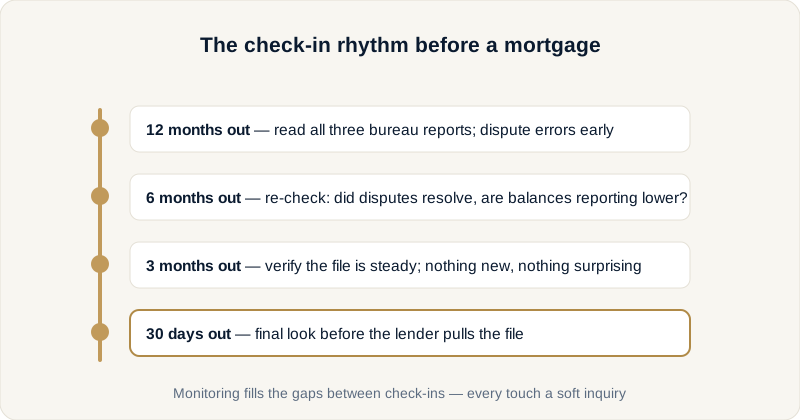
The rhythm that works: a full three-bureau review at 12 months, a re-check at 6, a steadiness check at 3, and a final look 30 days before the lender pulls the file — with monitoring covering the gaps in between. And check freely: looking at your own credit is a soft inquiry that never affects your score. Don’t have a year? Check today — even 90 days of runway catches errors and prevents the most expensive last-minute mistakes.
Why 12 months is the right runway
The 12-month figure isn’t a superstition — it’s arithmetic built from how slowly credit files move. A dispute takes roughly 30 days to investigate, and contested items sometimes need a second round with documentation, so an error found at 12 months is comfortably fixable while one found at 30 days may still be under investigation when the underwriter pulls the file. Paid-down balances only help once the lower numbers report, which takes a statement cycle or more per card.
On-time payment history — the heaviest factor in what makes up your credit score — accumulates strictly one month at a time. And inquiries and recent accounts fade with age, which only time provides. Every one of these clocks starts the day you first look — which is why the single most consequential move in home-buying credit is simply looking early. The full preparation sequence built on that first look is in preparing your credit before buying a home.
The check-in rhythm: 12, 6, 3, and 30
12 months out — the deep read. Pull all three bureau reports and go through them section by section (the map is in how to read your credit report). Dispute anything inaccurate now, while investigations have runway. 6 months out — the progress check. Did the disputes resolve? Are paid-down balances actually reporting lower? Anything new and unexpected on the file? 3 months out — the steadiness check.
By now the goal shifts from improving the file to not disturbing it: no new accounts, no new inquiries, no surprises — the full list of late-stage wounds is in common credit mistakes before applying for a mortgage. 30 days out — the final look, so nothing on the underwriter’s screen is news to you. Between check-ins, monitoring does the watching automatically — alerting you to changes when they happen instead of when you next remember to look; how that plays out at each stage is covered in how credit monitoring helps before buying a home.
What to look for when you check
A pre-mortgage review is a hunt for two kinds of problems. The first is errors: accounts you don’t recognize, late payments that never happened, wrong balances or credit limits, collections that aren’t yours or carry wrong amounts, duplicate listings of the same debt, and outdated personal information. Each is disputable — the process is free and federal, walked through in how to dispute an error on your credit report — and each matters more before a mortgage than at any other moment, because lenders read the reports directly rather than taking the score’s word for it.
The second is surprises that aren’t errors: a legitimate old collection you’d forgotten, a card reporting a higher balance than expected, an account someone opened in your name. Finding these at 12 months makes them projects; finding them at underwriting makes them emergencies. An unrecognized account in particular deserves immediate attention — the recovery steps are in what to do if someone opens an account in your name.
Why all three bureaus, every time
Checking one bureau before a mortgage is like proofreading one page of a three-page contract. The bureaus maintain separate files, creditors don’t all report to all three, and the files routinely differ — the reasons are unpacked in why are my three credit scores different. Mortgage lending makes this more than trivia: lenders typically pull all three reports and have commonly qualified borrowers on the middle of the three scores.
That math means an error sitting on just one bureau’s file — even your “worst” one — can define your qualifying score and your rate tier while the other two files are spotless. How that tier prices the loan is the subject of how your credit score affects mortgage interest rates; the short version is that one bureau’s mistake can cost real money every month for decades if nobody looks.
Checking never costs the file
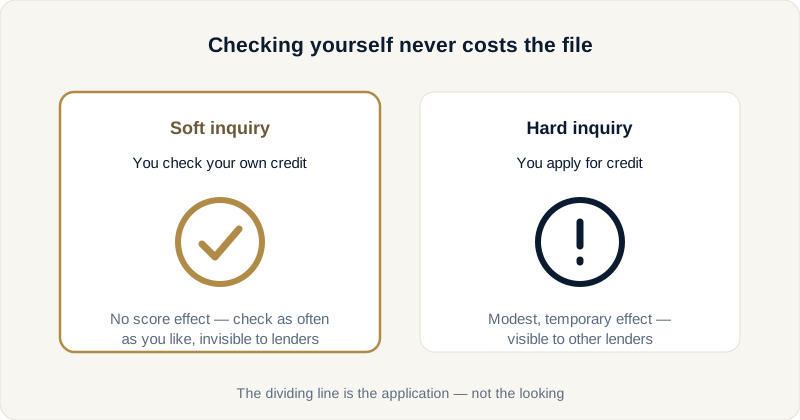
The most persistent myth in this process is that checking your credit hurts it — and it keeps buyers from looking at exactly the moment looking matters most. The truth: reviewing your own reports and using monitoring services are soft inquiries, invisible to lenders and ignored by every scoring model. Only hard inquiries — generated when you actually apply for credit — can have a modest, temporary effect. The dividing line is the application, not the looking; the full mechanics are in soft inquiry vs. hard inquiry and the myth’s origins in does checking my own credit hurt my score. The practical consequence: there is no such thing as checking too early or too often. Twelve months of monthly looks costs the file nothing; one unexamined error at underwriting can cost the loan.
What if you don’t have a year?
Then the answer changes from “12 months” to “today,” and the plan compresses rather than disappears. With 6 months, you can still run a full dispute cycle, pay balances down across several reporting cycles, and build half a year of clean history. With 90 days, you can catch and dispute the worst errors, get one or two cycles of lower balances reporting, and — critically — avoid the self-inflicted late-stage mistakes that sink files at the finish line.
With 30 days, the check is mostly reconnaissance: know what the lender will see, so nothing is a surprise and your loan officer can plan around what’s there rather than discovering it. At every runway length, the logic is identical — the file the underwriter sees is the file as it stands that day, and every day you look sooner is a day something can still be fixed. When the file is ready and it’s time to talk to lenders, the next step is mapped in pre-approval vs. pre-qualification.
Two real-world examples
The early look that paid for itself. Priya checks all three reports a year before house-hunting and finds a collection on one bureau that belongs to someone with a similar name. She disputes it with documentation; it takes two rounds and nine weeks to remove — time she has, because she looked early. When her lender pulls the file months later, her middle score sits a full tier higher than it would have, and the rate offer shows it.
The 30-day save. Tom doesn’t check anything until his agent insists, a month before applying. His reports reveal a card balance reporting near its limit — not an error, just bad timing. There’s no runway for disputes, but there’s enough to pay the balance down and let the statement cycle report before the lender pulls. It’s the only lever short runways leave — and it’s only available because he finally looked.
Key takeaways
- Check about 12 months out — disputes, reporting cycles, and payment history all need runway that can’t be compressed later.
- Follow a rhythm, not an event: deep read at 12 months, progress at 6, steadiness at 3, final look at 30 days — monitoring covers the gaps.
- Check all three bureaus — lenders typically qualify on the middle score, so one bureau’s error can set your price.
- Self-checks are soft inquiries — they never affect your score, so there’s no such thing as looking too early or too often.
- No year of runway? Check today — the plan compresses, and every earlier day is a day something can still be fixed.