
Published July 16, 2026 · Educational information — not legal, tax, lending, or financial advice.
Quick answer
FLASHBACK™ is a new MyFreeScoreNow feature that lets eligible members see up to 12 months of historical credit score information — including score points from before they enrolled, where that data is available. The point is context: instead of a chart that starts the day you sign up, you can see the recent trend. Paired with ScoreTrends™, three-bureau monitoring alerts, the Optimal Path™ educational tool, and automatic Equifax refreshes, it gives you more visibility into your credit journey. Two honest reminders: availability and the amount of history vary by member and bureau, and seeing your history never raises your score or guarantees any outcome. Review the current plan and terms before enrolling.
What FLASHBACK is
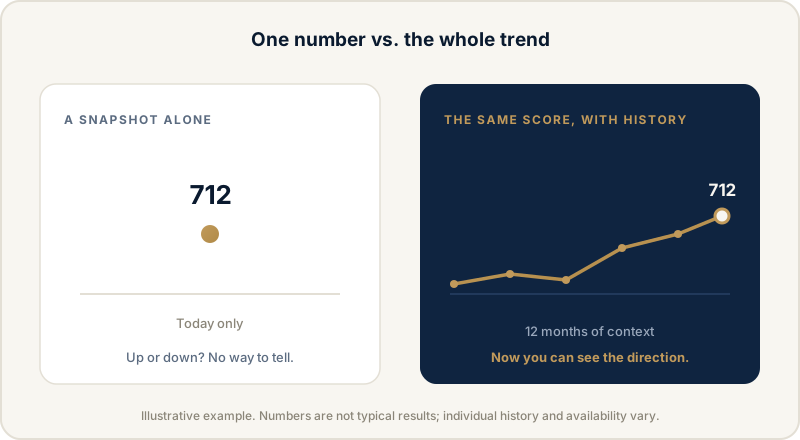
Most credit-tracking tools have the same quiet limitation: your score chart begins on the day you sign up. Everything before that is a blank. FLASHBACK™ is MyFreeScoreNow’s answer to that blank. For eligible members, it aims to reconstruct up to 12 months of historical credit score information — score points from before enrollment — so your very first view already includes a recent trend line instead of a single dot. Think of it as filling in the story that led up to today, rather than starting the story at “now.”
It’s worth being precise about what that means. FLASHBACK shows historical score information where that data is available for your file; it is not a rewrite of your credit report and it does not change anything on it. How far back it reaches, and how complete the picture is, can vary from one person to the next and from one bureau to another. That variability is normal — it reflects what history exists to draw on — so the honest way to describe the feature is “up to 12 months, where available,” not a guaranteed year for everyone.
Why historical credit data matters
A credit score is a snapshot: accurate for the moment it’s calculated, but silent about direction. Two people can share the exact same number while heading in opposite directions — one recovering steadily, the other slipping — and the single figure hides that completely. History is what turns a number into information. When you can see several months of movement, you can start asking better questions: Is my score trending up or down? Did that paid-off card actually help? Was last month’s dip a one-time blip or the start of a pattern?
That kind of context is exactly what we spend the Learning Center teaching people to read. A score is built from your track record over time — the reason payment history and balances carry so much weight is that they are a history. If you want the mechanics, what makes up your credit score breaks down the five components, and credit report vs. credit score explains why the report underneath the number is the fuller record. Historical score data sits on top of all that: it doesn’t replace reading your report, but it gives the trend a shape you can actually see.
There’s a practical side, too. Seeing a trend helps you catch problems earlier — a steady decline you might otherwise miss until an application — and it helps you recognize progress that’s easy to overlook month to month. For anyone rebuilding, that visible slope can be genuinely encouraging; our guide to rebuilding credit after financial hardship is largely about the patience that a trend line makes easier to sustain. The federal Consumer Financial Protection Bureau makes the same underlying point in its consumer guidance: credit scores move over time as your behavior and your file change, which is precisely why watching the direction — not just the number — is useful.
How lenders weigh long-term credit behavior
Here’s a detail that surprises people: when a lender pulls your credit, they don’t just see a score — they see your report, which is a running history of how you’ve handled credit. Payment history is one of the largest factors in most scoring models, and it’s a time-based factor by definition. Underwriters look beyond the headline number at the pattern behind it: recent late payments, balances that have been climbing, a burst of new accounts, or a stretch of steady, on-time behavior. In other words, the long view is already how lending decisions are made — the score is just the summary.
That’s why understanding your own trend matters before you apply. It won’t change how a lender scores you, but it lets you walk in seeing roughly what they’ll see: a direction, not just a data point. If you’re preparing for a mortgage, that awareness pairs directly with preparing your credit before buying a home and helps you time things sensibly — the whole reason checking your credit well before you buy is worth doing. On the business side, where an owner’s personal credit often factors into approval, a clear trend supports the prep work in what credit score you need for business funding and across the Business Funding Center. To be clear about the boundary: seeing your history helps you prepare and understand; it never guarantees an approval, a rate, or a particular score, all of which depend on each lender’s review and your full profile.
How FLASHBACK, ScoreTrends, monitoring & Optimal Path work together
FLASHBACK is most useful as one piece of a larger picture. On MyFreeScoreNow, four features complement each other — each answering a different question about your credit — and it helps to see how they fit.
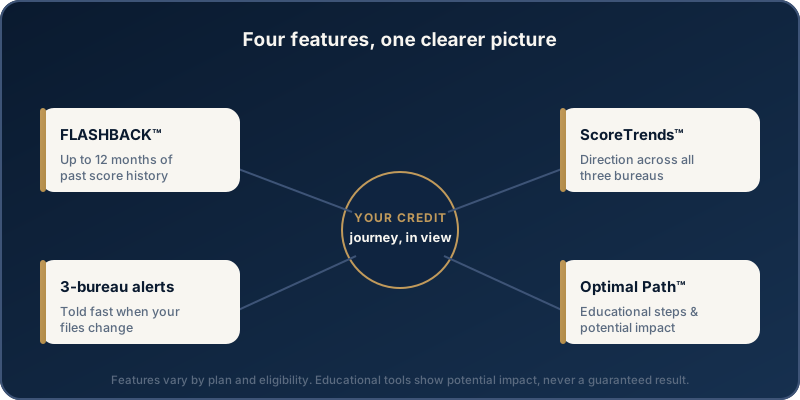
- FLASHBACK™ — the look back. Up to 12 months of historical credit score information (where available), so your chart starts with context instead of a blank.
- ScoreTrends™ — the direction across all three bureaus. A view of how your scores are moving at Experian, Equifax, and TransUnion while your membership is active, so you’re watching the slope, not just a single reading.
- Three-bureau monitoring alerts — the early warning. Ongoing monitoring that flags changes across your files — new inquiries, account changes, score movement — delivered fast, so a surprise doesn’t wait until your next manual check. This is the continuity we cover in why monitor your credit year-round.
- Optimal Path™ — the educational tool. An AI-assisted tool that lets you set a goal and see suggested steps with a potential impact on your score. It’s educational — it doesn’t make lending decisions or guarantee a result.
- Automatic Equifax refresh. An updated Equifax report and score refreshed at each login on applicable plans, so the most-viewed part of your file stays current.
Put together, the past (FLASHBACK), the present and its direction (ScoreTrends and monitoring alerts), and a forward-looking educational tool (Optimal Path) give you a fuller arc of your credit journey than any single score ever could. None of it, on its own, changes your credit — that’s the part our education is built to help with. For the full rundown of the platform and why we chose it, see why we recommend MyFreeScoreNow and the Professional Credit Monitoring hub.
Who may benefit from FLASHBACK
Historical score data isn’t equally valuable to everyone, and we’d rather be straight about that. It tends to help most in a few specific situations:
- People preparing for a big application. If a mortgage or business-funding decision is on the horizon, seeing your recent trend — not just today’s number — helps you judge whether you’re ready or need a few more months. That’s the same logic behind improving your credit before applying for a mortgage.
- Anyone rebuilding. When you’re working back from a setback, month-to-month change can feel invisible. A visible upward slope is both motivating and a useful check that your habits are working.
- New members who don’t want to start from zero. Instead of waiting months to accumulate a trend, eligible members can begin with up to a year of context on day one.
- Curious, detail-minded people. If you like connecting cause and effect — “my score moved when I did X” — history gives you the timeline to do it, which pairs naturally with the habit of checking your credit on a sensible rhythm.
And who might not need it? If you already keep meticulous records, review all three bureaus on a schedule, and understand your own trend cold, FLASHBACK is a convenience rather than a revelation. It’s worth weighing that honestly — our look at whether credit monitoring is worth paying for and the free vs. professional comparison lay out the trade-offs so you can decide based on your own situation.
The honest limits
A few boundaries keep expectations realistic. Availability varies. FLASHBACK shows up to 12 months of history “where available” and “for eligible members” — how far back it reaches depends on your file and the bureau, so treat any specific range as an estimate. History is context, not a lever. Seeing your past score doesn’t change it; it informs your decisions, and nothing more. No feature raises your score by itself. Score changes come from your own behavior over time, and educational tools that show a potential impact are not making a promise. Viewing your own credit is a soft inquiry and does not lower your score. And as always, MyFreeScoreNow is an independent third-party platform that Credit Consultants Group doesn’t own or operate; features vary by plan, so review the current features, pricing, billing, and cancellation terms — and your own free annual reports at AnnualCreditReport.com — before you decide what fits.
Key takeaways
- FLASHBACK™ lets eligible MyFreeScoreNow members view up to 12 months of historical credit score information — even from before enrollment, where available.
- Historical data turns a single score into a trend — direction you can act on, not just a number.
- Lenders already read long-term behavior in your report; understanding your own trend helps you prepare, but never guarantees an approval, rate, or score.
- FLASHBACK (the past), ScoreTrends™ and monitoring alerts (the present), and Optimal Path™ (a forward-looking educational tool) work together across all three bureaus.
- Availability varies by member and bureau; viewing your own credit is a soft inquiry. Review the current plan and terms before enrolling.