
Published July 5, 2026 · Educational information — not legal, tax, lending, or financial advice.
Quick answer
A late payment generally stays on your credit report for about seven years from the date of the delinquency. Two facts soften that number considerably. First, lenders typically don’t report a payment as late until it’s at least 30 days past due — a few days late usually means a fee, not a report entry. Second, scoring models weigh recent history most heavily, so a late payment’s influence typically fades well before the entry ages off, especially as on-time payments stack up after it. Accurate entries generally can’t be removed early, but inaccurate ones can be disputed — and the record keeps writing itself either way.
When does a late payment actually get reported?
Not every late payment becomes a credit report entry. Lenders generally report delinquency to the bureaus only once a payment is at least 30 days past the due date — so a payment that’s five days late may cost you a late fee and some interest, but it usually never reaches your file. That 30-day threshold is why a single forgotten due date, caught within the month, is typically recoverable with a phone call and a payment rather than a seven-year entry. It’s also worth knowing that reporting practices vary: lenders report on their own cycles, to the bureaus they choose — one reason your three files can tell slightly different stories, as covered in why your three credit scores are different. The set of products that report is also expanding — pay-in-4 plans, long invisible, are increasingly furnished to the bureaus, a shift explained in does buy now, pay later affect your credit score.
Severity tiers: 30, 60, 90, 120+
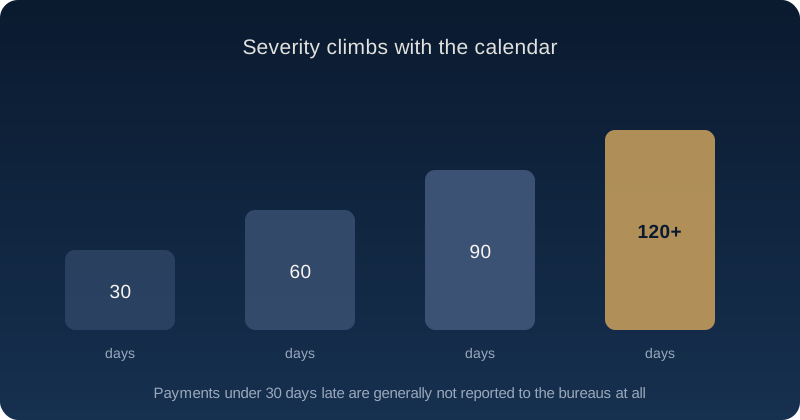
Once reporting begins, lateness is recorded in tiers — 30, 60, 90, then 120 or more days past due — and both lenders and scoring models generally read later tiers as more serious. The tiers reflect a real behavioral difference: a 30-day late often signals a slip, while a 90-day late signals sustained difficulty. This structure carries a practical implication that’s easy to miss in a stressful month: even after a payment is already 30 days late, bringing the account current before it rolls to 60 still matters, because it caps the severity of what gets recorded. Payment history is the heaviest of the five scoring factors — the full hierarchy is in what makes up your credit score — which is why the tier system deserves attention even mid-lapse.
The seven-year clock
Federal law generally limits how long most negative information can remain on a credit report, and for late payments that window is about seven years, measured from the date of the original delinquency. The clock doesn’t restart when you pay the account off, bring it current, or when the account later closes — it runs from the missed payment itself. When the window ends, the entry ages off the report automatically; no request or action is required. Meanwhile, the account’s positive history behaves differently and more generously: on-time payments and accounts in good standing can remain on the file for years, often longer than the negative entries they surround.
Why it stops hurting before it disappears
The entry’s presence and the entry’s weight are two different things. Scoring models generally emphasize recent behavior, so a late payment tends to matter most in the months after it’s reported and progressively less as it recedes — a five-year-old 30-day late on an otherwise clean file is a very different signal than one from last quarter. How much any single entry moves a score depends on the rest of the file: a long, deep history absorbs a lapse more easily than a thin one, which is also why identical events land differently for different people. If a score drop is what brought you to this question, the mechanics of sudden dips — and which ones ease naturally — are covered in why did my credit score drop overnight.
What can and can’t be removed
The honest version, without the sales pitch: accurate late payments generally cannot be removed early just because they’re unwelcome — be skeptical of anyone promising otherwise. What legitimately exists: if an entry is inaccurate — a payment marked late that you can document as on time, a date that’s wrong, an account that isn’t yours — you can dispute it with the bureau reporting it, which is generally obligated to investigate. Separately, some lenders will consider a goodwill adjustment for a longtime customer with an isolated lapse; it’s discretionary, never owed, and never guaranteed, but a polite request costs nothing — the full ask, from profile to wording, is in how to write a goodwill letter. Finding either kind of candidate starts with actually reading your reports — a habit with its own rhythm, laid out in how often should you check your credit report.
How the record rebuilds
The most underrated fact about a late payment is that the report keeps recording everything that happens after it. Every on-time month adds to the file, and because recent history speaks loudest, each one pushes the late entry further toward irrelevance long before it physically ages off. The rebuild isn’t exotic: automate at least the minimum payment so the heaviest factor is structurally protected, keep utilization reasonable, and let time do the compounding. If the lapse came during a harder stretch, the fuller playbook is in how to rebuild your credit after financial hardship. And if a home purchase is on the horizon, recent late payments draw the most underwriting scrutiny — common credit mistakes before applying for a mortgage covers what to watch. Nothing about that requires the old entry to disappear — the record simply outgrows it.

Two real-world examples
The 27-day save. Dana misplaces a card bill during a move and realizes it 27 days after the due date. She pays immediately — three days before the 30-day reporting threshold. She owes a late fee and some interest, but nothing reaches her credit reports; the lapse exists only between her and the lender. The same payment made ten days later would likely have become a seven-year entry. The threshold made the difference, not the intent.
The entry that got smaller without moving. Marcus has a 60-day late from a rough stretch three years ago. It’s still on his report — and will be for roughly four more years — but he’s made every payment on time since, and his file has deepened around it. When he checks his reports before an auto loan application, the entry is still there; it just no longer dominates the story his file tells. He confirms the dates are accurate (they are, so there’s nothing to dispute) and applies anyway, letting three years of on-time history speak.
Key takeaways
- Late payments generally remain on a report for about seven years from the delinquency date.
- Reporting typically starts at 30 days past due — a few days late usually means a fee, not an entry.
- Severity climbs in tiers (30/60/90/120+), so stopping the roll to the next tier still matters mid-lapse.
- Influence fades well before the entry ages off — recent on-time history speaks loudest.
- Accurate entries generally can’t be removed early; inaccurate ones can be disputed, and goodwill requests are discretionary.