
Published July 19, 2026 · Educational information — not legal, tax, lending, or financial advice.
Quick answer
Credit monitoring helps funding applicants because most small-business reviews weigh the owner’s personal credit — and funding opportunities often arrive on shorter, less predictable timelines than a mortgage. Monitoring keeps your personal file a known quantity: errors and surprises surface while there’s still time to address them, comparison shopping stays clean because every inquiry alert matches a check you authorized, and nothing new appears mid-review without you hearing about it first. Monitoring checks are soft inquiries that never affect a score, and monitoring never raises a score or guarantees funding — it makes sure your preparation covers the same ground the lender’s review will.
Why the review starts with your personal file
A funding review reads two credit stories: the business’s and yours. They are separate files built from separate activity — but for most small businesses, especially younger ones, the business file is thin, so lenders lean on the owner’s personal credit to gauge risk. Personal guarantees, common across small-business products, keep that file relevant even as the company matures. How heavily it counts varies by lender and product — the full landscape is in what credit score you need for business funding — but “your personal credit is part of the review” is a safe working assumption.
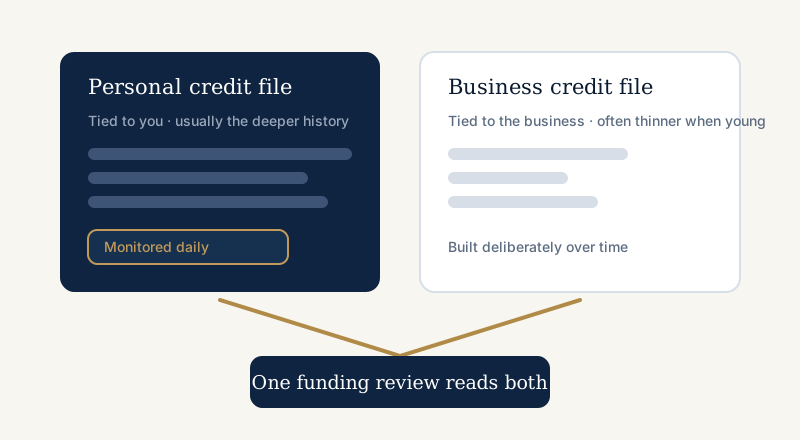
That’s exactly where consumer credit monitoring fits. It watches your personal files at the consumer bureaus and alerts you when anything changes — a new account, an inquiry, a balance movement, a collection. It does not watch business credit files at commercial bureaus like Dun & Bradstreet; that’s a separate system built deliberately over time, covered in how to build business credit. But since the personal file is usually the one under the microscope, watching it is where awareness pays off first. One more wrinkle makes coverage breadth matter: you rarely know which consumer bureau a given lender will pull, and your three files are rarely identical — the case for watching all three is laid out in three-bureau credit monitoring explained.
The funding clock is shorter than you think
Home buyers usually control their timeline; business owners often don’t. The equipment that fails, the bulk-inventory discount with a deadline, the contract that requires working capital to accept — funding needs have a habit of arriving on their schedule. A mortgage applicant can plan a six-month runway; a business owner may get six weeks, or six days. That compression changes what preparation looks like: it rewards the owner whose file is already known over the one who starts checking when the need appears. An error that would be a routine dispute with months of runway — investigations generally run about 30 days — becomes a real constraint on a short clock.
The practical rhythm looks like this. Continuously: monitoring runs in the background, and you read your full reports periodically — free ones are available at AnnualCreditReport.com, and how to read your credit report turns the reading into an audit. When funding moves from “someday” to “soon”: confirm the file is clean, keep utilization in check, and pause new personal credit — the wider countdown of documents and financials lives in how to prepare your business before applying for funding. If you’re rebuilding on the way there: the same watchfulness keeps the progress in rebuilding credit after financial hardship visible while the file strengthens; the honest picture of applying earlier is in can you get business funding with bad credit.
Comparison shopping without collateral damage
Funding rarely means one application to one lender. Owners compare banks, online lenders, and product types — and every comparison involves someone looking at credit. The distinction that keeps shopping from damaging the file you’re trying to protect is soft versus hard inquiries: pre-qualification checks are often soft and invisible to scores, while formal applications typically create hard inquiries that stay on the report — and a cluster of them right before serious applications raises exactly the questions covered in how many hard inquiries is too many.
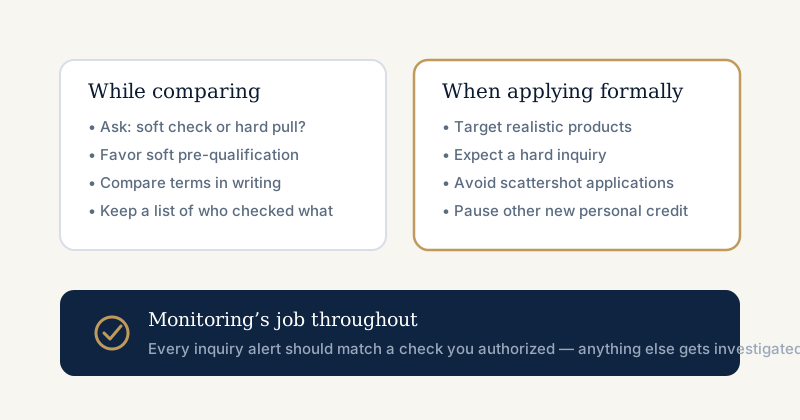
Monitoring’s role here is bookkeeping you don’t have to do by hand. Every inquiry alert should match a check you authorized; when one doesn’t, you’ve caught either a lender pulling harder than promised or something worse — an application that isn’t yours, which calls for the immediate steps in what to do if someone opens an account in your name. Ask each lender what kind of check they run before you agree to it, keep formal applications targeted at products whose stated requirements you plausibly meet, and let the alerts confirm the record matches the plan.
During the review: alerts as your early warning
Once an application is in a lender’s hands, your job shifts from improving the file to not disturbing it — the same logic home buyers know from the quiet period before closing, compressed into a funding review that may run days or weeks. Hold off on new personal accounts and large credit-funded purchases, and keep balances from spiking mid-review. Monitoring inverts its role in this window: earlier, alerts told you what to fix; now, silence is the good news, and an unexpected alert — an account you didn’t open, an inquiry you didn’t authorize, a balance that posted oddly — is precisely what you want to know about within hours rather than after a decision. The mechanics of what triggers an alert and how to respond calmly are in how credit alerts help you stay informed.
For owners who want that watchfulness handled professionally, Credit Consultants Group recommends and provides education around MyFreeScoreNow, an independent third-party platform offering three-bureau scores, reports, and daily monitoring alerts — our reasoning is in why we recommend MyFreeScoreNow, with the wider resource set at the Credit Monitoring hub and the funding-side education at the Business Funding Center. Review any plan’s features, pricing, billing, and cancellation terms before enrolling. For neutral small-business borrowing guidance, the U.S. Small Business Administration’s loan resources are a solid companion.
What monitoring won’t do for your application
Clear limits keep the tool honest. Monitoring will not raise your score — movement comes from what happens in the file over time. It will not build your business credit file; that’s separate, deliberate work. It cannot guarantee approval, an amount, a rate, or a timeline — those turn on each lender’s review of your full picture: credit, revenue, time in business, cash flow, and documentation, all of which vary by lender and product. And it doesn’t replace reading your actual reports — alerts are the alarm, the full report is the audit, and applicants need both. What it reliably does is make sure that whichever file a lender pulls, whenever they pull it, you have already seen everything they’re about to see. For a decision that can land on a short clock, that’s the piece worth controlling. Credit Consultants Group provides education and guidance and does not guarantee approvals, funding amounts, rates, score increases, or specific credit outcomes.
Key takeaways
- Most small-business funding reviews weigh the owner’s personal credit — the file consumer monitoring watches.
- Funding timelines are short and unpredictable — continuous monitoring beats scrambling when an opportunity appears.
- Shop with soft pre-qualification checks, apply formally with intent, and let inquiry alerts confirm every check was one you authorized.
- During review, hold the file steady — silence from your alerts is the good news; a surprise alert deserves fast attention.
- Monitoring informs preparation; it never raises scores or guarantees approvals, amounts, rates, or timelines. Review any plan’s terms before enrolling.