Published July 25, 2026 · Educational information — not legal, tax, lending, or financial advice.
Before you apply
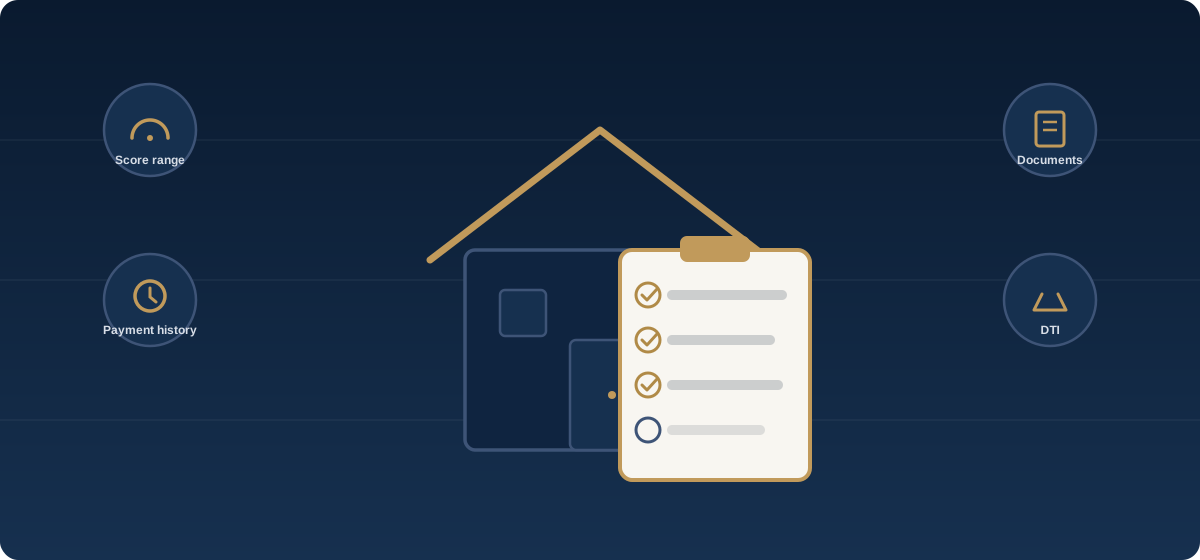
Mortgage underwriting looks at more than a single number. Lenders may review your credit score range, recent late payments, collections or charge-offs, how much of your available credit you’re using, recent hard inquiries, and your debt-to-income picture — alongside the documents that support your application. Working through each item below before you apply can help you spot issues early, ask better questions, and walk into the process with a clearer sense of where your file stands.
This checklist is educational. It is not a guarantee of approval, a specific score, or a specific rate — every lender sets its own underwriting guidelines, and outcomes depend on your full financial picture.
Credit score range
Your score range is often the first thing a lender looks at, and different mortgage programs may work with different ranges. FHA loans can allow lower scores than conventional loans, and VA loans typically don’t set a fixed government minimum, though individual lenders may still apply their own floor. Knowing your general range before you apply can help you understand which programs may be realistic for your situation.
- Know your approximate score range across all three bureaus, not just one.
- Compare your range to the general ranges lenders may look for under FHA, VA, and conventional programs.
- Note that individual lenders may apply their own overlays on top of program minimums.
For more detail on how scores map to loan programs, see what credit score do you need to buy a house, FHA loan credit requirements, and VA loan credit requirements.
Late payments
Payment history is typically one of the most heavily weighted credit factors, and recent late payments may draw more attention from underwriting than older ones.
- Review your reports for any late payments in the last 12–24 months.
- Confirm every account is set up to avoid missed payments going forward (autopay or reminders).
- If you find a late payment that looks incorrect, note it for a possible dispute rather than assuming it will resolve on its own.
See how long late payments stay on your credit report and how to dispute an error on your credit report.
Collections and charge-offs
Open collections or charge-offs may be reviewed differently depending on the loan program, and some lenders may ask about them specifically during underwriting.
- List any collections or charge-offs currently on your reports.
- Note the balance, age, and whether each item has been disputed.
- Understand that paying off a collection does not automatically remove it from your report, and requirements can vary by lender and program.
See can you get a mortgage with a collection on your credit report and should you pay off a collection account.
Credit utilization
Credit utilization — how much of your available revolving credit you’re using — can influence your score and may be part of what a lender reviews.
- Check the balance-to-limit ratio on each revolving account.
- Note your overall utilization across all accounts, not just one card.
- Give balance paydowns time to report before you apply — changes can take a statement cycle or more to show up.
See what is credit utilization.
Hard inquiries
New credit applications generate hard inquiries, which can have a modest, temporary effect on your score and may be reviewed by underwriters as part of your recent activity.
- Count how many hard inquiries appear in the last 6–12 months.
- Avoid opening new credit accounts in the months leading up to your application.
- Flag any inquiry you don’t recognize for review.
See soft inquiry vs hard inquiry and how many hard inquiries is too many.
Debt-to-income concerns
Debt-to-income (DTI) compares your monthly debt payments to your monthly income, and lenders may use it alongside your credit file to evaluate an application.
- Add up your recurring monthly debt payments (cards, loans, existing housing costs).
- Compare that total to your gross monthly income for a general sense of your DTI.
- Consider whether paying down a specific balance before applying may improve your ratio.
Credit monitoring setup
Monitoring your credit in the months before you apply can help you catch changes or errors early, without changing what’s actually on your file.
- Set up ongoing monitoring so you’re alerted to new inquiries, accounts, or changes.
- Review your file at a regular cadence in the months before you plan to apply, not just once.
- Start with a free Credit Snapshot, and consider ongoing monitoring if you want continued visibility.
See what is credit monitoring and credit monitoring before buying a home.
Documents to gather
Beyond credit, lenders typically ask for documentation to support your application. Gathering these ahead of time can make the process smoother.
- Recent pay stubs and W-2s or tax returns, depending on your income type.
- Bank and asset statements for the past two to three months.
- Identification and proof of address.
- A written explanation for any large or unusual deposits a lender may ask about.
Questions to ask before applying
A short list of questions to bring to a lender or loan officer can help you understand where you stand before you formally apply.
- Which loan programs might fit my current credit profile?
- Does this lender apply overlays above the program’s minimum requirements?
- How might an open collection or charge-off be reviewed for this loan program?
- What documentation will you need from me, and when?
- Is there anything in my file that could delay or complicate underwriting?
See pre-approval vs pre-qualification for what typically comes next.
When to request a free credit review
Reviewing your credit early — generally several months before you plan to apply — gives you time to spot issues, consider disputes, and let paydowns report before a lender ever pulls your file. If you’re unsure where your credit stands on any of the items above, requesting a free credit review is a reasonable next step.
Want help reviewing your credit before you apply?
Educational information only, not legal, tax, lending, or financial advice. Results vary; nothing on this page guarantees a specific score, score increase, mortgage approval, interest rate, or removal of any negative item from a credit report. Credit Consultants Group provides education, guidance, and financial-readiness resources, and may provide credit restoration guidance where appropriate. MyFreeScoreNow is an independent, third-party platform that provides the free Credit Snapshot and optional professional credit monitoring referenced on this page. Review MyFreeScoreNow’s product, pricing, billing, and cancellation terms before enrolling. Credit Consultants Group may receive compensation when you enroll through these links.