
Published July 7, 2026 · Educational information — not legal, tax, lending, or financial advice.
Part of the Home Buying & Credit Resource Center.
Quick answer
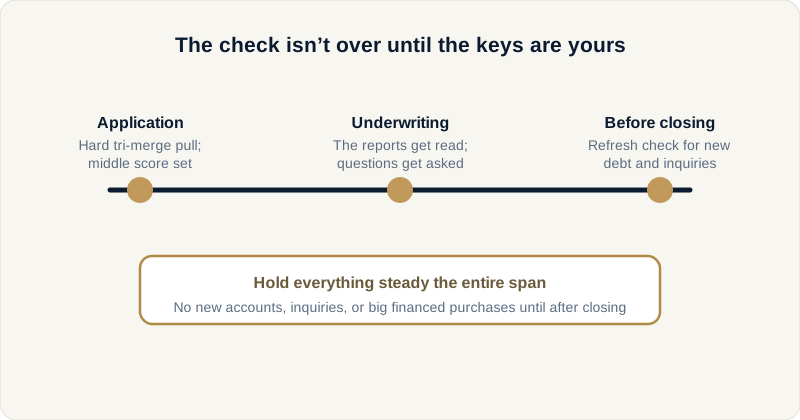
When you formally apply for a mortgage, the lender orders a tri-merge report — a single hard inquiry that pulls your file from all three bureaus at once — and typically qualifies you on the middle of your three scores. But the score is only the opening line: an underwriter reads the reports themselves — every account’s month-by-month payment history, balances and limits, recent inquiries, collections and public records — and may ask for written explanations of anything that raises a question.
The inquiry itself costs little (a small, temporary dip, and clustered mortgage inquiries in a rate-shopping window generally count as one event — how counts and clusters actually read to models and underwriters is covered in how many hard inquiries is too many). Then comes the part that surprises people: many lenders run a refresh check shortly before closing, looking for new debt and new inquiries — so the file has to hold steady from application day until the keys are in your hand.
The tri-merge pull and the middle score
A mortgage credit check differs from most credit checks in its thoroughness: instead of pulling one bureau’s file, the lender orders a tri-merge report that combines all three into a single document, side by side. From the three scores that come with it, lenders have commonly qualified borrowers on the middle one — not the best, not the average — and with co-borrowers, often the lower of the two middle scores.
The logic is simple risk hygiene: the middle score can’t be flattered by one unusually generous file or ruined by one unusually harsh one. The consequence for you is that all three files matter equally: an error sitting on any single bureau can define your middle score while the other two are spotless. It’s also normal for the lender’s numbers to differ from your app’s — mortgage lending can use different scoring model versions than consumer tools display, a gap unpacked in why are my three credit scores different.
What lenders actually see
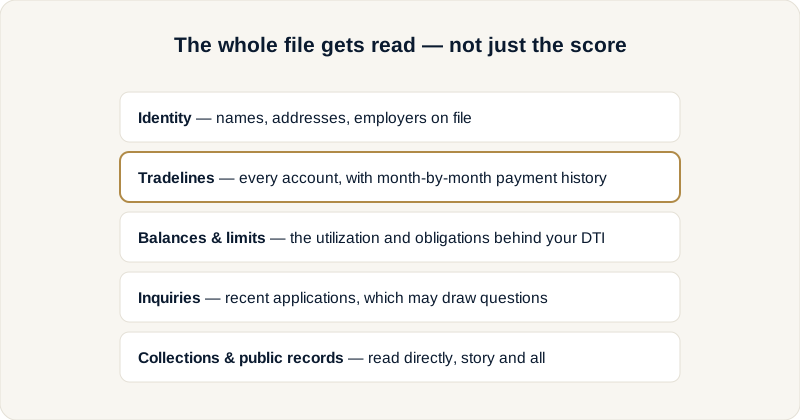
The tri-merge shows the lender essentially everything the bureaus have: your identity information (names, addresses, reported employers), every tradeline with its month-by-month payment grid, current balances against limits, the age of every account, every recent inquiry, and any collections, charge-offs, or public records — the same sections you’d find reading your own file, mapped in how to read your credit report. Two of these get special mortgage-flavored attention. Balances feed directly into your debt-to-income ratio, since the reported minimum payments become the “debt” in that math. And recent inquiries draw questions: a fresh inquiry suggests you may have new debt that isn’t reporting yet, which underwriters routinely ask about. Nothing in the file is invisible — which is precisely why reading it yourself first, months ahead, is the whole game.
Does the mortgage credit check hurt your score?
The application pull is a hard inquiry, and borrowers routinely overestimate what that costs. The typical effect is a small, temporary dip — often just a few points — whose influence fades well before the inquiry stops being visible on the report. More importantly for shoppers: scoring models generally treat multiple mortgage inquiries within a rate-shopping window as a single event, specifically so borrowers can compare lenders without stacking damage. The practical guidance is to shop in a short, focused burst rather than scattering applications across months — the full mechanics are in soft inquiry vs. hard inquiry. One distinction worth knowing at the front end: pre-qualification estimates often use soft inquiries, while full pre-approval typically involves the hard pull — the document-reviewed commitment costs an inquiry because it’s worth one.
How the underwriter reads the file
Once the reports are in, a human (and an automated underwriting system) reads past the score into the story. Recency outweighs existence: a late payment from five years ago in an otherwise clean run reads very differently from one six months old, and a recent pattern of on-time payments after old trouble is a story underwriters recognize. Collections and charge-offs get read directly — the amounts, the dates, whether they’re medical, whether they’re paid — and some programs require certain items resolved before closing.
Open disputes can complicate things: an unresolved dispute at underwriting can hold up the file, which is one more reason the dispute work belongs months earlier, not application week. The good news threaded through all of it: underwriting is a whole-file read, so strength in one area genuinely offsets weakness in another — the score opens the conversation, and the file finishes it. If the read comes back negative, the lender must name the principal reasons — why mortgage applications get denied because of credit walks through what those reasons usually mean.
When the lender asks for a letter of explanation
Somewhere in most mortgage files, the underwriter asks for a “letter of explanation” — a short written answer to a question the report raises. Common prompts: a recent inquiry (what was it for, and did it produce new debt?), a past late payment (what happened, and why won’t it recur?), an address on the file you don’t recognize, a gap in employment, or a large recent deposit.
These letters are routine, not accusatory — the underwriter needs the file to document its own answers, and a clear, honest, boring paragraph is exactly what they want. The best preparation is simply knowing your own file cold before anyone asks: if you’ve read all three reports months ahead, nothing in the letter-writing stage is news to you, and answers that might take days of digging get written in minutes.
One more thing worth knowing before the file is finalized: if the pull surfaces something that is simply out of date — a balance you already paid, a limit reported wrong — your lender may be able to request a rapid rescore, which asks the bureaus to update documented information in days rather than waiting for the next reporting cycle.
The refresh check before closing
The check most borrowers don’t see coming: many lenders re-examine your credit shortly before closing — commonly a soft refresh, though practices vary — hunting for anything that changed since the original pull. New accounts, new hard inquiries, new debt, ballooned card balances: any of these can trigger questions, re-qualification at worst, and delays at best, because your approval was priced on the file as it stood at application.
This is the mechanism behind the classic warnings — don’t finance furniture for the new house before you own it, don’t open a card for the moving expenses, don’t co-sign anything — all catalogued in common credit mistakes before applying for a mortgage. The rule is simple and absolute: from application day to closing day, the file holds still. Celebrate with the new card after the keys.
Two real-world examples
The furniture that almost cost the house. Two weeks before closing, Jasmine finances a bedroom set for the new place — a small monthly payment, she reasons. The lender’s refresh catches the new account and inquiry, underwriting reopens to re-verify her debt-to-income, and closing slips by a week while she documents the purchase. It ends fine, but the lesson is permanent: the loan wasn’t hers until the keys were.
The letter that took five minutes. Underwriting flags two inquiries on Andre’s report and an old address he never lived at. Because he’d read all three files ten months earlier, he already knows the story: the inquiries were his focused rate-shopping window, and the address was a bureau mix-up he’d corrected by dispute — with the paperwork saved. His letters of explanation take minutes, the file keeps moving, and the closing date never wobbles.
Key takeaways
- The application pull is a hard tri-merge of all three bureaus, and the middle score typically qualifies you — so every file matters equally.
- The inquiry costs little — a small temporary dip, with clustered mortgage inquiries in a shopping window generally counted as one event.
- Underwriters read the reports, not just the score — recency, patterns, and the story behind derogatory marks all count, and open disputes can hold up a file.
- Letters of explanation are routine — and effortless when you already know your own file cold.
- The check isn’t over at approval: a refresh before closing hunts for new debt and inquiries, so the file holds still until the keys are yours.