
Published July 7, 2026 · Educational information — not legal, tax, lending, or financial advice.
Quick answer
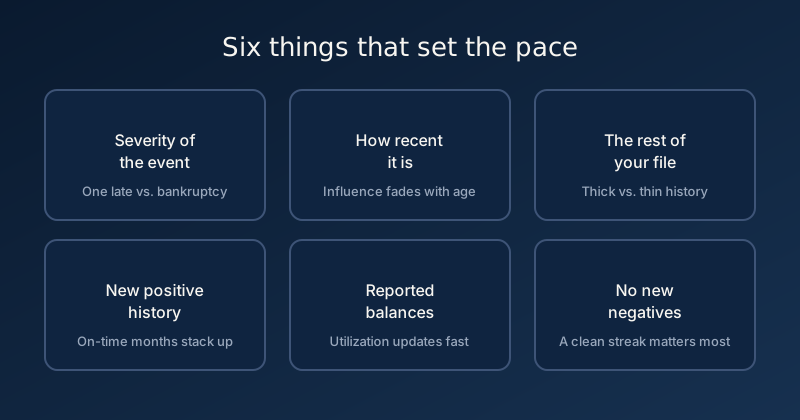
There is no single rebuilding clock. Recovery speed depends on the severity of what happened (one late payment vs. a bankruptcy), how recent it is (influence fades with age), the rest of the file around it (thick, aged files absorb damage better than thin ones), and what happens next (new on-time history and lower balances vs. fresh negatives). Some parts move fast — utilization generally updates as soon as lower balances report. Some move slowly — payment history repairs by accumulation, month after month. Serious entries can influence a file for years while steadily losing weight, and everything ages off eventually, generally around seven years from the original delinquency (up to ten for some bankruptcies). Anyone promising a specific score by a specific date is guessing or selling.
Why there’s no single answer
Two people miss a payment in the same month. One has fifteen years of clean history, low balances, and a mix of well-aged accounts; the other opened her first card eighteen months ago. The identical event lands completely differently — and recovers on completely different schedules — because scores react to whole files, not isolated entries. That’s the core reason every honest answer to “how long?” starts with “it depends”: the question assumes a universal clock, and the scoring math doesn’t contain one.
What the math does contain is a consistent set of levers, and those are worth knowing precisely — because while nobody can tell you the date your file recovers, the factors that set the pace are the same for everyone.
The six factors that set the pace
1. Severity of the event. A single 30-day late and a Chapter 7 bankruptcy are not in the same weight class. Deeper delinquencies (90+, charge-off, collection) and public-record events carry more initial weight and take longer to outweigh.
2. Recency. Most scoring models are built to weigh recent behavior most heavily, because it predicts best. The practical consequence: a negative entry’s influence generally declines as it ages, even while it remains visible on the report.
3. The rest of the file. Thick, aged files with plenty of positive history dilute damage; thin or young files have nothing to dilute it with. This is the single biggest reason identical events produce different recoveries.
4. New positive history. Recovery isn’t just negatives fading — it’s positives accumulating. Every on-time month adds material, and the effect compounds. A file adding clean history recovers on a fundamentally different trajectory from one sitting still.
5. Reported balances. Utilization — balances relative to limits — is recalculated from whatever the file shows right now, with no memory of past months in most models. That makes it the fastest-moving factor in either direction; the mechanics are unpacked in what is credit utilization.
6. Whether the bleeding stopped. Nothing extends a recovery like fresh negatives landing mid-rebuild. Each new late starts its own clock (see how long do late payments stay on your credit report), and one new miss can outweigh months of accumulation. A clean streak is the precondition for every other factor working.
What moves fast, what moves slowly
The rebuild has a fast lane and a slow lane, and knowing which is which prevents both false hope and false despair. In the fast lane: utilization, which updates as soon as lower balances report — often within a cycle or two of a paydown; and error corrections, since a successful dispute removes an inaccurate entry entirely, typically within the roughly 30-day investigation window.
In the slow lane: payment history, which repairs only by accumulation — there is no bulk upload of on-time months, only tools like a secured credit card generating them one calendar month at a time; and account age, which grows in real time and no faster. Serious negative entries sit in their own lane: they fade in influence gradually and fall off on schedule, generally about seven years from the original delinquency — the collection-specific version of that clock, including the fact that it never restarts when debts are sold, is detailed in how long do collections stay on your credit report.
What recovery often looks like, setback by setback
With every caveat above standing, setbacks do have characteristic shapes. An isolated recent late on a healthy file tends to sting sharply and fade over months as clean history stacks on top. High balances without missed payments is the most recoverable situation in all of credit — utilization has no memory, so the damage reverses as the balances come down.
Collections and charge-offs influence a file for years with declining weight; resolving them stops balances from growing and reads better to lenders reviewing the report, though the entries remain until they age off. Bankruptcy is the longest arc — seven to ten years of visibility depending on chapter — but files typically strengthen well before the entry disappears, because the discharge stops new damage and the rebuild starts from a stable floor; the chapter-by-chapter clocks and the post-discharge sequence are mapped in rebuilding your credit after bankruptcy. The full recovery playbook for each scenario lives in the pillar guide, how to rebuild your credit after financial hardship.
What people get wrong about recovery time
“Paying a collection removes it.” Paying updates the status — the entry generally remains until it ages off. Some newer scoring models do treat paid collections more favorably, which is a real but different thing from removal.
“Seven years means seven years of equal pain.” Reporting duration and scoring influence are different measurements. Most entries matter less each year they age, especially under fresh positive history.
“Someone can speed this up for a fee.” The legitimate levers — disputing errors, lowering balances, paying on time — are free and available to everyone. Accurate information cannot lawfully be removed early, whatever the sales page says.
“My score should move every month.” Progress is lumpy. Scores can sit still for months and then move as thresholds are crossed, statements report, or entries age past weighting boundaries. A flat quarter isn’t a failed rebuild.
“Checking my credit slows it down.” Self-checks are soft inquiries and never affect scores — a persistent myth that keeps people from watching their own progress.
How to measure progress honestly
Because recovery is gradual and lumpy, measurement beats feeling. Track three things on a schedule: whether every account reported on time this month (the streak), where reported balances sit relative to limits (the ratio), and whether any new or incorrect entries appeared (the surprises). Watching all three bureaus matters because they don’t always agree, and an error on one file can quietly misrepresent your progress there — the case for making review a routine rather than a reaction is laid out in why monitor your credit year-round. The trend over quarters, not the wiggle over weeks, is the honest signal.
Key takeaways
- There is no universal rebuilding clock — severity, recency, file thickness, and behavior set the pace.
- Utilization is the fast lane: lower reported balances generally register within a cycle or two.
- Payment history is the slow lane: it repairs only by accumulation, month after month.
- Negative entries fade in influence as they age — visibility and weight are different things.
- Anyone promising a specific score by a specific date is guessing or selling.