
Published July 15, 2026 · Educational information — not legal, tax, lending, or financial advice.
Quick answer
Free tools give you depth on your own schedule — full reports from all three bureaus at AnnualCreditReport.com, and a score from some card issuers — at no cost. Professional monitoring adds continuity: an automated watch that alerts you to changes across your credit files, usually with broader change detection and identity features. Professional monitoring tends to earn its place when you have a deadline (a mortgage or funding application), elevated fraud risk, or simply no time for a reliable manual habit. If you consistently review all three bureaus on a schedule and your risk is ordinary, free may be plenty. Importantly, neither one raises your score by itself — monitoring keeps you informed so you can act; the choice depends on your goals and the features you need.
What “free” credit monitoring usually means
“Free” covers a few different things, so it helps to be specific. The federally authorized source, AnnualCreditReport.com, has generally made free weekly access to all three bureau reports available — that means real depth at no cost: every account, inquiry, and address, whenever you choose to look. Many card issuers and banks also show a free score alongside your statement, usually from one bureau and one model, which is why the numbers rarely match across bureaus. And after a data breach, the exposing company sometimes provides a stretch of free monitoring. None of this is a watered-down version of a paid product; it is a genuinely useful, different product. What free tools generally do not do is watch continuously and tell you when something changes — that part depends on you remembering to look.
What “professional” credit monitoring adds
Professional monitoring — the kind offered on a dedicated platform — is built around continuity. Instead of waiting for your next manual review, the service watches your credit files and alerts you within days of a change: a new account, a hard inquiry, an address you don’t recognize. That continuous watch is the whole subject of why monitoring year-round matters. Professional platforms also tend to broaden coverage — watching more than one bureau — and add detection for collections, public records, and personal-information changes, often layered with identity features and resolution support. Some also add a view of your score history over time so you can see the trend, not just a single reading. Exact coverage, alert types, pricing, and terms vary by platform and plan, so the specifics always come down to the plan you choose. Because viewing your own credit is a soft inquiry, none of this costs you score points; the trade-off is a membership fee in exchange for continuity you don’t have to remember.
Side by side: the areas that actually differ
Rather than declaring one option better, it’s more useful to look at the specific areas where free and professional monitoring diverge. Here is how they generally compare — with the reminder that any specific service’s features should be confirmed on its own plan details.
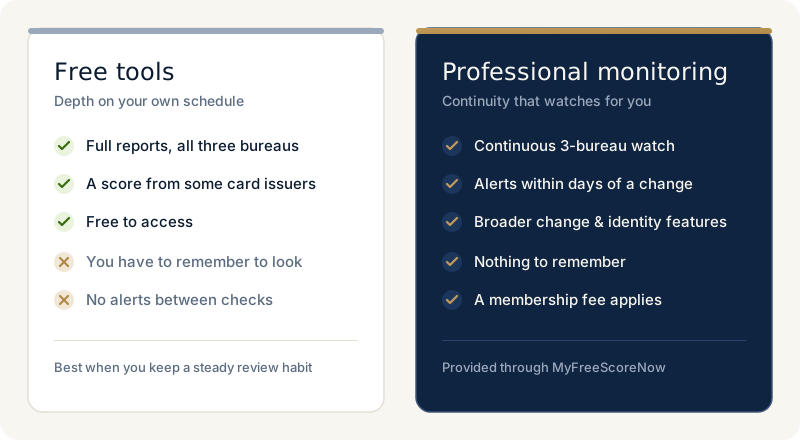
- Type of monitoring. Free is typically on-demand — you pull a report or check a score when you think of it. Professional is continuous — the platform watches and notifies you.
- Credit information access. Free gives full reports from all three bureaus (via AnnualCreditReport.com) plus, sometimes, a single-bureau score. Professional platforms usually centralize scores and monitoring across multiple bureaus in one dashboard — the coverage difference we unpack in three-bureau credit monitoring explained.
- Alerts and notifications. Free generally has none between your own checks. Professional monitoring is built around alerts for new accounts, inquiries, and other changes.
- Educational resources. Free tools mostly hand you the raw data. Credit Consultants Group adds plain-English education either way — but pairing education with a professional platform keeps the information and the explanation close together.
- Preparation for home buying. Both can support mortgage prep, but a continuous watch helps you catch an error or surprise change before it reaches underwriting. Neither guarantees approval or a specific rate.
- Preparation for business funding. When your personal credit backs a funding application, continuity helps you keep that file clean and current. Monitoring is preparation, not a promise of funding.
- Financial readiness overall. Free rewards discipline; professional monitoring reduces how much discipline you need. The better fit is the one you’ll actually use consistently.
Where free is genuinely enough
Free tools can carry a lot of the load. If you keep an honest review rhythm across all three bureaus, your fraud risk is ordinary, no major application is on the calendar, and your files are frozen as a prevention layer, you already cover much of what monitoring watches for. The practical rotation for doing this well is laid out in how often you should check your credit report. The single word that decides it is consistently — free tools only protect you when you actually use them.
Where professional tends to be worth it
Continuity earns its cost in specific situations: after a breach or past fraud, when your data is already exposed; ahead of a mortgage, refinance, or business funding application, when a late-caught error is expensive; when life is genuinely too busy for a reliable manual habit; or when your personal credit underwrites business financing. In those cases, the value isn’t a higher score — it’s time and early warning. If you want a fuller cost-benefit breakdown, see is credit monitoring worth paying for.
How Credit Consultants Group fits in
Whichever path you choose, monitoring is only half the picture — the other half is understanding what you’re looking at, starting with what credit monitoring is in the first place. That’s our role. Credit Consultants Group provides plain-English education, mortgage-readiness and business-funding resources, and credit-recovery guidance. For the professional monitoring itself, we partner with MyFreeScoreNow, an independent third-party platform that provides the credit scores, reports, alerts, and monitoring technology — the full reasoning is in why we recommend MyFreeScoreNow, and our Professional Credit Monitoring hub gathers it all in one place. We combine that professional monitoring with AI-assisted educational guidance — tools and plain-English explanations that help you make sense of your credit information and prepare for decisions like buying a home or seeking business funding. The AI helps explain; it does not make lending decisions and does not guarantee any score change or approval.
Choosing based on your goals
Start from the goal, not the product. If your aim is a steady, low-cost habit and you’re disciplined about it, free tools plus a freeze may be all you need. If your aim is protection ahead of a deadline, or you simply want the watching handled for you, a professional platform’s continuity is the point — just read the plan’s coverage, alerts, pricing, and cancellation terms before enrolling; the full comparison checklist is in what to look for in a credit monitoring service. Many people even do both: free reports for depth, professional monitoring for continuity. There’s no universally correct answer — only the one that matches the features you actually need.
Key takeaways
- Free tools give depth on your own schedule; professional monitoring gives continuity and alerts.
- Neither option raises your score by itself — monitoring keeps you informed so you can act.
- Professional monitoring earns its cost mainly around deadlines, elevated risk, or a busy schedule.
- Confirm coverage, alerts, pricing, and cancellation on any specific plan before enrolling.
- Credit Consultants Group provides the education and AI-assisted guidance; MyFreeScoreNow provides the professional monitoring.