
Published July 20, 2026 · Educational information — not legal, tax, lending, or financial advice.
Quick answer
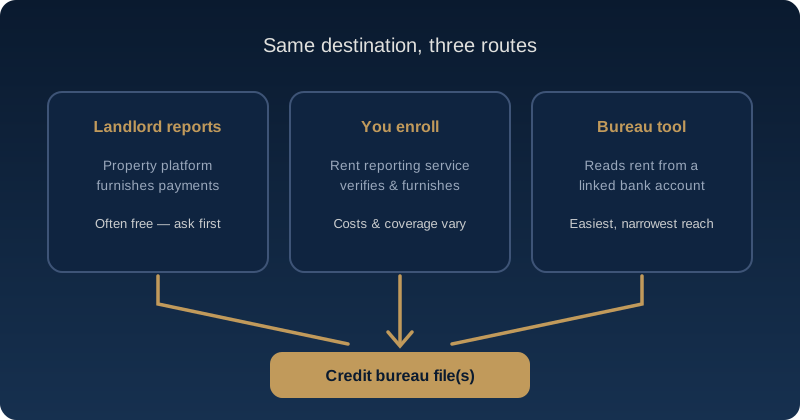
Yes — but only if the payments are actually reported, and only with scoring models and lenders that read rent data. By default, most landlords don’t report rent to the credit bureaus, so years of perfect payments typically leave no trace on your file. Getting rent counted takes one of three paths: a landlord or property manager who reports through their payment platform, a rent reporting service you enroll in yourself, or a bureau tool that reads rent payments from a linked bank account. When reported rent lands on your file, newer scoring models can treat it as payment history — potentially meaningful for thin files — while many older models still ignore it. So the honest framing: rent reporting is a legitimate, increasingly supported credit-building tool with real limitations, not a shortcut. Confirm what a service reports, where, and for how much before paying for it.
Why rent is usually invisible to your credit
Credit reports contain what creditors and furnishers send to the bureaus — and most landlords aren’t furnishers. An individual landlord with a duplex has no reporting relationship with any bureau; even many large property managers collect rent without reporting it. So the system described in what makes up your credit score simply never sees the payment most renters make first and most reliably. The asymmetry stings on the way down, too: while on-time rent goes unrecorded, unpaid rent can still reach your file the hard way — through a collection agency, as covered in what happens when a debt goes to collections. For decades that was the whole story: rent could only hurt, never help. Rent reporting exists to fix the helping half.
The three paths onto your credit report
Path one: the landlord reports. Some property-management payment platforms furnish rent data to one or more bureaus, sometimes free to the tenant or as an opt-in. If this exists where you live, it’s usually the cheapest, most durable option — ask your manager before assuming it doesn’t. Path two: you enroll in a rent reporting service. These services verify your payments — typically by connecting to your bank account or coordinating with your landlord — and furnish them as a rental tradeline. Costs range from free tiers to monthly or annual fees, coverage ranges from one bureau to all three, and some can add up to a year or two of past on-time payments, which matters because history you already earned starts working immediately. Path three: bureau-side tools. Some bureaus offer programs that read recurring payments, including rent, from a linked bank account and factor them into certain scores. These are the easiest to start and the narrowest in reach — generally affecting only that bureau’s file and only some score versions. All three paths produce the same species of data — verified rent payment history — but differ in cost, bureau coverage, and durability, which is why the questions in the choosing section below matter more than any brand name.
Which scoring models actually read rent
Reported rent only helps when the model scoring your file knows what to do with it — and here the landscape is genuinely mixed. Newer models, including VantageScore 4.0 and recent FICO versions, can consider rental tradelines when present, and the broader industry shift toward alternative data — rent, utilities, phone plans — keeps expanding what counts. But many lending decisions still run on older model versions that skip rental data entirely, even when it’s sitting right there on the report. The result is the same unevenness that shows up whenever your three credit scores differ: reported rent might lift the score one lender pulls and do nothing at the next. Mortgage lending is the most interesting frontier — some programs can consider rent history in underwriting, particularly for first-time buyers, and the scoring models being adopted for mortgage use can read rental tradelines — but treatment varies by program, and rent is always one factor among many, never a guarantee of anything.
Who benefits most from rent reporting
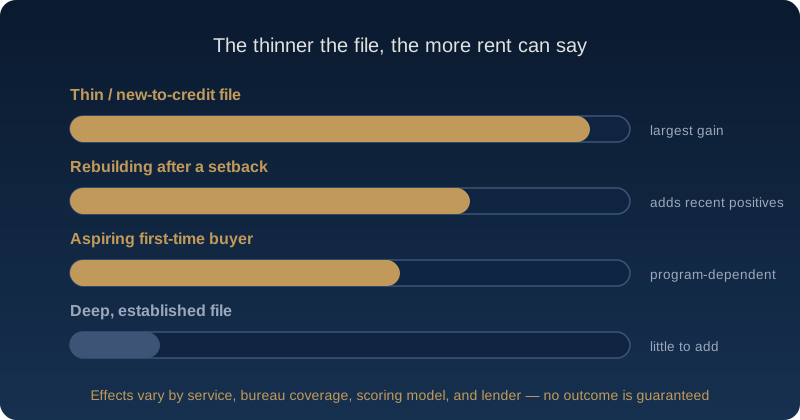
The gains concentrate where the file is thinnest. Someone with no cards and no loans — common among younger renters and anyone who’s avoided borrowing — may have too little history to score at all; a verified rental tradeline can be the first positive entry a model sees, the same first-rung role that secured credit cards, credit-builder loans, and authorized-user status play, without taking on new debt. Rebuilders are the second group: after a setback, the challenge described in rebuilding your credit after financial hardship is stacking recent positive history against old negatives, and rent is positive history most people are already generating anyway. Aspiring first-time buyers round out the list — a documented rent record can support certain mortgage programs’ view of payment reliability, complementing the runway work in preparing your credit before buying a home. On the other end: if you already have a deep file with years of on-time accounts, reported rent typically moves little — the model already knows you pay your bills.
Costs, limitations, and the downside risk
Three cautions keep expectations honest. Cost versus benefit: a paid service at several dollars a month adds up to real money per year for an effect that may be modest and lender-dependent — a poor trade for a thick file, a defensible one for a thin file with a goal ahead. Reach: a service reporting to one bureau helps only files pulled from that bureau; if a future lender pulls elsewhere, the tradeline may as well not exist. The downside risk lives outside reporting: most arrangements furnish positive history, and some report only on-time payments — but seriously unpaid rent can still become a collection or court judgment, which reports and damages your file regardless of any service. Rent reporting changes what your on-time payments do; it doesn’t change what missed ones can do. One more housekeeping note: once a rental tradeline exists, it’s subject to the same accuracy rules as everything else on your file — if a verified on-time month shows as missed, the standard process in how to dispute an error on your credit report applies.
Choosing a reporting path — the questions to ask
Work the free options first: ask your property manager whether their payment platform reports, and check what bureau-side tools cover before paying anyone. If you’re considering a paid service, five questions separate the useful from the decorative. Which bureaus receive the data — all three is meaningfully better than one. How are payments verified — bank-connection or landlord verification carries more weight than self-attestation. What’s the true yearly cost, including setup and any fee to add past payments. Can past on-time payments be included, and how far back. What happens if you cancel — some tradelines persist as closed accounts, while other services’ practices differ, so ask directly. The Consumer Financial Protection Bureau’s credit reports and scores resources are a good plain-language companion for how furnished data and disputes work. Then verify the result yourself: a month or two after enrolling, read your reports and confirm the tradeline actually appears where promised — the walkthrough in how to read your credit report shows where rental accounts show up.
Two real-world examples
The file that finally existed. Priya, 26, has paid rent flawlessly for four years but never carried a card or loan — lenders pulling her file found almost nothing to score. Her property manager’s payment platform offered free reporting to two bureaus; she opted in, and the service included her past twelve months of verified payments. Within a few months, two of her three files showed an active rental tradeline with a year of on-time history. Under the newer models that read it, her file went from unscorable to scorable — not a high score yet, but a starting point, which is exactly what a thin file lacks.
The subscription that wasn’t doing much. Devon, with fifteen years of clean credit across cards, an auto loan, and a paid-off mortgage, signed up for a paid rent reporting service after seeing an ad promising a score boost. The tradeline appeared — at one bureau — and his scores barely moved: his deep file already demonstrated everything the rent data could add. After six months he ran the math on the annual fee, canceled, and put the money toward paying a card balance down instead — a change the models actually weighed.
Key takeaways
- Rent doesn’t build credit by default — it only counts when a landlord platform, reporting service, or bureau tool furnishes it.
- Newer scoring models can read rental tradelines; many older models still used by lenders ignore them — benefits are real but uneven.
- Thin files, rebuilders, and first-time buyers gain the most; deep established files typically see little movement.
- Before paying a service: confirm bureau coverage, verification method, yearly cost, past-payment inclusion, and what happens on cancel.
- Reporting changes what on-time rent can do for you — unpaid rent can still hurt through collections either way.