
Published July 19, 2026 · Educational information — not legal, tax, lending, or financial advice.
Quick answer
A bankruptcy generally reports for up to ten years from filing (Chapter 7) or seven years (Chapter 13) — but its scoring influence fades long before it falls off, especially once fresh on-time history starts stacking on top. The rebuild sequence: verify that every discharged debt reports a zero balance and nothing is still marked open or past due; stabilize with a small cash cushion so the new accounts never slip; add one secured account that reports to all three bureaus; then automate every payment and keep balances low. Lender seasoning periods for big goals like a mortgage are waiting games, not verdicts — the clock runs while you rebuild. And be wary of the “fresh start” offers that target this exact moment: high-fee cards, expensive rebuild loans, and promises to erase accurate entries.
Two chapters, two clocks
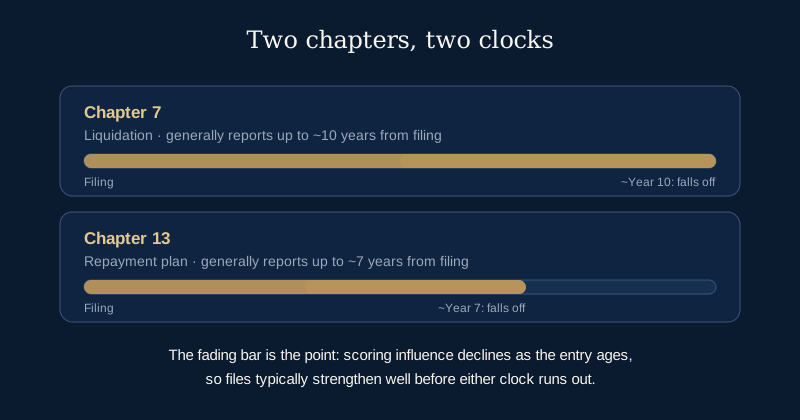
The two consumer chapters carry different reporting windows. Chapter 7 — liquidation, where qualifying debts are discharged without a repayment plan — generally reports for up to ten years from the filing date. Chapter 13 — a court-supervised repayment plan, typically three to five years, followed by discharge of the remaining qualifying balances — generally reports for up to seven. (The mechanics of each chapter are laid out plainly in the federal judiciary’s Bankruptcy Basics.) Here’s the part the raw numbers hide: reporting duration and scoring influence are different measurements. The entry’s weight declines as it ages and as positive history accumulates after it, so files typically strengthen well before either clock runs out — the same aging principle that governs every negative entry, as unpacked in how long does it take to rebuild your credit.
What discharge actually changes
A discharge legally releases you from personal liability on the included debts, which means collectors can no longer pursue them and the accounts stop generating new damage — no more fresh late payments, no more growing balances, no new collection entries on those debts. That’s why a post-discharge file, heavy as it is, is often more stable than the file of someone still mid-spiral: the bleeding has stopped. The rebuild starts from a floor instead of a slope. What discharge does not do is erase history. The bankruptcy entry remains, the accounts it covered remain (marked accordingly), and certain debts — commonly some taxes, most student loans, domestic support obligations — generally survive discharge and still need managing. The broader recovery playbook that this fits inside — stabilize, repair the record, rebuild — is the subject of the pillar guide, how to rebuild your credit after financial hardship.
Verify the file before you build on it
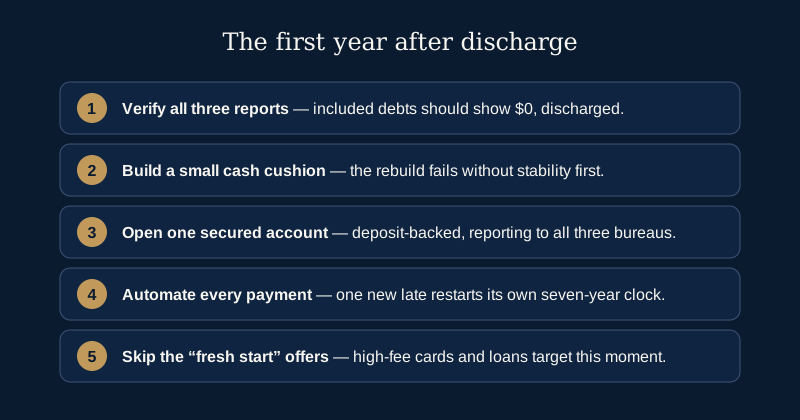
Post-discharge credit reports are famously error-prone, and this step is where free points hide. Pull all three reports and check every account that was included: each should generally report a zero balance with a notation like “included in bankruptcy” or “discharged” — not open, not past due, not carrying the old balance, and not freshly re-reported by a collector as if it were still collectible. Any of those errors misrepresents you as still owing discharged debt, and each is disputable through the standard free process detailed in how to dispute an error on your credit report. If reading the file itself still feels like decoding, start with how to read your credit report. Checking all three bureaus matters because they don’t always agree — an error can live on one file and not the others.
The first-year sequence
The first year has an order of operations, and respecting it is most of the game. First, stability: a small cash cushion — even a modest one — exists so that a car repair never turns into a missed payment on the brand-new accounts you’re about to open. A late payment on a post-bankruptcy file starts its own seven-year clock and undercuts the entire premise of the rebuild. Second, one account, not five: add a single small tradeline, let it report cleanly for a stretch, and resist the instinct to sprint. Third, automation: autopay at least the minimum on everything, because the rebuild is won by the streak, and streaks die to forgetfulness more often than to hardship. Fourth, patience with the scoreboard: progress is lumpy, and a flat quarter isn’t a failed rebuild.
Choosing your first accounts
The standard on-ramp is a secured credit card: you place a refundable deposit that becomes the credit limit, and the card reports to the bureaus like any other — which is exactly the point, because months of on-time payments accumulate as ordinary positive history. Because the deposit limits the issuer’s risk, secured cards are commonly available relatively soon after discharge, when unsecured approvals are still out of reach. Look for no annual fee, reporting to all three bureaus, and a real graduation path — the full selection-and-usage guide, including the low-limit utilization trap and how graduation works, is in secured credit cards for rebuilding credit. A credit-builder loan — where payments come first and the funds unlock at the end — adds installment history and pairs well with a card, and becoming an authorized user on a well-managed account someone you trust owns can layer aged, clean history behind both. What every legitimate tool has in common: it manufactures fresh, on-time payment history, which is the single heaviest input in what makes up your credit score.
Seasoning periods and the big goals
Major lending goals after bankruptcy mostly come down to seasoning periods — program rules requiring a set amount of time between discharge (or dismissal) and a new approval. Mortgages are the classic case: waiting periods vary by loan program and by chapter, with government-backed programs generally among the more forgiving — FHA loan credit requirements covers how that program treats past credit events. Two things make seasoning periods survivable. They’re waiting games, not verdicts — the clock runs on its own while your file strengthens. And they reward exactly the behavior the rebuild requires anyway: by the time the waiting period ends, a file with a year or two of flawless post-discharge history presents far better than the calendar alone suggests. General guidance on rebuilding after financial distress is also available from the Consumer Financial Protection Bureau.
The offers to avoid
The months after a discharge attract a specific ecosystem of offers, because the mailing lists know exactly who just filed. Three patterns deserve a hard look. High-fee “fresh start” cards — subprime unsecured cards whose annual fees, setup fees, and monthly fees can consume most of a small limit before you’ve spent a dollar; a plain secured card almost always beats them. Expensive rebuild loans with rates that turn a credit-building tool into a debt problem. And credit repair pitches promising to remove the bankruptcy or other accurate entries for a fee — accurate information cannot lawfully be deleted early, and the legitimate levers (disputing real errors, paying on time, keeping balances low) are free. If it arrived because you filed, read the fee table twice.
Key takeaways
- Chapter 7 generally reports up to ~10 years from filing; Chapter 13 up to ~7 — but influence fades long before visibility ends.
- Discharge stops new damage on included debts — the rebuild starts from a floor, not a slope.
- Verify all three reports first: included debts should show $0 and “discharged,” not open or past due.
- One secured account, automated payments, low balances — the streak is the strategy.
- Seasoning periods are waiting games, not verdicts — and high-fee “fresh start” offers deserve double scrutiny.