
Published July 10, 2026 · Educational information — not legal, tax, lending, or financial advice.
Quick answer
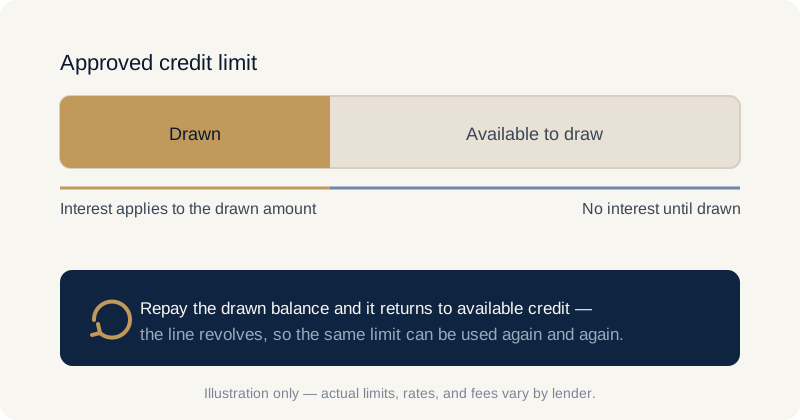
A business line of credit approves your business to borrow up to a set limit, but transfers nothing until you draw. You take only what you need, interest generally applies only to what you’ve drawn, and repaying restores the availability so you can draw again. That revolving structure makes it well suited to recurring or hard-to-predict working-capital needs — covering a payroll gap, buying seasonal inventory, or holding standby capacity — rather than a single, defined purchase. Lines can be secured or unsecured, costs and terms vary widely by lender, and qualification always depends on lender review and eligibility.
What a business line of credit is
A line of credit is a standing arrangement rather than a single transaction. A lender approves your business for access up to a limit — say $50,000 — and from that point the capital is available whenever you need it, in whatever amounts you choose, up to that ceiling. Nothing moves until you actually draw. If this is your first look at the broader funding landscape, the pillar guide What Is Business Funding in New Jersey? maps every major category; this article zooms in on the line of credit specifically.
The core idea: a limit you borrow against
Think of the approved limit as a ceiling, not a deposit. Draw $10,000 for inventory and you owe $10,000, with the remaining $40,000 still available. Interest generally begins on the $10,000 you drew — not the untouched $40,000. When you repay part or all of that balance, the amount you repay becomes available to draw again. The line stays open and reusable, which is what separates it from a one-time loan.
How revolving credit works
“Revolving” simply means the credit replenishes as you repay it. Draw, repay, draw again — the same limit can serve a business many times over. That is a real advantage for needs that recur or arrive on an unpredictable schedule, but it carries a matching risk: a revolving balance that is never fully repaid can quietly settle in and become long-term, higher-cost debt. The discipline involved mirrors credit utilization on the personal side — revolving credit rewards restraint and punishes drift.
Secured vs. unsecured lines
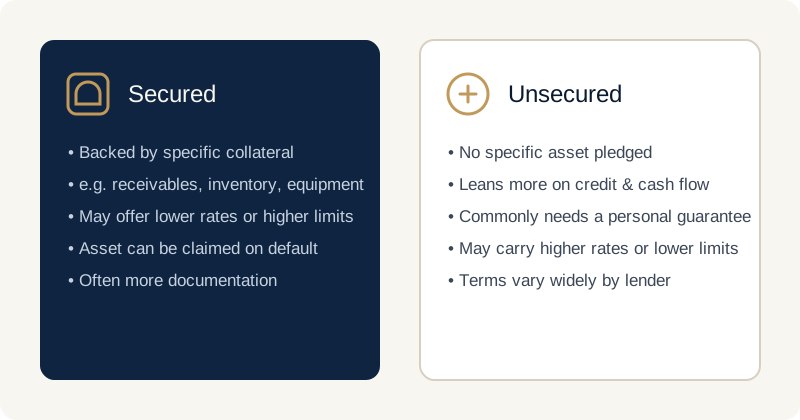
Lines of credit come in two broad forms, and the difference shapes both cost and risk.
Secured lines
A secured line is backed by collateral — often business assets such as accounts receivable, inventory, or equipment, and sometimes a cash deposit. Because the lender has something to claim if the balance goes unpaid, a secured line may come with a lower rate or a higher limit. The trade-off is direct: the pledged asset is genuinely at risk, and a lender can move to claim it if the obligation is not met.
Unsecured lines
An unsecured line pledges no specific asset. That does not mean it is risk-free for the borrower — unsecured lines commonly rely more heavily on credit history and cash flow, and very often require a personal guarantee from the owner, which puts personal assets on the line if the business cannot pay. Unsecured lines may carry higher rates or lower limits to offset the lack of collateral. Whether either type is available, and on what terms, depends entirely on the lender and the business.
What lenders typically look for
There is no single, universal checklist — standards differ meaningfully from one lender to the next. That said, a familiar set of factors comes up again and again, and understanding them helps you see an application the way a lender does.
Personal and business credit
For most small businesses, lenders review both the business’s credit profile and the owner’s personal credit. Business credit reflects how the company has handled its own obligations; personal credit still matters because owners frequently guarantee the debt. If you haven’t looked at your own report recently, How to Read Your Credit Report walks through what lenders will see, and What Credit Score Do You Need for Business Funding in New Jersey? explains why there’s rarely one magic number.
Revenue and time in business
Lenders want evidence that the business generates consistent revenue and has enough operating history to show a pattern. Because a line can revolve indefinitely, many lenders lean especially hard on cash-flow consistency — steady deposits suggest the business can service a balance whenever one exists. Newer businesses and those with uneven revenue aren’t automatically excluded, but they may face narrower options or different terms. Requirements for time in business and minimum revenue vary widely.
Documents lenders may request
Exactly what’s asked for depends on the lender and the size of the line, but requests commonly include some combination of: recent business bank statements, business and sometimes personal tax returns, financial statements such as a profit-and-loss and balance sheet, business formation and ownership documents, and details of existing debt. Having these organized before you apply tends to make the process smoother — the full preparation walkthrough lives in How to Prepare Your Business Before Applying for Funding in New Jersey.
What a line of credit can cost
The rate is only part of the picture. Two lines with identical interest rates can cost very different amounts depending on their fees and how you use them.
Interest
Lines of credit frequently carry variable interest rates that move with the market, though fixed-rate structures exist. Interest generally accrues only on the drawn balance, which is the product’s core cost advantage for occasional use. A rate that looks low today can rise over time if it’s variable, so it’s worth asking how the rate is set and whether it can change.
Draw fees, annual fees, and other charges
Beyond interest, lines can carry a range of fees: an annual or monthly maintenance fee to keep the line open, a draw fee each time you pull funds, an origination fee to establish the line, and sometimes an inactivity fee if you don’t use it. None of these are universal, but they add up — and for a business that draws lightly, the fee schedule can matter more than the headline rate. Read it in full before committing.
How repayment and credit limits work
Repayment on a line typically flexes with your balance: carry nothing and there’s often nothing to pay beyond any standing fees; carry a balance and a minimum payment applies. As you repay principal, that amount returns to your available credit. Limits aren’t necessarily permanent — lenders commonly review lines periodically and may raise, reduce, or change terms at renewal based on the business’s performance. Treat the limit as a reviewed arrangement, not a guarantee of ongoing access.
How it compares to other options
Line of credit vs. term loan
The cleanest contrast is with a term loan, which hands over a lump sum repaid on a fixed schedule with interest on the full amount from day one. A term loan suits a defined, one-time investment where the amount is known; a line suits recurring or uncertain needs where paying interest only on what you use is the efficient structure. Many established businesses eventually hold both. For a side-by-side treatment, see Business Line of Credit vs. Term Loan.
Line of credit vs. business credit card
A business credit card is also revolving, so the two overlap — but they tend to fit different jobs. Cards are convenient for everyday purchases, often come with rewards, and are easy to use at the point of sale, but they typically carry higher rates and lower limits, and drawing cash against them is usually expensive. A line of credit generally offers larger limits and cash access at a lower cost of borrowing, which makes it better suited to sizable working-capital needs like payroll or inventory. Some businesses use both: a card for small recurring expenses and a line for larger, cash-based needs.
When a line fits — and when it doesn’t
Appropriate uses
A line of credit is at its best when the need recurs or the timing is uncertain. Covering payroll while waiting on customer payments. Smoothing seasonal swings in revenue. Restocking inventory repeatedly through the year. Bridging the gap between billing a client and getting paid. Holding standby capacity so a sudden opportunity or a surprise expense doesn’t derail operations. In each case the value comes from drawing capital briefly and repaying it quickly, so interest stays modest.
Risky or inappropriate uses
The same flexibility becomes a hazard when a line is used for the wrong things. Funding a large, one-time purchase that would be better matched to a fixed-schedule loan can leave a revolving balance lingering indefinitely. Using a line to cover ongoing operating losses tends to postpone a problem rather than solve it. Drawing on a line to make payments on other debt can compound difficulty. And carrying a balance at or near the limit month after month turns a short-term tool into expensive long-term debt. A line rewards drawing with a clear repayment plan; it punishes drawing without one.
How to compare offers responsibly
If you receive more than one offer, comparing them fairly takes a little structure, because lenders present terms differently. Rather than anchoring on the advertised rate alone, line the offers up across the factors that actually determine cost and flexibility:
- The interest rate — and whether it’s fixed or variable, and how it can change.
- Every fee: origination, annual or maintenance, draw, and inactivity.
- Whether it’s secured or unsecured, and what collateral or personal guarantee is required.
- The limit, the repayment terms, and how and when the line is reviewed or renewed.
- The total cost for your expected usage pattern — not a generic example.
The honest comparison isn’t “which line is cheapest” in the abstract, but “which is cheapest for the way my business will actually use it.” A line drawn briefly and repaid fast is a different animal from one carried near its limit all year.
How to prepare before you apply
A little preparation tends to make an application clearer and less stressful, whatever the outcome. Know your numbers first: recent revenue, cash-flow patterns, and existing debt. Gather the documents a lender is likely to ask for so you’re not scrambling mid-process. Review both your business credit and your personal credit report so nothing on them surprises you. And get clear on the specific need the line is meant to serve — a defined purpose helps you choose the right limit and avoid borrowing more than the situation calls for. One practical note on credit: pre-qualification checks are frequently soft inquiries, while formal applications may involve hard inquiries, so it’s reasonable to ask each lender which they use before you apply.
Common reasons applications are denied
Applications don’t always succeed, and understanding the usual sticking points can help you strengthen a future one. Lenders commonly cite factors such as limited time in business, revenue that’s too low or too inconsistent for the requested limit, weak business or personal credit history, high existing debt relative to income, incomplete or disorganized documentation, or cash flow that doesn’t clearly support servicing a balance. A denial from one lender isn’t a verdict from all of them — criteria differ — but it’s a useful signal about which area to shore up. Building business credit and tightening documentation over time can widen the options available later; Can You Get Business Funding With Bad Credit in New Jersey? covers that ground in depth.
Questions to ask a lender
Before you commit to a line, a handful of direct questions can surface the details that matter most:
- Is the rate fixed or variable, and what causes it to change?
- What fees apply — origination, annual, draw, inactivity — and when?
- Is collateral or a personal guarantee required?
- How is the line reviewed or renewed, and can the limit be reduced?
- Will the application involve a soft or hard credit inquiry?
- Do you report this account to business and/or personal credit?
Your next-step checklist
- Name the specific, recurring need the line is meant to serve.
- Review both your business and personal credit before anyone else does.
- Gather bank statements, financials, tax returns, and formation documents.
- Compare offers on rate, fees, collateral, limit, and renewal terms together.
- Decide how you’ll repay each draw before you make it — and stick to it.
- Remember qualification depends on lender review and eligibility — nothing here guarantees approval.