
Published July 7, 2026 · Educational information — not legal, tax, lending, or financial advice.
Part of the Home Buying & Credit Resource Center.
Quick answer
A first mortgage doesn’t require perfect credit — it requires an accurate, steady, well-documented file, and that’s buildable with a checklist. The seven items: review your reports from all three bureaus (early, since fixes take time); monitor continuously so nothing lands unseen; protect payment history above all else; keep card balances low relative to limits; open nothing new in the final months; save the documents lenders will ask for; and talk to a lender when the file is ready. Each item has a season on the 12-month countdown, and the don’t list is short but absolute: no new accounts, no co-signing, no big financed purchases, no closed old cards — from the final stretch all the way through closing day.
Why a checklist works
A first mortgage is unfamiliar territory crossed under pressure — new vocabulary, long timelines, and a credit file being read more closely than it ever has been. The antidote to unfamiliar-plus-pressure is a checklist: it converts a vague anxiety (“is my credit good enough?”) into a short list of concrete, checkable actions, most of which cost nothing but attention. It also front-loads the work correctly.
The items that need the most time — error disputes, balance paydowns, history building — come first; the items that need discipline — touching nothing — come last. And it’s worth saying plainly: none of this requires perfect credit. Loan programs exist across a wide range of profiles, and lenders read whole files, not just scores — the ranges are covered in what credit score do you need to buy a house. The checklist’s goal is accurate, steady, and documented — a standard any diligent buyer can reach.
The seven-item checklist
1. Review your credit reports — all three bureaus, line by line, early. Lenders typically qualify you on the middle of your three scores, so an error on any one file can set your price; the walkthrough is in how to read your credit report, and anything wrong gets disputed now. 2. Monitor your credit regularly — continuous watch between deliberate check-ins, so new accounts, errors, and surprises surface with time to act. 3. Avoid late payments — payment history is the heaviest factor in what makes up your credit score, and a fresh late mark lands hardest; automate minimums if it helps.
4. Keep credit utilization low — balances relative to limits are the fastest-moving major factor, mechanics in what is credit utilization. 5. Avoid opening unnecessary new accounts — new inquiries and new tradelines move the file at exactly the wrong moment. 6. Save documentation — the paperwork season starts early (details below). 7. Speak with a lender when ready — pre-approval turns your preparation into a reviewed, documented file sellers take seriously.
Mapping the items to the countdown
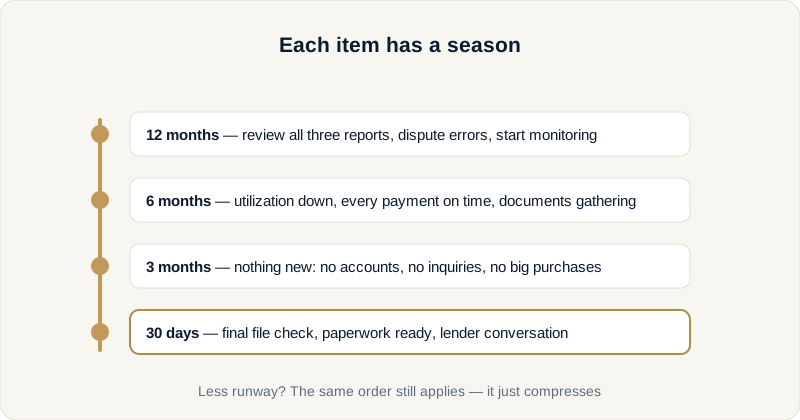
The checklist isn’t seven simultaneous chores — each item has a season. 12 months out: items 1 and 2 — the deep three-bureau read, disputes filed, monitoring switched on. 6 months out: items 3 and 4 do their compounding — every payment on time, balances working down cycle by cycle, and a re-check confirming disputes resolved and lower balances reporting. 3 months out: item 5 becomes the whole job — the file’s goal shifts from improving to holding still.
30 days out: item 6 finishes (paperwork assembled) and item 7 begins (the lender conversation, with a final file check so nothing on the underwriter’s screen is news). The full reasoning behind each milestone lives in preparing your credit before buying a home and how long before buying a house should you check your credit — and if you don’t have a year, the order survives compression: same sequence, shorter seasons.
The don’t list
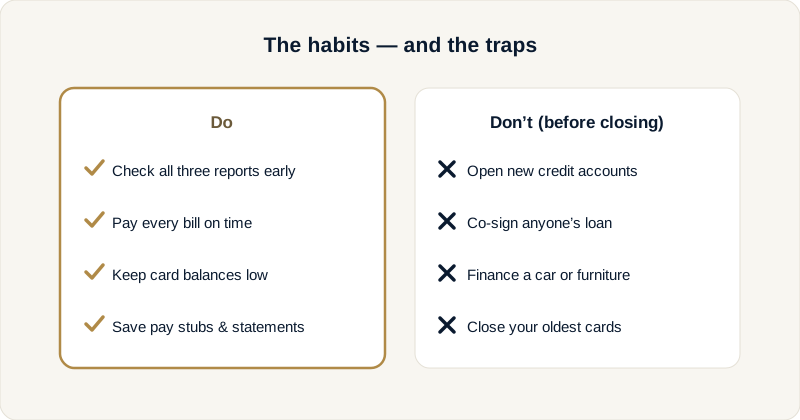
The don’t list is short because the theme is single: don’t change the file. No new credit accounts — not the store card with the discount, not the travel card for the honeymoon. No co-signing anyone’s loan — their debt becomes your debt-to-income. No big financed purchases — the car, the furniture, the appliances all wait until after closing.
No closing old cards — it can shrink your available credit and spike utilization at the worst moment, per can closing a credit card hurt your credit score. And the deadline isn’t application day: lenders commonly refresh your credit before closing, hunting for exactly these moves — the mechanism is detailed in what happens during a mortgage credit check, and the full catalogue of late-stage wounds in common credit mistakes before applying for a mortgage. The file holds still until the keys are in your hand.
The documents to gather
Item 6 deserves its own list, because the buyers who suffer at underwriting are rarely the ones with imperfect credit — they’re the ones hunting for paperwork under deadline. Commonly requested: recent pay stubs; W-2s or 1099s and tax returns, often covering two years; bank statements, often two to three months; documentation of other income; identification; and an explanation trail for any large deposits (underwriters ask where lump sums came from). Self-employed buyers should expect deeper income documentation and start earlier. Add the credit-side paper too: if you disputed errors, keep the dispute results — they answer underwriter questions in one attachment. A single folder, physical or digital, assembled across the year rather than scrambled in a weekend, is one of the quietest advantages a first-time buyer can hand themselves.
When to talk to a lender
Item 7 comes last not because lenders are intimidating but because the conversation is more useful when the file is ready — a pre-approval issued against your best file is a stronger card in every negotiation than one issued against a file mid-repair. “Ready” means: reports read and errors resolved, balances reporting low, several months of spotless payments, documents in the folder.
From there, understand what you’re asking for — pre-approval, not just pre-qualification — and shop more than one lender in a short, focused window, since scoring models generally treat clustered mortgage inquiries as a single event. Ask each lender about first-time buyer programs they work with; many state and local programs offer down-payment help or favorable terms with their own eligibility criteria. The buyer who arrives prepared gets to compare offers instead of hoping for one.
Two real-world examples
The year of quiet moves. Nia starts her checklist thirteen months before house-hunting: reads all three reports (finds and disputes one wrong late payment), sets up monitoring, automates every minimum, and pays her two cards down across the spring. By application day her file is boring in the best way — the pre-approval comes back at a tier she couldn’t have touched a year earlier, and underwriting asks exactly one question she answers from her folder in minutes.
The compressed version. Devon decides to buy with only four months of runway. Same checklist, shorter seasons: reports read in week one (one error, disputed immediately), balances attacked for two reporting cycles, nothing new opened, documents gathered in parallel. His file isn’t everything a year would have built — but it’s accurate, steady, and documented, and the loan closes without drama. The checklist didn’t need a year; it needed to start.
Key takeaways
- Seven items: review all three reports, monitor continuously, protect payment history, keep utilization low, open nothing new, save documents, then talk to a lender.
- Each item has a season: slow work (reading, disputing, paying down) starts at 12 months; pure discipline (touching nothing) owns the final stretch.
- The don’t list has one theme — don’t change the file — and it runs through closing day, because lenders commonly refresh credit before the keys.
- Perfect credit isn’t the bar — accurate, steady, and documented is, and programs exist across a wide range of profiles.
- No year of runway? Keep the order, compress the seasons — the checklist doesn’t need twelve months; it needs to start.