
Published July 20, 2026 · Educational information — not legal, tax, lending, or financial advice.
Quick answer
When a primary cardholder adds you to their credit card as an authorized user, most major issuers report that account to your credit file too — its age, its payment history, and its utilization. If the account is old, spotless, and lightly used, that can be a meaningful lift, especially for a thin file, and it costs nothing: no application, no hard inquiry, no deposit, no legal liability for the debt, and no requirement to ever touch the card. But the pipe flows both ways — the primary’s late payment or maxed-out month can land on your reports just as easily. So the decision is really about the account: confirm the issuer reports authorized users, confirm the history is worth inheriting, and remember the escape hatch — removal is one call to the issuer, and the account can come off your file. Treat it as a supplement to accounts you own, not a substitute for them.
What an authorized user actually is
An authorized user is someone the owner of a credit card account — the primary cardholder — adds to that account. The issuer can send you a card with your name on it, and you can make purchases, but the legal arrangement is one-sided: every dollar of the debt belongs to the primary cardholder. You aren’t applying for anything, so there’s no application to be judged and typically no hard inquiry on your file. What makes the arrangement interesting for rebuilding is a reporting convention: most major issuers report the account to the authorized user’s credit file as well as the primary’s. That means an account’s age, its payment record, and its utilization can appear on your reports — history you didn’t have to build, attached to a payment you don’t have to make. The Consumer Financial Protection Bureau’s credit card resources cover the consumer-protection side of card arrangements like this one.
Authorized user vs. joint holder vs. cosigner
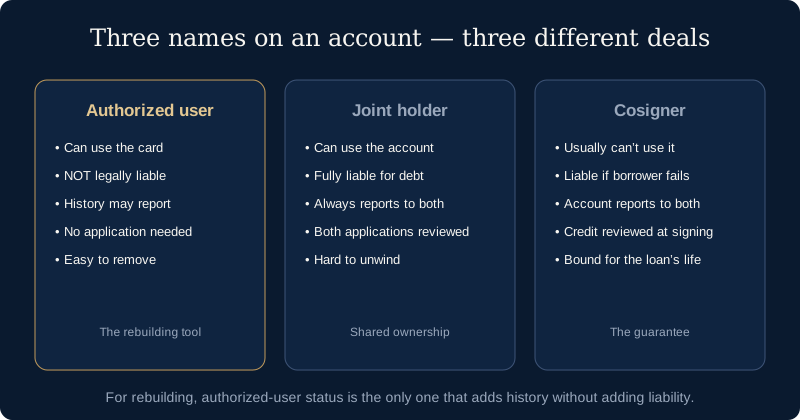
Three arrangements put a second name near an account, and they are nothing alike. A joint account holder co-owns the account: both parties typically apply together, both are fully liable for the balance, and the account reports to both files always — and unwinding it later usually means closing the account. A cosigner guarantees someone else’s loan: they usually can’t use the account, but they’re legally on the hook the moment the borrower doesn’t pay, for the life of the loan. An authorized user is the light-touch version: use without liability, reporting without application, and removal on request. For rebuilding specifically, that last profile is the whole appeal — it’s the only arrangement that can add history to your file without adding a single dollar of legal exposure.
How it can help your file
The lift comes from three inherited properties. Age: a nine-year-old account joining your file can raise the average age of your accounts — a factor that otherwise only grows in real time and can’t be rushed any other way. Payment history: the account’s record of on-time months becomes visible on your reports, feeding the heaviest input in what makes up your credit score. Utilization: the card’s limit joins your available credit, and if its reported balance is low, your overall ratio can improve — the same denominator math explained in what is credit utilization. The effect is generally largest on a thin file, where one aged, clean account has little to compete with, and smaller on a file already crowded with your own accounts. It is not a cure for existing negatives: your own late payments and collections remain yours, on their own clocks.
When it backfires
Everything that makes the pipe valuable makes it dangerous, because the account’s behavior flows to your file in both directions. If the primary cardholder misses a payment, that late payment can appear on your reports — a fresh negative you didn’t cause and can’t prevent, of exactly the kind whose long tail is described in how long do late payments stay on your credit report. If they run the balance up, the card’s high utilization can drag your ratio with it, even while your own accounts are pristine. There’s a human risk too, pointing the other way: if you spend on the card, the primary owes that money — a fast route to damaged relationships. The clean solution to that one is simple: don’t use the card at all. The reporting benefit comes from being on the account, not from spending on it, and many rebuilding arrangements never activate the card in the first place.
Does it always report — and does it always count?
Two honest caveats keep expectations calibrated. First, reporting isn’t universal: most major issuers report authorized-user accounts to the bureaus, but not all do, and policies vary — so confirm with the issuer before anyone files paperwork, because an unreported account helps no one. Second, counting isn’t universal either: scoring models and lenders know authorized-user history is borrowed. Some modern scoring models weigh authorized-user accounts less than accounts you own, and some lenders — particularly in manual underwriting, such as for a mortgage — may look past authorized-user tradelines entirely and ask about the accounts that are actually yours. This is also why the paid shortcut version of this strategy — renting a spot on a stranger’s account through a “tradeline company” — is a poor idea: it costs real money for history lenders are most inclined to discount, and it hands your personal information to a business model built on gaming the system. Borrowed history from someone you actually know, as a supplement, is the version that holds up.
Choosing the account (and the person)
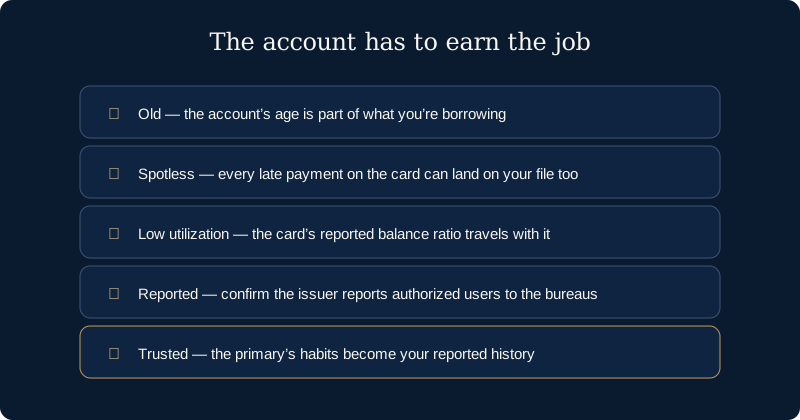
The decision is less “should I become an authorized user” and more “is this account worth inheriting.” Five checks: the account should be old, because its age is part of what you’re borrowing; spotless, because every blemish can transfer; lightly used, because its utilization travels with it; confirmed reporting, because the issuer’s policy on authorized users decides whether any of this reaches your file; and held by someone whose financial habits you genuinely trust, because you’re signing up to inherit their next twelve months, not just their last nine years. Have the conversation plainly: agree on whether you’ll ever use the card (the simplest answer is no), and agree that either side can end the arrangement with one call. A parent, spouse, or sibling with a long, boring, well-run card is the classic profile — and boring is exactly what you want.
The escape hatch: removal
Unlike nearly everything else in credit, this one has an undo button. Either party can contact the issuer and ask to remove the authorized user — typically a quick request with no penalty and no effect on the primary’s account. After removal, the account generally stops reporting to your file, and in most cases the tradeline is removed from your reports altogether, taking its history — good or bad — with it. That’s the strategic point: if the primary’s habits deteriorate and the account starts dragging your file, you aren’t trapped the way a joint holder or cosigner would be. If a removed account lingers on a report, dispute it with the bureaus using the standard process in how to dispute an error on your credit report. Removal also means the benefit is reversible — when the account comes off, so does its lift — which is one more reason it should supplement your own accounts rather than replace them.
Why it can’t work alone
Authorized-user status adds history you didn’t build — which is both its power and its ceiling. Lenders ultimately want to see accounts you own and pay, and a file made entirely of borrowed history reads as exactly that. The durable rebuild pairs this tool with accounts of your own: a secured credit card generating your own revolving history, and a credit-builder loan generating your own installment history — with the authorized-user tradeline as the aged backdrop behind them. Where each piece fits in the larger arc — after hardship, collections, or bankruptcy — is mapped in how to rebuild your credit after financial hardship, with pacing expectations in how long does it take to rebuild your credit.
Key takeaways
- Authorized-user status can add an account’s age, payment history, and limit to your file — with no application, no inquiry, and no liability.
- The pipe flows both ways: the primary’s late payment or high balance can land on your reports too.
- Pick the account like it’s applying for the job: old, spotless, lightly used, confirmed to report — held by someone you trust.
- You never have to use the card — the benefit comes from being on the account, not spending on it.
- Removal is one call to the issuer — and pair borrowed history with accounts you own; it supplements a rebuild, it doesn’t replace one.