
Published July 7, 2026 · Educational information — not legal, tax, lending, or financial advice.
Part of the Home Buying & Credit Resource Center.
Quick answer
The two terms sound interchangeable and aren’t. Pre-qualification is an informal estimate: you state your income, debts, and assets; the lender runs quick math — often with a soft credit check or none — and hands back a ballpark. Pre-approval is a documented review: pay stubs, tax documents, and bank statements are verified, credit is pulled with a hard inquiry, and the lender issues a written, conditional commitment for a specific amount, typically good for 60–90 days.
The division of labor follows: pre-qualification suits the exploring stage months out; pre-approval belongs at the start of serious shopping, since sellers and agents commonly expect the letter with an offer. Neither is a guarantee — final approval comes from underwriting after you’re under contract — and the credit rules differ too: soft checks (most pre-quals) never touch a score, while the hard inquiry behind a pre-approval can nudge one a few points. The letter is only as strong as the file behind it, which is why the credit work comes first.
Pre-qualification: the ballpark
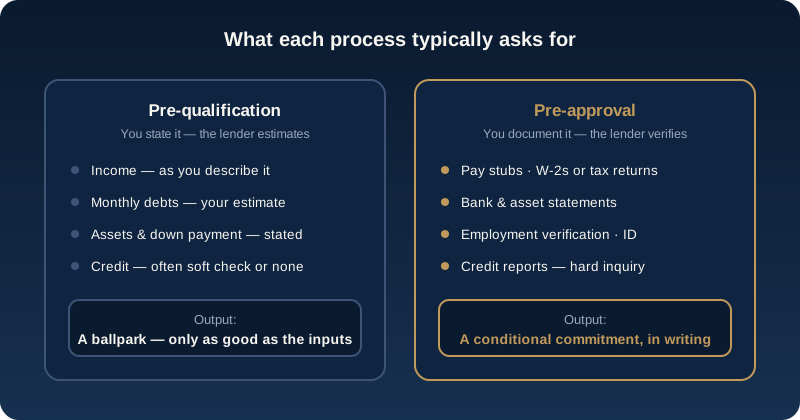
Pre-qualification is a conversation with arithmetic attached. You tell a lender — on a call, a form, or a website — roughly what you earn, what you owe monthly, and what you’ve saved; the lender applies standard ratios and returns an estimate: “based on what you’ve told us, you might qualify for about this much.” Nothing is verified.
Credit is often checked softly or not at all, income is taken at your word, and the result is only as accurate as your inputs — overstate income or forget a car payment, and the ballpark inflates accordingly. That’s not a flaw; it’s the design. Pre-qualification exists to answer an early, low-stakes question — is the budget I’m imagining realistic? — quickly and without commitment, before you’ve decided whether to start the real preparation. The math it runs is mostly the debt-to-income arithmetic covered in understanding debt-to-income ratio when buying a home, just with unverified numbers.
Pre-approval: the reviewed file
Pre-approval replaces your word with your paperwork. The lender collects documentation, pulls your credit from the bureaus with a hard inquiry, verifies employment, and has an underwriter or automated system review the file. What comes back — if the review goes well — is a pre-approval letter: a written, conditional commitment to lend up to a specific amount, commonly valid for 60 to 90 days before the file goes stale and needs refreshing. The letter carries weight the ballpark doesn’t.
To a seller weighing offers, a pre-approved buyer has already survived a lender’s scrutiny; the deal is less likely to collapse in financing. That’s why in many markets the letter is effectively the price of admission — agents ask for it before showings, and listing agents expect it stapled to the offer. The trade for that weight: real documents, a real credit pull, and a file that has to actually hold up — what that pull involves, step by step, is in what happens during a mortgage credit check.
The documentation, side by side
Requirements vary by lender and loan type, but the pattern is consistent. Pre-qualification asks for statements: your income as you describe it, your monthly debts as you estimate them, your savings as you report them — minutes of effort, no paperwork. Pre-approval asks for proof: recent pay stubs; W-2s or tax returns, often covering two years and typically more extensive for self-employed borrowers; bank and asset statements showing the down payment and reserves; photo ID; and written authorization to pull credit.
Gathering it takes days if the records are organized and weeks if they aren’t — which is its own argument for starting early. One preparation step costs nothing and protects the whole stack: read your own reports before the lender does. The debt side of your file feeds the lender’s math directly, and an error inflating a balance or showing a false late payment is cheapest to dispute before it’s embedded in an underwriter’s review — the walkthrough is in how to read your credit report.
Which one do you need right now?
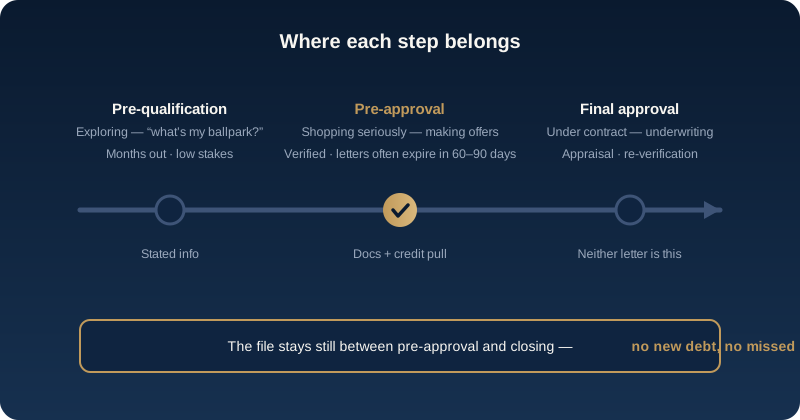
The two steps belong to different moments on the same timeline. Pre-qualification fits the exploring stage — six months to a year out, when the questions are “what price range is realistic?” and “should I start preparing?” It’s fast, free, commitment-light, and its answer shapes the preparation itself: a ballpark that lands below the homes you want tells you which levers — debt paydown, savings, credit work — need the months you still have, the countdown laid out in preparing your credit before buying a home.
Pre-approval fits the start of serious shopping — when you’re touring homes you might actually bid on. Get it too early and the 60–90-day clock expires mid-search, forcing a refresh; too late and the right house appears while your offer waits on paperwork. Many buyers run the sequence — pre-qualify while exploring, pre-approve when the search turns real; buyers on short timelines with organized files often skip straight to pre-approval. Neither order is wrong. What’s wrong is shopping seriously with only a pre-qualification in a market where every competing offer carries a letter.
How credit fits into both
Credit runs through both processes, but at different depths. Pre-qualification typically involves a soft inquiry or no credit check at all — soft pulls never affect scores, which is what makes the step costless to repeat while exploring. Pre-approval means a hard inquiry: the lender pulls your reports, and often a mortgage-specific score, from the bureaus. A single hard pull may trim a few points temporarily — the mechanics are in how long do hard inquiries stay on your credit report — and scoring models treat multiple mortgage inquiries within a shopping window as one event, so comparing several lenders inside that window doesn’t stack the cost.
Two implications follow. First, the file should be ready before the hard pull, not after: the score the lender sees at pre-approval is the score that starts shaping your pricing conversation, which is why the preparation work — utilization down, errors disputed, no new accounts — belongs in the months before the letter, per common credit mistakes before applying for a mortgage. Second, the pre-approval isn’t the last look: lenders commonly re-check credit before closing, so the file has to stay still — no new debt, no missed payments — from letter to keys.
What neither one is
Neither a pre-qualification nor a pre-approval is a loan. Final approval happens in underwriting, after you’re under contract on a specific property: income and assets are re-verified, the home is appraised, title is checked, and credit is often pulled again days before closing. A pre-approval can shrink or evaporate between letter and closing if the file changes — a financed car, a new credit card, a missed payment, a job change — which is why the strongest buyers treat the pre-approval not as a finish line but as the start of a stillness period. The letter says a lender reviewed the file and liked it; the closing depends on the file still looking that way when the lender looks again.
Key takeaways
- Pre-qualification is a stated-info estimate; pre-approval is a verified, written, conditional commitment.
- Pre-approval typically means pay stubs, tax documents, bank statements, and a hard credit pull; pre-qualification means minutes and your word.
- Pre-qualify while exploring; pre-approve when the shopping turns serious — letters commonly run 60–90 days.
- Soft checks (most pre-quals) never touch a score; the hard pull behind pre-approval can trim a few points, and mortgage shopping windows count multiple pulls as one.
- Neither is final approval — underwriting re-verifies everything, so the file stays still from letter to closing.