
Published July 20, 2026 · Educational information — not legal, tax, lending, or financial advice.
Quick answer
Historically, most buy now, pay later (BNPL) plans didn’t affect credit scores because providers didn’t report them to the credit bureaus. That’s changing: FICO has introduced scoring models designed to read BNPL data, more providers have begun furnishing plan and payment information, and the bureaus are building BNPL into reports. The practical translation: on-time BNPL payments may start helping — especially thin files with little traditional history — while missed payments, once invisible, can now show up and hurt. Adoption is gradual and varies by provider, bureau, scoring model, and lender, so the same plan can matter at one lender and not at another. The reliable move is the boring one: pay every installment on time, keep open plans few enough to track, and read your own reports so you know what’s actually being reported before a lender does.
The credit blind spot BNPL lived in
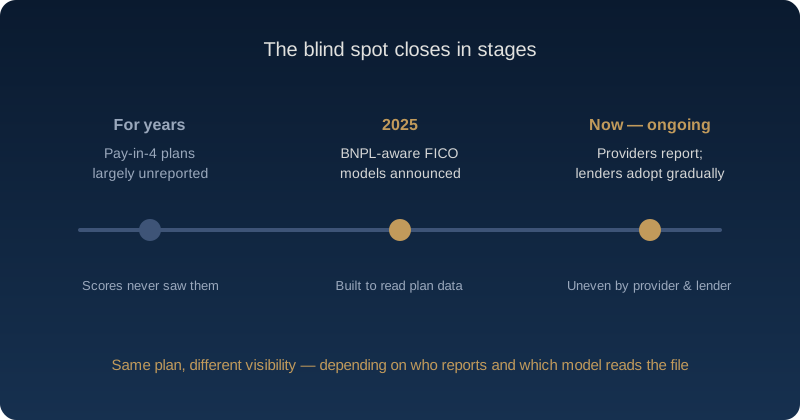
Pay-in-4 plans became one of the most widely used forms of short-term credit in the country while remaining almost entirely absent from credit reports. You could split a dozen purchases into installments, pay every one perfectly — or pay every one late — and the file lenders reviewed wouldn’t show any of it. The plans were real borrowing, but they didn’t feed the system described in what makes up your credit score: no tradeline, no payment history, no utilization, nothing. The one exception was failure at the far end — an unpaid balance sold to a collection agency could surface as a collection account, the same way any unpaid bill can, as explained in what happens when a debt goes to collections. Short of that, BNPL was credit that didn’t count — in either direction.
What changed — and what’s still changing
Three shifts are closing the gap, on different clocks. First, scoring models: FICO announced BNPL-inclusive scoring models in 2025, built to read pay-in-4 activity as its own account type rather than forcing it into the credit-card or installment-loan boxes. Early published testing suggested most consumers would see only modest movement — on the order of small single-digit to low double-digit point changes — with on-time payers more likely to hold steady or improve. Second, reporting: more BNPL providers have begun furnishing plan and payment data to one or more bureaus, though practices differ by provider and product, and some plans still go unreported. Third, adoption: a scoring model only matters when a lender actually uses it, and lenders migrate slowly — many decisions today still run on models that don’t read BNPL data at all. That’s why the honest answer to “does BNPL affect my score?” is increasingly, and unevenly: the same plan can be visible at one bureau and absent at another, scored by one lender’s model and ignored by the next. It’s a fresh example of why your three credit scores can differ — the underlying files and models aren’t identical.
When BNPL can help your credit
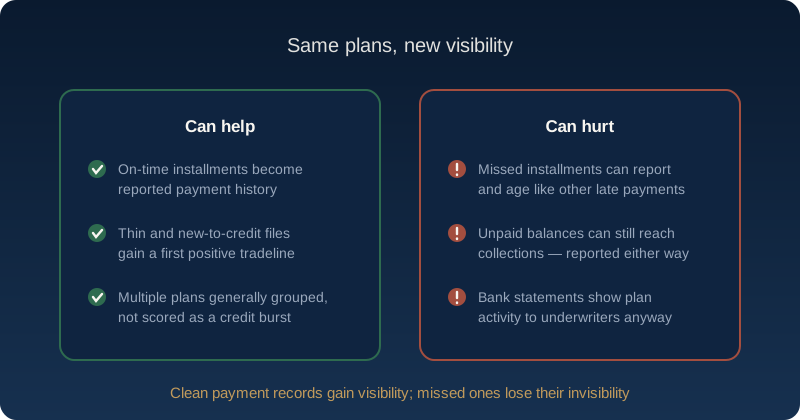
For a plan to help, two things have to line up: the provider reports it, and the model reading your file considers it. When they do, consistent on-time installments become payment history — the heaviest factor in most scoring models. The consumers with the most to gain are the ones traditional scoring has the least to say about: young files, new-to-credit files, and anyone whose borrowing has mostly lived outside the reported system. For someone with no cards and no loans, reported BNPL activity can be among the first positive tradelines a model sees — a role that used to belong almost exclusively to products like the ones covered in secured credit cards for rebuilding credit. One design detail works in consumers’ favor: BNPL-aware models generally aggregate multiple plans rather than scoring each pay-in-4 as a brand-new account, so ordinary usage patterns — several small plans across a season — aren’t automatically read as a burst of new credit. None of this is guaranteed, and no one should open BNPL plans in order to build credit; but if you already use the plans and pay them cleanly, the reporting shift moves that record from invisible to potentially useful.
When BNPL can hurt your credit
The same visibility cuts the other way, and this is the half catching people off guard. A missed installment at a reporting provider can now appear on your file and age the way other late payments do — the timelines in how long late payments stay on your credit report apply to any reported late payment, whatever product it came from. Balances that go unpaid long enough can still take the old path into collections, which reports regardless of what the original provider does. And beyond scoring, there’s the underwriter’s eye: lenders that review bank statements — standard in mortgage underwriting — can see a rhythm of BNPL debits even when nothing appears on the credit report, and a file dense with overlapping payment plans invites questions about obligations that haven’t been disclosed. If a score dips after a forgotten fourth installment finally reports, that’s the new reality doing exactly what it was built to do — and one more entry for the list in why credit scores drop overnight.
Applications, inquiries, and approvals
Most pay-in-4 approvals run on a soft check — the kind that never touches a score, as unpacked in soft inquiry vs. hard inquiry. That’s part of why the plans feel frictionless at checkout. The exception is longer-term financing that some BNPL providers offer — multi-month installment loans, often interest-bearing — which can involve a hard inquiry like any other loan application. The application flow generally discloses which check is used; the disclosure is worth the ten seconds it takes to read, especially in the months before a major application when inquiry pacing matters, a discipline covered in how many hard inquiries is too many.
Managing BNPL before a big application
If a mortgage, auto loan, or business funding application is on the horizon, BNPL management is mostly about simplifying the story your file tells. Inventory every open plan — they’re easy to lose track of precisely because each one is small. Bring anything past due current first; a reported late installment costs far more than the purchase was worth. Then let plans close out without opening optional new ones, so bank statements and any reported tradelines show obligations winding down rather than multiplying. Throughout, read your own reports — a soft self-check, free to repeat — to see which plans are actually reporting and to catch anything unfamiliar; the walkthrough in how to read your credit report shows where new account types appear. The Consumer Financial Protection Bureau’s credit reports and scores resources are a solid plain-language reference as BNPL reporting practices continue to evolve. And if an entry looks wrong — a plan you didn’t open, a payment marked late that wasn’t — the standard dispute process applies, step by step in how to dispute an error on your credit report.
Two real-world examples
The thin file that thickened. Amara, 24, has no credit cards and one student loan — a file most models can barely score. She’s used pay-in-4 plans for two years, every installment on time, and her main provider began reporting last year. Under the BNPL-aware model one of her lenders uses, that history now reads as consistent payment behavior on an active account type. It’s not a dramatic jump — early testing suggested most movement is modest — but her file went from nearly empty to showing a payment pattern, which is the difference that matters when a lender needs something to evaluate.
The forgotten fourth payment. Marcus split a purchase into four installments, changed banks mid-plan, and the final autopay failed quietly. Two years ago, nothing would have happened to his credit. This time his provider reports, the installment went 30 days late before he noticed, and the late payment surfaced on his file three months before a planned auto-loan application. The damage isn’t catastrophic — one late payment on an otherwise clean file — but it’s real, it’s recent, and it was entirely preventable with an autopay check after the bank switch.
Key takeaways
- BNPL spent years unreported — newer scoring models and provider reporting are ending the blind spot, gradually and unevenly.
- Reported on-time installments can become payment history — the potential upside is largest for thin and new-to-credit files.
- Missed installments lost their invisibility — reported lates age like any others, and unpaid balances can still reach collections.
- Most pay-in-4 approvals are soft checks; longer-term BNPL financing can carry a hard inquiry — the disclosure says which.
- Before a big application: inventory plans, cure anything past due, let plans wind down, and read your own reports to see what’s reporting.