
Published July 21, 2026 · Educational information — not legal, tax, lending, or financial advice.
Quick answer
Most people don’t need one — because a credit repair company has no rights, tools, or access you lack. The lawful repair toolkit is three items long: disputes for inaccurate entries, goodwill letters for accurate lapses, and debt validation for collections — and every one of them is free to use yourself, through processes designed for consumers. What a company sells is labor: reviewing your reports and mailing the letters for a monthly fee. That can be worth paying for as a convenience, the way tax preparation is. What it can never deliver — no matter the marketing — is removal of accurate, timely negative information. Nobody can. Federal law (CROA) backs this up: no charging before work is performed, a written contract, a right to cancel, and no advice to misstate your identity. Anyone promising guaranteed removals, demanding payment up front, or selling a “new credit identity” has answered the question in this article’s title for you.
What repair companies actually do
Strip away the marketing and the legitimate version of the service is straightforward: a repair company pulls your credit reports, flags entries that may be inaccurate or unverifiable, and files disputes with the bureaus and furnishers on your behalf — sometimes supplementing with goodwill letters or debt validation requests, usually for a monthly fee for as long as you stay subscribed. Understand what that is and isn’t. It is process management: someone else tracking deadlines, drafting letters, and reading responses. It isn’t leverage: there is no special portal, no professional-grade dispute, no relationship with the bureaus that changes outcomes. The Fair Credit Reporting Act gives the dispute right to you, the consumer — a company acting on your behalf borrows your rights; it doesn’t bring its own. That’s why the honest framing of the purchase decision is the same as tax preparation or lawn care: you’re buying time and attention, not results the tools couldn’t produce in your own hands. The Consumer Financial Protection Bureau’s credit reporting resources document those consumer rights in detail.
What nobody can do
One sentence sorts every credit repair claim ever made: accurate, timely, verifiable negative information generally cannot be removed by anyone. A late payment that really happened, a legitimate collection inside its reporting window, a charge-off that reflects a real default — these stay for their full term, typically about seven years, regardless of who disputes them, how often, or how aggressively. Dispute volume doesn’t wear the system down; it just recycles verifications. The playbooks for what accurate negatives actually respond to are already in this Learning Center: time and severity mechanics in how long do late payments stay on your credit report and how long do collections stay on your credit report, and the discretionary courtesy path in how to write a goodwill letter — a request any consumer can make directly, no intermediary required. When a company’s pitch depends on making accurate items vanish, the pitch is the problem: it’s promising an outcome the law doesn’t permit and the bureaus don’t deliver.
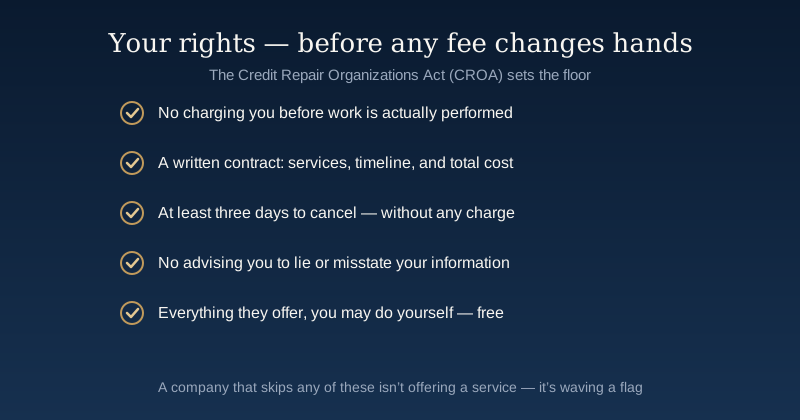
Your rights: CROA sets the floor
Congress addressed this industry directly in the Credit Repair Organizations Act, and its rules double as a screening test. A credit repair organization can’t charge you until the promised services have actually been performed — the advance-fee ban that most scams violate first. It must give you a written contract spelling out the services, the timeline, and the total cost, plus a written notice of your rights — including the right to do everything yourself for free. You get at least three days to cancel without charge. And no company may advise you to make untrue statements to the bureaus or to misrepresent your identity. State laws often layer on bonding and licensing requirements. The practical use of all this isn’t litigation — it’s that a company’s relationship with these rules tells you who you’re dealing with before any money moves. An operation that charges up front, skips the contract, or coaches you to “dispute everything” has already shown you how it treats legal obligations. Assume its promises get the same treatment.
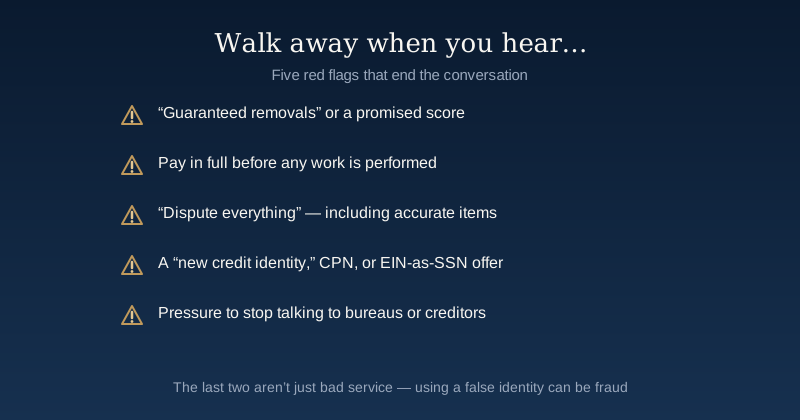
Red flags that end the conversation
Five signals, any one of which is disqualifying. Guaranteed removals or a promised score — outcomes nobody controls, sold as certainties. Payment before work — a direct CROA violation dressed as a “setup fee.” Instructions to dispute accurate information — a strategy that wastes the tool, can undermine your credibility, and puts your name on claims you know are false. A “new credit identity” — typically a CPN (“credit privacy number”) or an EIN offered in place of your Social Security number; using a false identifier on a credit application can constitute fraud, and the consequences attach to the applicant, not the company that sold the number. Pressure to cut off contact with the bureaus or your creditors — isolation that mostly serves to keep you from discovering what’s being filed in your name. The last two aren’t bad service; they’re invitations to participate in schemes with legal exposure. Walking away isn’t caution — it’s the whole point of knowing the list.
The DIY toolkit — free, and yours already
The entire lawful repair toolkit fits in three moves, each with a walkthrough in this Learning Center. For entries that are wrong: the dispute process in how to dispute an error on your credit report — a legal right, free, with a roughly 30-day investigation clock the bureaus must honor. For entries that are true but isolated: the goodwill request in how to write a goodwill letter — discretionary, free, and most persuasive coming from the actual customer. For collections: debt validation, covered in what happens when a debt goes to collections — making a collector demonstrate the debt is real, yours, and correctly stated before anything else happens. Around all three sits the part no letter performs: the rebuild itself — on-time payments, low balances, and accounts of your own, sequenced in how to rebuild your credit after financial hardship. Doing it yourself isn’t the budget option; it’s the informed one. You know your own history, you control what’s claimed in your name, and every response comes straight to you.
When paying for help makes sense
The honest case for paid help exists — it’s just narrower than the industry’s marketing. If your reports carry many entries across all three bureaus, the errors are tangled (identity mix-ups, duplicated collections, a fraud cleanup), and your time is genuinely scarce, paying a reputable, CROA-compliant firm to manage the paperwork is a legitimate convenience purchase — evaluated like any service: written contract, fees after work, realistic claims, and you stay in the loop on every dispute filed. Two alternatives deserve a look first. For debt strategy, budgeting, and hardship plans, a nonprofit credit counseling agency typically offers more value per dollar than dispute-mailing — and addresses causes rather than entries. And for one specific situation — correct-but-outdated report data standing between you and a mortgage closing — the lender-initiated path in rapid rescore explained is the tool built for the job, not a repair subscription. Whatever route you take, verify the results yourself on your own reports — that part was never delegable.
Key takeaways
- A repair company borrows your rights — it has no tools, access, or leverage you lack, and everything it files, you could file free.
- Accurate, timely negatives can’t be removed by anyone — they age off on schedule while new positive history builds over them.
- CROA is your screening test: fees only after work, written contract, cancellation right, no coached falsehoods — violations tell you everything.
- Guaranteed removals, up-front fees, “dispute everything,” CPNs, and cut-off-contact pressure each end the conversation on their own.
- The free toolkit — dispute, goodwill, validation — plus your own rebuild covers most situations; paid help buys labor, never leverage.