
Published July 6, 2026 · Educational information — not legal, tax, lending, or financial advice.
Quick answer
A credit report has five sections: personal information (names, addresses, employers), accounts (your cards and loans, each with balance, limit, status, and a month-by-month payment history grid), inquiries (who pulled your file and when), collections and public records (third-party debts and bankruptcies), and dispute instructions. Read the whole thing with two questions: what’s hurting me (late marks, high balances relative to limits, collections) and what isn’t mine (unfamiliar accounts, inquiries, addresses). The first list is your improvement roadmap; the second is a fraud signal. Errors get disputed — the report itself tells you how — and remember it shows data, not a score: those are separate products.
Getting your copy
Federal law entitles you to free copies of your credit reports from each of the three major bureaus through AnnualCreditReport.com — currently available weekly, which makes the old ration-them-out strategy unnecessary. Pull from all three at least occasionally: the bureaus maintain separate files, lenders don’t all report to all three, and an error or fraud item can sit on one file while the other two stay clean.
Checking your own report is a soft inquiry with zero score impact, no matter how often you do it. What lands in your hands is a data document, not a scorecard — the report/score distinction is its own topic, covered in credit report vs. credit score — and the reading rhythm that keeps this from being a once-a-decade event is in how often should you check your credit report.
Section 1: Personal information
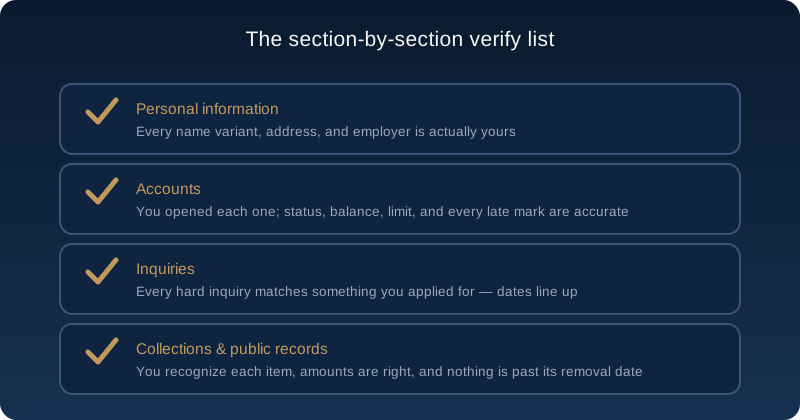
The header section lists every name variant, address, employer, and phone number that creditors have reported for you — and it’s longer than you expect, because it accumulates: maiden names, old apartments, a typo’d middle initial from a decade-old application. Most of it is harmless history. What you’re verifying is that every entry traces to you: an address you never lived at or an employer you never had can mean someone else’s applications are feeding data into your file, which is one of the quieter fraud signals covered in how to spot identity theft. This section doesn’t affect your score at all — but it’s where mixed files (your data tangled with a similarly-named stranger’s) and identity issues show up first, so it earns its thirty seconds.
Section 2: Accounts (tradelines)
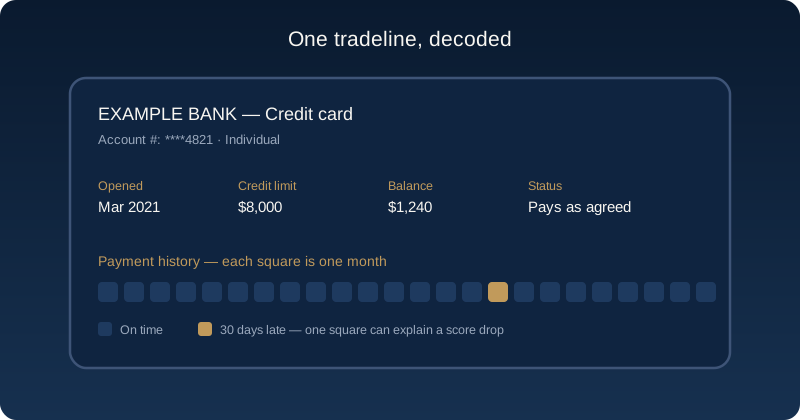
The longest section, and the one doing most of the scoring work. Each account — card, auto loan, mortgage, student loan — appears as a tradeline with a standard set of fields: creditor name (often a parent company, which is why entries can look unfamiliar), account type, open date, credit limit or original loan amount, current balance, and status (“pays as agreed,” “30 days late,” “charged off”). Below the fields sits the payment history grid: one square per month, marking on-time or the depth of lateness.
Three reading passes: verify you opened each account; check the numbers (a wrong limit quietly distorts your utilization); and scan the grids for late marks — confirming any you find are real and correctly dated. Closed accounts appearing here is normal, not an error: good-standing history keeps reporting and helping for years. What a charged-off status actually means when you hit one is unpacked in what is a charge-off.
Section 3: Inquiries
The inquiries section logs who accessed your file and when, split into the two kinds: hard inquiries, triggered by credit applications, visible to lenders and mildly score-relevant; and soft inquiries — your own checks, prescreening, account reviews — visible only to you and score-irrelevant. The full taxonomy, including the gray areas, is in soft inquiry vs. hard inquiry. The reading job here is matching: every hard inquiry should correspond to an application you actually made, dates aligned. Two innocent explanations account for most surprises — a lender’s parent-company name, and rate-shopping pulls from a single loan hunt. A hard inquiry that survives both explanations is a meaningful red flag, because an application in your name is exactly how new-account fraud begins.
Section 4: Collections & public records
When a debt is sold or assigned to a third-party collector, it appears here as its own entry — often alongside the original account, which is legitimate (one debt, two chapters of its story) as long as only one collector reports it at a time and the amounts line up. Verify each item three ways: you recognize the underlying debt, the balance is right, and it’s within its reporting window — collections generally fall off about seven years from the original delinquency, a clock that paying doesn’t restart, per how long do collections stay on your credit report. The same seven-year logic governs most negative items. Public records on modern credit reports are essentially bankruptcies; civil judgments and tax liens were removed from bureau files years ago, so anything else appearing here deserves scrutiny.
Section 5: Dispute instructions
Every report ends with the mechanics for challenging what’s wrong, because the right to dispute is built into federal law: you flag the item with the bureau (online, by mail, or by phone — mail with documentation creates the best paper trail), the bureau investigates with the furnisher, generally within about thirty days, and the item is corrected, removed, or verified. Disputing is free, and no company has powers you lack here. Two routing rules keep it clean: dispute with every bureau showing the error, since they don’t sync outcomes; and match the tool to the problem — ordinary errors get ordinary disputes, while accounts that aren’t yours at all get the stronger identity-theft path, with its report-backed blocking mechanism, laid out in what to do if someone opens an account in your name.
The red-flag shortlist
Scanning done, here’s what earns action. Dispute-worthy errors: late marks on months you paid on time, wrong balances or credit limits, an account showing open that you closed (or the reverse), the same debt reported by two collectors simultaneously, and anything past its removal date still reporting. Fraud signals: accounts you never opened, hard inquiries you can’t match, and personal-information entries that aren’t yours — these skip the ordinary dispute queue and go down the identity-theft path. Not errors: closed accounts still reporting in good standing, unfamiliar parent-company names, and soft inquiries you don’t remember — the three findings that generate the most unnecessary alarm. The test throughout is the same one: unexplainable after investigation, not merely unfamiliar at first glance.
Two real-world examples
The wrong limit. Amara reads her report for the first time in years and almost skips the numbers — every account is hers, nothing looks scary. But one card shows a $2,000 limit; the issuer raised it to $6,000 last year. Her $1,500 balance reads as 75% utilization instead of 25% on that card, quietly dragging her file. One dispute with a statement showing the real limit, and the correction posts within the month. Nothing on her report was fraudulent, nothing was even derogatory — the error was a single stale number that only a field-by-field read would catch.
The two-collector debt. Devon finds an old $800 medical debt in his collections section — listed twice, by two different agencies, both showing active balances. The debt is real, but it can only be owed once: it was sold from the first collector to the second, and the first never updated its entry to zero and transferred. He disputes the stale entry with documentation at both bureaus showing it, and it comes off, halving the apparent collection load on his file. The lesson he takes: the collections section isn’t just about whether debts are real, but whether the bookkeeping around them is current.
Key takeaways
- Five sections: personal information, accounts, inquiries, collections & public records, and dispute instructions — read all of them, from all three bureaus.
- Read with two questions: what’s hurting you (the improvement roadmap) and what isn’t yours (the fraud signal).
- The payment history grid is the heart of each tradeline — one square per month, and check the numbers too: a wrong limit distorts utilization.
- Closed accounts still reporting, parent-company names, and soft inquiries are normal — unexplainable-after-investigation is the escalation bar.
- Disputing is free and built into the report itself — errors get disputes at every bureau showing them; fraud gets the identity-theft path.