
Published July 5, 2026 · Educational information — not legal, tax, lending, or financial advice.
Quick answer
Yes, closing a card can nudge your score — but the main mechanism is utilization, not the account-age erasure most people fear. Closing removes the card’s limit from your total available credit, so the same balances suddenly occupy a larger share of a smaller pie. The age story is mostly myth in the short term: closed accounts in good standing generally stay on your report for years, still contributing history. Whether closing hurts you depends on arithmetic you can run in advance — and sometimes closing is still the right call. When it is, timing (not before a major application) and card choice (newest, smallest, fee-charging) minimize the effect; a downgrade to a no-fee version often skips it entirely.
Why closing can move your score: utilization
Utilization — your reported balances divided by your total limits — is typically the second-heaviest scoring factor, and it’s a fraction with a denominator. Closing a card deletes that card’s limit from the denominator instantly. If you carry $3,000 in balances across $15,000 of limits, you’re at 20%; close a card holding $6,000 of those limits and the same $3,000 now reads as 33% — no new spending, higher ratio. The silver lining is built into the same math: utilization has little memory, so if the ratio later improves — balances fall, limits rise elsewhere — the effect fades with the next reporting cycle. The full mechanics, including why statement balances are what report, are in what is credit utilization.
The age myth, corrected
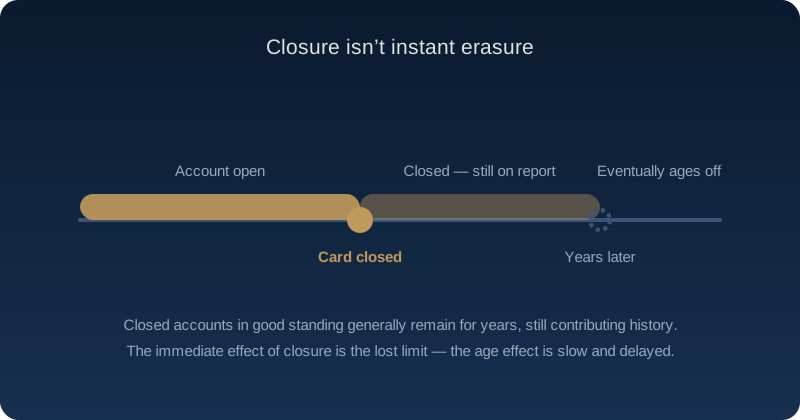
The folk version says closing a card “deletes its history” and your average account age craters overnight. Reality is gentler: closed accounts in good standing generally remain on your reports for years, and while they remain they keep contributing payment history and age. Nothing about the on-time record vanishes at closure. The genuine age effect is slow and delayed — it arrives years later, if and when the closed account finally drops off and the averages shift. So the honest ranking of closure effects: utilization moves now; age moves maybe, eventually, modestly. If a closure-adjacent score dip shows up this month, look at the ratio, not the calendar — the same triage covered in why did my credit score drop overnight.
Run your own math first
Because the main effect is arithmetic, you can preview it. Add up your card balances as they typically report; add up your limits with and without the card you’re considering closing; compare the two ratios. Someone with $400 in reported balances against $30,000 in limits barely moves the needle by closing a $5,000-limit card (1.3% → 1.6%). Someone carrying $4,000 against $10,000 who closes a $4,000-limit card jumps from 40% to 67% — a move worth knowing about in advance. Two refinements: models also read per-card utilization, so check that closing won’t leave a remaining card looking maxed; and if the answer is “this closure would sting right now,” the fix is often just sequencing — pay balances down first, then close.
When closing still makes sense
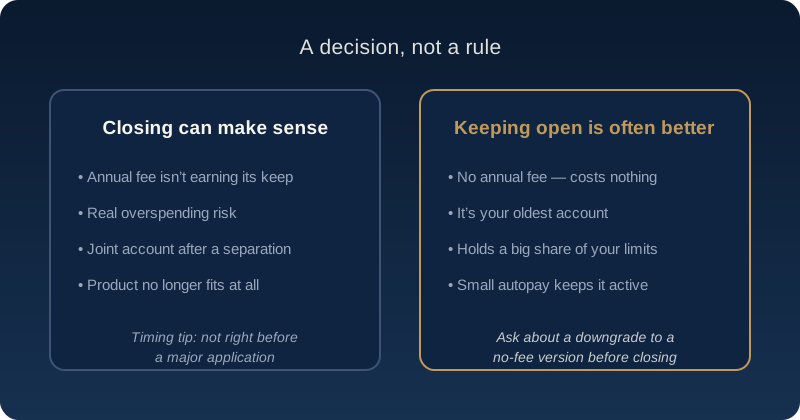
None of this makes closing wrong — it makes it a decision with visible costs and benefits. Closing is often reasonable when an annual fee isn’t earning its keep, when a card is a genuine overspending trigger, when a joint account needs unwinding after a separation, or when the product simply no longer fits.
Card choice matters if you have options: the newest card with the smallest limit is usually the least disruptive candidate, while the oldest card or the one holding a large share of your limits is the most. And one timing rule covers most regret: don’t close cards in the month or two before a mortgage or auto application — underwriters read the file as it stands, and there’s no reason to hand them a freshly reshaped one, the same file-stability logic that applies around debt payoff in can paying off debt lower your credit score.
Alternatives: downgrade, sock-drawer, autopay
Before closing, three cheaper moves cover most motivations. Downgrade: if the annual fee is the problem, ask the issuer to convert the card to a no-fee version of the same product line — this typically preserves the account, its limit, and its history while killing the fee. Sock-drawer: if disuse is the concern, a no-fee card kept open costs nothing; put one small recurring subscription on it with autopay-in-full and it stays active, keeps its limit in your denominator, and quietly extends its history.
Freeze the temptation, not the account: for overspending risk, removing the card from wallets and payment apps — or asking the issuer to lower the limit — addresses the behavior with less arithmetic damage than closure, though a lowered limit does shrink the denominator too. Closure remains on the menu; it’s just rarely the first tool worth reaching for.
When the issuer closes it for you
Issuers can and do close accounts on their own — most commonly for extended inactivity, sometimes in broader portfolio decisions — and the scoring arithmetic is identical to a voluntary closure: the limit leaves your denominator. This is the practical argument for the small-autopay habit on cards you intend to keep. If an issuer closure catches you by surprise, it’ll show up on your reports as a status change — one of the quiet file changes that a regular review rhythm catches early, per the cadence in how often should you check your credit report. A call to the issuer sometimes reverses a recent inactivity closure; failing that, knowing your new ratio at least removes the mystery from any score movement that follows.
Two real-world examples
The fee that outlived its perks. Amara’s travel card charges $95 a year she no longer offsets since she stopped flying for work. Instead of closing outright, she calls and asks about a product change; the issuer moves her to the no-fee version of the same card. Same account number, same open date, same $8,000 limit — still in her denominator, still aging — and the fee is gone. Total score effect: none. The dilemma most people agonize over had a third option the whole time.
The pre-mortgage purge. Three weeks before applying for a mortgage, Devon “cleans up” by closing two old no-fee cards holding half his total limits. His modest balances suddenly report as high utilization, and his file arrives at underwriting freshly reshaped. The application still proceeds — this is a nudge, not a catastrophe — but he handed himself a worse-looking ratio at the exact moment it was being read. Same closures done three months after closing on the house would have cost him nothing that mattered.
Key takeaways
- The real closure effect is utilization — the limit leaves your denominator immediately.
- The age myth is mostly myth: closed accounts in good standing keep contributing history for years.
- Preview the effect with simple division — balances over limits, with and without the card.
- Ask about a no-fee downgrade before closing — it often solves the problem with zero side effects.
- If closing anyway: newest and smallest card first, never right before a major application.