
Published July 5, 2026 · Educational information — not legal, tax, lending, or financial advice.
Quick answer
Commonly referenced ranges place a “good” credit score around 670–739, with 740–799 often described as very good and 800 and above as exceptional. Treat those bands as orientation, not a rule: multiple scoring models exist, FICO and VantageScore calculate somewhat differently, and every lender applies its own standards. What lenders respond to is the information behind the number — payment history, utilization, and the rest of your report — which is also the part you can actually review and keep accurate.
What counts as a “good” range?
Most consumer scores run on a 300–850 scale, and the bands you'll see referenced most often look like this: below 580 is usually described as needing improvement, 580–669 as fair, 670–739 as good, 740–799 as very good, and 800–850 as exceptional. Our homepage keeps a visual version of these ranges for quick reference. The bands are useful shorthand — and that's all they are. No band guarantees an approval, and no band rules one out on its own, because the ranges describe the number while lenders evaluate the person.
What do lenders actually consider?
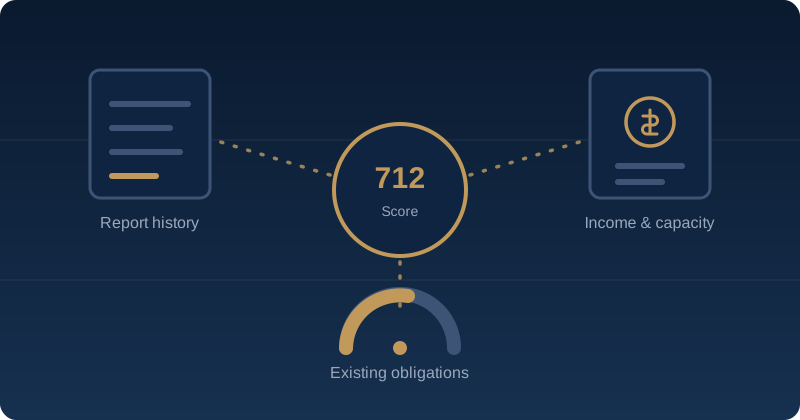
A score is one input into a bigger evaluation. Lenders generally look at the full credit report behind the number — the payment history, balances, account ages, and inquiries that produced it. Many also weigh things the score doesn't capture at all: income, employment, existing obligations relative to income, down payment or collateral, and the specifics of the product being applied for. That's why two people with the same number can receive different offers, and why the same person can be approved by one lender and declined by another in the same week. Each lender sets its own cutoffs, pricing tiers, and underwriting standards, and those standards shift over time.
Why do FICO and VantageScore differ?
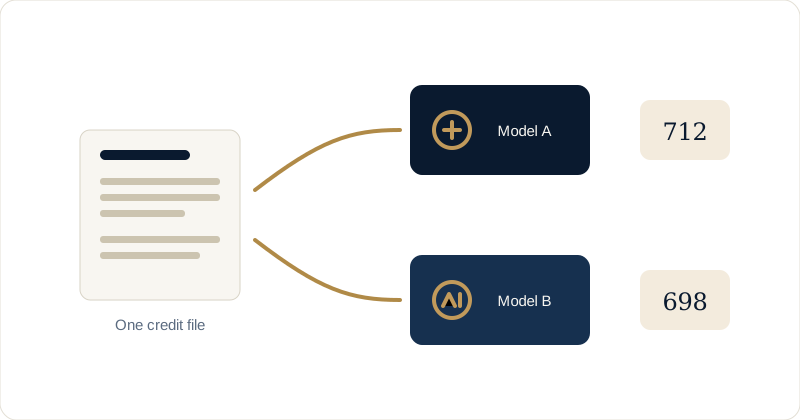
FICO and VantageScore are the two widely known families of scoring models, built by different companies. Both read the same kind of credit report information, both commonly use the 300–850 scale, and both exist in multiple versions — a lender might use an older FICO version for a mortgage while your monitoring app shows a recent VantageScore. The models weigh details somewhat differently: how they treat medical collections, small balances, or brief late payments varies by model and version. The practical takeaway is that the same report can legitimately produce different numbers, and none of them is more “real” than the others. If you've noticed your numbers disagree across apps and bureaus, that's the subject of our article on why your three credit scores are different.
What’s behind your number?
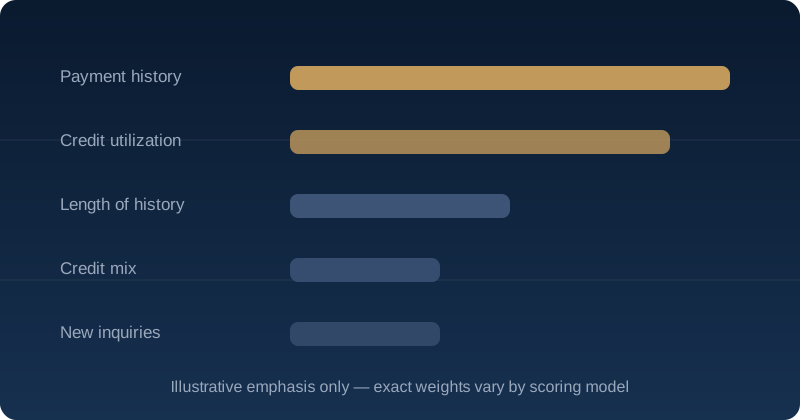
Whatever the model, the same five concepts explain most of what moves a score. Payment history — whether accounts are paid on time — typically carries the most weight. Credit utilization — how much of your available revolving credit you're using — is usually next. Length of credit history, credit mix, and new inquiries round out the picture with smaller roles. The exact weights vary by model and aren't published as simple percentages for every version, but the ordering above is a reasonable mental model. Our homepage covers each factor in plain English, and it's worth remembering the relationship between the pieces: the report is the record, the score is the shorthand — a distinction our reports vs scores comparison spells out.
What people often get wrong
“There's one true score.” There isn't — there are many models, versions, and three separate bureau files, so a range of numbers is normal.
“Checking my score hurts it.” Checking your own credit is typically a soft inquiry, which generally does not affect your score. Hard inquiries from lender applications are the kind that can have a modest impact.
“You need to carry a balance to build credit.” Paying in full doesn't prevent an account from reporting positive history. Carrying a balance mainly generates interest charges — not a scoring advantage.
“Income is part of my score.” Income doesn't appear on credit reports and isn't a scoring input — though lenders often consider it separately when evaluating applications.
“A good score guarantees approval.” No score guarantees anything. Approval always depends on the individual lender's review of the full picture.
“Closing old cards helps.” Closing accounts can raise utilization and eventually shorten average account age — effects that often work against the intent. Circumstances vary, so this is a decision to think through rather than a rule.
Two real-world examples
The same number, two different files. Dana and Marcus both show 705. Dana's file is two accounts and three years old; Marcus's is twelve accounts across fifteen years with a paid-off auto loan. Same band, different depth — and a lender reviewing the full reports may treat those applications quite differently, which is exactly why the number alone tells an incomplete story.
The overnight dip that wasn't a problem. Elena's score drops 18 points the week before she plans to apply for a car loan — her card statement closed with a vacation balance on it, raising her reported utilization. The account history is spotless; the dip is mechanical, and it eases as the balance reports lower. The pattern — and when a sudden drop does deserve a closer look — is covered in why credit scores drop overnight.
Key takeaways
- “Good” is commonly referenced around 670–739 — orientation, not a rule.
- Lenders evaluate the report and the broader application, not just the number.
- FICO and VantageScore are different model families — the same file can produce different numbers.
- Payment history and utilization typically carry the most weight across models.
- No score guarantees approval — and accuracy on the report matters more than chasing points.